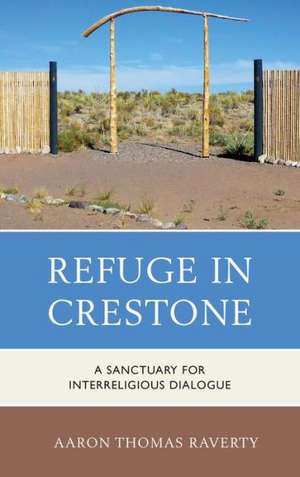
Refuge in Crestone: A Sanctuary for Interreligious Dialogue
Autor Aaron Thomas Ravertyen Limba Engleză Hardback – 18 iun 2014
Preț: 594.28 lei
Preț vechi: 910.42 lei
-35%
Puncte Express: 891
Carte tipărită la comandă
Livrare economică 12-26 noiembrie
Livrare prin curier în România Termenul estimat este afișat lângă disponibilitate.
Transport gratuit pentru acest produs Plată online sau ramburs, în funcție de opțiunile comenzii.
Retur gratuit în 14 zile Comandă securizată și suport în română.
Specificații
ISBN-13: 9780739183755
ISBN-10: 0739183753
Pagini: 183
Ilustrații: 2 BW Illustrations, 7 BW Photos
Dimensiuni: 160 x 232 x 20 mm
Greutate: 0.42 kg
Editura: Bloomsbury Publishing
Colecția Lexington Books
Locul publicării:New York, United States
ISBN-10: 0739183753
Pagini: 183
Ilustrații: 2 BW Illustrations, 7 BW Photos
Dimensiuni: 160 x 232 x 20 mm
Greutate: 0.42 kg
Editura: Bloomsbury Publishing
Colecția Lexington Books
Locul publicării:New York, United States
Cuprins
Introduction
Chapter 1: Interreligious Dialogue as Praxis
Chapter 2: Ethnographic Method and Interreligious Dialogue
Chapter 3: Refuge Place as Sacred Space
Chapter 4: Spiritual Monuments within the Refuge
Chapter 5: Ritual Interface and Dialogue Opportunity
Conclusion
References
Chapter 1: Interreligious Dialogue as Praxis
Chapter 2: Ethnographic Method and Interreligious Dialogue
Chapter 3: Refuge Place as Sacred Space
Chapter 4: Spiritual Monuments within the Refuge
Chapter 5: Ritual Interface and Dialogue Opportunity
Conclusion
References
Recenzii
The growing "field'...of interreligious studies ought to welcome Raverty's contribution set forth in this book. He offers an interdisciplinary approach drawing on sociology, anthropology, ethnography, and theology. . . .This book is a welcome addition to the field of interreligious studies and serves as a solid ethnographic example of how the social sciences might contribute greatly to mapping the terrain of interreligious encounter in the contemporary world.
With a nod to New Age thinking and practices within globalized modernity, Raverty explores theoretical and practical contributions of the ethnographic method to interreligious dialogue, the sacred space of this geographical region, and the commodification of rituals and pilgrimage in the operation of a ritual economy.. Raverty finds innovative applications of many standard practices of cultural anthropology.to the context of interreligious dialogue. As well, he argues for the inclusion of gender considerations, cultural artifacts and material culture, and archival sources to enrich the practice of interreligious dialogue.. Thus, Raverty raises a range of ethnographic concerns emerging from his fieldwork in the sanctuary of Crestone, Colorado, with the aim of moving through enhanced interreligious dialogue to an inclusivist comparative theology.
I had often heard of Crestone, but only after reading this work did I understand the fascinating way in which so many religious-spiritual groups have come to settle there. Raverty is admirably clear in showing how the methods of sociocultural anthropology can shed light on this unique phenomenon.
Aaron Raverty's new book shows us how the use of ethnographic method might serve to deepen the interreligious encounter by sensitizing us to the multi-faceted cultural context in which such encounters take place. Such an approach sharpens our awareness of the meaning of other religions beyond mere words and doctrines and enables us to return to the construction of a Christian theology of religions with renewed vigor and greater sensitivity. With advanced training in both sociocultural anthropology and theology and many years of inter-religious engagement, the author is especially qualified to write this important book
In the vein of the great 20th century scientist-theologian Teilhard de Chardin, anthropologist and Benedictine monk Aaron Thomas Raverty blends systematic theology and in-depth ethnographic research at the New Age spiritual center in Crestone, Colorado to reveal the ways in which anthropology and theology can helpfully inform each other. Anthropology-the holistic study of humankind in all of its diversity-is not simply a descriptive science, but can be used to foster peaceful intercultural and interreligious exchange. Through this unique book, which is part anthropological study of a quintessentially American pilgrimage site, and part practitioners' guide, Raverty convincingly reveals just how anthropological theories and methods can contribute to more equitable and productive dialogue within interfaith movements
With a nod to New Age thinking and practices within globalized modernity, Raverty explores theoretical and practical contributions of the ethnographic method to interreligious dialogue, the sacred space of this geographical region, and the commodification of rituals and pilgrimage in the operation of a ritual economy.. Raverty finds innovative applications of many standard practices of cultural anthropology.to the context of interreligious dialogue. As well, he argues for the inclusion of gender considerations, cultural artifacts and material culture, and archival sources to enrich the practice of interreligious dialogue.. Thus, Raverty raises a range of ethnographic concerns emerging from his fieldwork in the sanctuary of Crestone, Colorado, with the aim of moving through enhanced interreligious dialogue to an inclusivist comparative theology.
I had often heard of Crestone, but only after reading this work did I understand the fascinating way in which so many religious-spiritual groups have come to settle there. Raverty is admirably clear in showing how the methods of sociocultural anthropology can shed light on this unique phenomenon.
Aaron Raverty's new book shows us how the use of ethnographic method might serve to deepen the interreligious encounter by sensitizing us to the multi-faceted cultural context in which such encounters take place. Such an approach sharpens our awareness of the meaning of other religions beyond mere words and doctrines and enables us to return to the construction of a Christian theology of religions with renewed vigor and greater sensitivity. With advanced training in both sociocultural anthropology and theology and many years of inter-religious engagement, the author is especially qualified to write this important book
In the vein of the great 20th century scientist-theologian Teilhard de Chardin, anthropologist and Benedictine monk Aaron Thomas Raverty blends systematic theology and in-depth ethnographic research at the New Age spiritual center in Crestone, Colorado to reveal the ways in which anthropology and theology can helpfully inform each other. Anthropology-the holistic study of humankind in all of its diversity-is not simply a descriptive science, but can be used to foster peaceful intercultural and interreligious exchange. Through this unique book, which is part anthropological study of a quintessentially American pilgrimage site, and part practitioners' guide, Raverty convincingly reveals just how anthropological theories and methods can contribute to more equitable and productive dialogue within interfaith movements