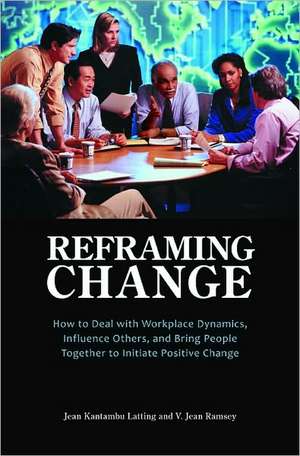
Reframing Change: How to Deal with Workplace Dynamics, Influence Others, and Bring People Together to Initiate Positive Change
Autor Jean Kantambu Latting, V. Jean Ramseyen Limba Engleză Hardback – 27 oct 2009
Reframing Change: How to Deal with Workplace Dynamics, Influence Others, and Bring People Together to Initiate Positive Change is based on the premise that if people act with integrity and learn to develop positive workplace relationships, a ripple effect can engender similar changes in the organization as a whole. Of extraordinary value to leaders, middle managers, and management students, it is a fresh and practical how-to manual for putting new ways of thinking to work in an organizational setting-one that backs its advice with results from a rapidly growing body of rigorous social science research.
Organized around a series of essential skills, Reframing Change shows readers how to test assumptions about others, clear negative emotions and augment positive ones, build effective relationships, bridge cultural differences with people, deal with difficult situations, and initiate change in work environments. This advice is driven home with the stories of real people in real situations that explain key underlying principles, with a single storyline running through each chapter.
Preț: 259.97 lei
Preț vechi: 342.92 lei
-24%
Puncte Express: 390
Carte tipărită la comandă
Livrare economică 24 noiembrie-08 decembrie
Livrare prin curier în România Termenul estimat este afișat lângă disponibilitate.
Transport gratuit de la 400.00 lei Plată online sau ramburs, în funcție de opțiunile comenzii.
Retur gratuit în 14 zile Comandă securizată și suport în română.
Specificații
ISBN-13: 9780313381249
ISBN-10: 0313381240
Pagini: 240
Ilustrații: 20 bw illus
Dimensiuni: 156 x 235 x 23 mm
Greutate: 0.5 kg
Editura: Bloomsbury Publishing
Colecția Praeger
Locul publicării:New York, United States
ISBN-10: 0313381240
Pagini: 240
Ilustrații: 20 bw illus
Dimensiuni: 156 x 235 x 23 mm
Greutate: 0.5 kg
Editura: Bloomsbury Publishing
Colecția Praeger
Locul publicării:New York, United States
V-ar putea interesa
-
 The Master StrategistKetan J PatelPreț: 114.85 lei
 -
 -28%Preț: 366.50 lei510.67 lei
 -
 Only the Paranoid SurviveAndrew S. GrovePreț: 108.44 lei
 -
 -20%Preț: 972.52 lei1215.64 lei
 -
 Cultural Change and Leadership in OrganizationsJaap J. BoonstraPreț: 356.91 lei
 -
 Handbook of Technology and Innovation ManagementScott Shane-9%Preț: 802.62 lei881.99 lei
 -
 -11%Preț: 119.52 lei134.52 lei
 -
 Capitalism and Its AlternativesChris Rogers-18%Preț: 130.03 lei157.69 lei
 -
 Anti-CapitalismSimon TormeyPreț: 78.29 lei
 -
 Preț: 178.40 lei
Cuprins
Acknowledgments
1 Matt's Story: An Introduction to Conscious Change
Plan of the Book
Why This Book?
2 Testing Assumptions
Mental Models: Short-cuts to Perception
Being in the Answer
Making Up Stories
Being in the Question
Choosing to Test Assumptions
Retraining Neural Pathways
Building Positive Emotions
3 Clearing Emotions
Emotions and Feelings
The Emotionally Flooded Manager
The Myth of Suppressed Emotions
Preventing Self-fulfilling Prophecies
Clearing Emotions: The Process
What Results Can You Expect?
Other Sources of Help
Building Positive Emotions
4 Building Effective Relationships
Powerful Listening
Inquiry
Openness
Giving Feedback
Receiving Feedback
Seeking Feedback
What If the Other Person Really Is the Problem?
5 Bridging Differences
Dominants and Nondominants
Dominance Dynamics
Dominants' Blind Spots
Acute Awareness of Nondominant Status
Dominance Dynamics at the Organizational Level
From Guilt to Learning and Contribution
Bridging Differences: Antidotes to Dominance Dynamics
6 Conscious Use of Self
Get Your Emotional Attachments Out of the Way
Accept Responsibility for Your Own Contribution
Maintain Integrity
Focus on the Other Person's Strengths
Adopt a Learning Orientation
Seek to Understand Others' Perspectives
Recognize Your Own Power and Use It Responsibly
7 Initiating Workplace Change
Steps for Initiating Change
Moving Forward: A Sequence of Small Wins
8 Matt's Story Redux
Focusing on Strengths
Being in the Question
Building Relationships and Bridging Differences
Seeing Situational Factors, Not Just Individuals
Clearing Emotions
Changing Workplace Dynamics and Relationships through Changing Oneself
Allowing the Unexpected to Emerge
Conclusion: Sustaining Hope
Appendix: Principles for Conscious Change
Index
1 Matt's Story: An Introduction to Conscious Change
Plan of the Book
Why This Book?
2 Testing Assumptions
Mental Models: Short-cuts to Perception
Being in the Answer
Making Up Stories
Being in the Question
Choosing to Test Assumptions
Retraining Neural Pathways
Building Positive Emotions
3 Clearing Emotions
Emotions and Feelings
The Emotionally Flooded Manager
The Myth of Suppressed Emotions
Preventing Self-fulfilling Prophecies
Clearing Emotions: The Process
What Results Can You Expect?
Other Sources of Help
Building Positive Emotions
4 Building Effective Relationships
Powerful Listening
Inquiry
Openness
Giving Feedback
Receiving Feedback
Seeking Feedback
What If the Other Person Really Is the Problem?
5 Bridging Differences
Dominants and Nondominants
Dominance Dynamics
Dominants' Blind Spots
Acute Awareness of Nondominant Status
Dominance Dynamics at the Organizational Level
From Guilt to Learning and Contribution
Bridging Differences: Antidotes to Dominance Dynamics
6 Conscious Use of Self
Get Your Emotional Attachments Out of the Way
Accept Responsibility for Your Own Contribution
Maintain Integrity
Focus on the Other Person's Strengths
Adopt a Learning Orientation
Seek to Understand Others' Perspectives
Recognize Your Own Power and Use It Responsibly
7 Initiating Workplace Change
Steps for Initiating Change
Moving Forward: A Sequence of Small Wins
8 Matt's Story Redux
Focusing on Strengths
Being in the Question
Building Relationships and Bridging Differences
Seeing Situational Factors, Not Just Individuals
Clearing Emotions
Changing Workplace Dynamics and Relationships through Changing Oneself
Allowing the Unexpected to Emerge
Conclusion: Sustaining Hope
Appendix: Principles for Conscious Change
Index
Recenzii
Consultants Latting and Ramsey draw from industrial and organizational psychology, social work, education, and marketing in these guidelines for improving interpersonal relationships in the workplace. The authors take care to include only ideas that have been supported by academic research, borne out by their own experiences as consultants, and reported as useful by their students and clients. The techniques described will help leaders, middle managers, and management students harness the power of self-change, test assumptions about others, clear negative emotions, bridge cultural differences, and deal with difficult situations. An ongoing story, based on real conversations between consultants and clients, students and instructors, and between colleagues, illustrates key principles. Boxes are included summarizing recent research supporting the techniques.