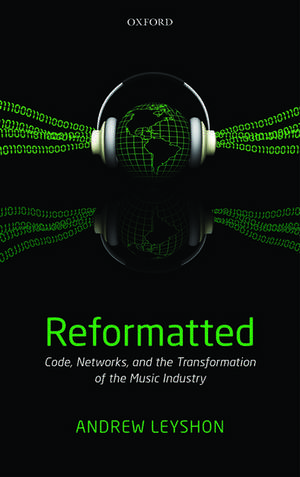
Reformatted: Code, Networks, and the Transformation of the Music Industry
Autor Andrew Leyshonen Limba Engleză Hardback – 26 iun 2014
Preț: 704.05 lei
Preț vechi: 1021.99 lei
-31%
Puncte Express: 1056
Carte tipărită la comandă
Livrare economică 04-09 decembrie
Livrare prin curier în România Termenul estimat este afișat lângă disponibilitate.
Transport gratuit pentru acest produs Plată online sau ramburs, în funcție de opțiunile comenzii.
Retur gratuit în 14 zile Comandă securizată și suport în română.
Specificații
ISBN-13: 9780199572410
ISBN-10: 0199572410
Pagini: 220
Dimensiuni: 156 x 222 x 21 mm
Greutate: 0.4 kg
Editura: OUP OXFORD
Colecția OUP Oxford
Locul publicării:Oxford, United Kingdom
ISBN-10: 0199572410
Pagini: 220
Dimensiuni: 156 x 222 x 21 mm
Greutate: 0.4 kg
Editura: OUP OXFORD
Colecția OUP Oxford
Locul publicării:Oxford, United Kingdom
V-ar putea interesa
-
 Free RideRobert Levine-19%Preț: 57.85 lei71.11 lei
 -
 How Music Got FreeStephen Witt-19%Preț: 75.40 lei93.11 lei
 -
 -14%Preț: 199.27 lei231.50 lei
 -
 -10%Preț: 286.56 lei317.43 lei
 -
 Preț: 194.47 lei
 -
 Music: The Business (9th Edition)Ann HarrisonPreț: 273.81 lei
 -
 How Music WorksDavid ByrnePreț: 149.83 lei
 -
 Preț: 110.21 lei
 -
 Music Business for DummiesLoren WeismanPreț: 160.30 lei
 -
 Songs In The Key of MP3: The New Icons of the Internet AgeLiam Inscoe-Jones-26%Preț: 107.98 lei144.95 lei
 -
 -26%Preț: 90.69 lei122.53 lei
 -
 RippedGreg KotPreț: 87.78 lei
 -
 -27%Preț: 67.97 lei93.05 lei
 -
 All You Need to Know About the Music Business: Eleventh EditionDonald S. Passman-22%Preț: 152.26 lei195.07 lei
 -
 -20%Preț: 101.15 lei126.71 lei
 -
 The Economics of MusicPeter TschmuckPreț: 218.51 lei
 -
 Vinyl NYCJames & Karla MurrayPreț: 282.13 lei
 -
 Channel PowerDetlef DiederichsenPreț: 73.67 lei
 -
 Independence in 21st-Century Popular Music: Cases from Beyond Anglo-AmericaDr. Shannon Garland-25%Preț: 214.31 lei284.94 lei
Recenzii
Leyshon has produced a highly relevant book in a field that moves very quickly. This is quite an accomplishment.He has been able to connect the dots and outlines a story of the music industry in terms that allow for a fuller understanding of the dynamics at work in a very important moment in time. In this respect, this book will be relevant for a long time since it asked a historical question and provided an ultimately historical account through the apparatus of economic geography. Leyshon has produced a book that speaks to the work of authors like John Alderman (2001) and provides a useful and timely book end to some of the most important events in the restructuring of the music industry in the late 20th and early 21st centuries
Notă biografică
Andrew Leyshon is Professor of Economic Geography and Head of the School of Geography (2011-2015), University of Nottingham. He has authored and edited several books and published over 100 academic papers and chapters. He was Editor-in-Chief of Geoforum between 1995-2006, has presented over 90 conference papers and seminars, been a Principal Investigator on six major Economic and Social Research Council grants. He was, until 2012, Deputy Director of the Financial Services Research Forum at Nottingham University Business School. He is a member of the Editorial Board of Environment and Planning A, and of the Editorial Advisory Board of Economy and Society.In 2007 he was elected as an Academician of the Academy of Social Sciences and he is a Fellow of the Royal Geographical Society.