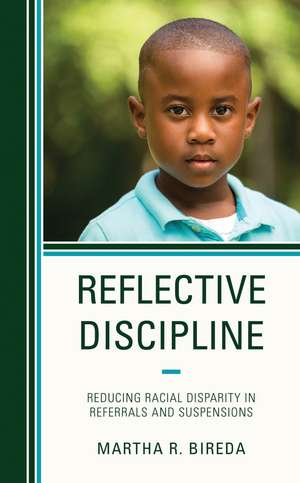
Reflective Discipline: Reducing Racial Disparity in Referrals and Suspensions
Autor Martha R. Biredaen Limba Engleză Hardback – 23 aug 2019
While focusing on the specific issues that educators face in addressing and eliminating racial disparity in disciplinary perceptions and referrals, the reflective exercises provided in this book are valuable to any reader who wishes to examine programmed unconscious beliefs that can lead to racist behaviors. This is a book that helps the reader to understand the source, purpose, and ways in which stereotypical beliefs and images have been and continue to be reinforced in our present society.
Reflective Discipline is a timely and especially significant book for this time in American life. The exercises can be utilized not only in educational but in other environments, i.e. law enforcement, social service, etc. in which understanding the forces that perpetuate racist beliefs in our society are important to ensuring fair and equitable treatment of all.
| Toate formatele și edițiile | Preț | Express |
|---|---|---|
| Paperback (1) | 168.93 lei 6-8 săpt. | |
| Bloomsbury Publishing – 14 aug 2019 | 168.93 lei 6-8 săpt. | |
| Hardback (1) | 350.35 lei 6-8 săpt. | |
| Bloomsbury Publishing – 23 aug 2019 | 350.35 lei 6-8 săpt. |
Preț: 350.35 lei
Preț vechi: 450.79 lei
-22%
Puncte Express: 526
Preț estimativ în valută:
62.00€ • 72.46$ • 53.83£
62.00€ • 72.46$ • 53.83£
Carte tipărită la comandă
Livrare economică 19 februarie-05 martie
Preluare comenzi: 021 569.72.76
Specificații
ISBN-13: 9781475849028
ISBN-10: 1475849028
Pagini: 120
Ilustrații: 5 tables
Dimensiuni: 160 x 228 x 18 mm
Greutate: 0.42 kg
Editura: Bloomsbury Publishing
Colecția Rowman & Littlefield Publishers
Locul publicării:New York, United States
ISBN-10: 1475849028
Pagini: 120
Ilustrații: 5 tables
Dimensiuni: 160 x 228 x 18 mm
Greutate: 0.42 kg
Editura: Bloomsbury Publishing
Colecția Rowman & Littlefield Publishers
Locul publicării:New York, United States
Cuprins
Dedication
Foreword
Acknowledgements
Workshops
Introduction
Part I
Chapter 1: Racial Disparity in Discipline: A Worsening Problem
Chapter 2: Persistent Factors Escalating Racial Disparity in Discipline
Chapter 3: New Threats: Adultification and Policing in the Schools
Chapter 4: Reflective Discipline
Part II
Chapter 5: Culturally Conditioned Beliefs
Chapter 6: Cultural Conditioning and Disciplinary Practices
Chapter 7: African American Cultural Patterns
Chapter 8: Cross-cultural Communication Conflicts
Part III
Chapter 9: Adolescent Development
Chapter 10: School Climate and School Discipline
Chapter 11: The Discipline Event Analysis
Part IV
Chapter 12: Reflective Leadership
Chapter 13: The "Village" Approach: School Community Partnerships
Chapter 14: Evaluating the Process
Chapter 15: Seeing with New Eyes
Part V: Reflective Exercises
Appendix
Bibliography
About the Author
Foreword
Acknowledgements
Workshops
Introduction
Part I
Chapter 1: Racial Disparity in Discipline: A Worsening Problem
Chapter 2: Persistent Factors Escalating Racial Disparity in Discipline
Chapter 3: New Threats: Adultification and Policing in the Schools
Chapter 4: Reflective Discipline
Part II
Chapter 5: Culturally Conditioned Beliefs
Chapter 6: Cultural Conditioning and Disciplinary Practices
Chapter 7: African American Cultural Patterns
Chapter 8: Cross-cultural Communication Conflicts
Part III
Chapter 9: Adolescent Development
Chapter 10: School Climate and School Discipline
Chapter 11: The Discipline Event Analysis
Part IV
Chapter 12: Reflective Leadership
Chapter 13: The "Village" Approach: School Community Partnerships
Chapter 14: Evaluating the Process
Chapter 15: Seeing with New Eyes
Part V: Reflective Exercises
Appendix
Bibliography
About the Author
Recenzii
Upon entry into the arena of formal schooling - molds have been designed and designated by some educators as to the success of many students of color, especially the boys.
Depending on the names, gender, and even the address - students who do not look like the educators will have few memorable moments in school. The students (boys) are subject to close scrutiny all day. They will find themselves reacting to situations created by school personnel in ways that guarantee molds cast earlier preconstructed will be filled. Each year discipline forms, sarcasm, bullying, aggressive language suspensions, and expulsion will consume their aspirations and finally their will to become successful.
We are beyond "diversity training" for educators, much more is needed. Dr. Martha Bireda's book should become a must read if we are to help minority students.
Many educators are not aware of the damages they cause in young black boys' lives. These young students entering school for the first time with bright eyes and smiles hoping to learn have contagious energy. They soak in everything, unfortunately, the negative message will outnumber the positives throughout their school years. They soon realize that any small infraction, harsh words, or rule change is usually directed towards them. Zero tolerance is the defining target for them. Total dismissal of these students as "capable of learning" immediately becomes the norm. This book reflects the place where education have fallen short in helping recognize the needs of minority students placed in their care.
Depending on the names, gender, and even the address - students who do not look like the educators will have few memorable moments in school. The students (boys) are subject to close scrutiny all day. They will find themselves reacting to situations created by school personnel in ways that guarantee molds cast earlier preconstructed will be filled. Each year discipline forms, sarcasm, bullying, aggressive language suspensions, and expulsion will consume their aspirations and finally their will to become successful.
We are beyond "diversity training" for educators, much more is needed. Dr. Martha Bireda's book should become a must read if we are to help minority students.
Many educators are not aware of the damages they cause in young black boys' lives. These young students entering school for the first time with bright eyes and smiles hoping to learn have contagious energy. They soak in everything, unfortunately, the negative message will outnumber the positives throughout their school years. They soon realize that any small infraction, harsh words, or rule change is usually directed towards them. Zero tolerance is the defining target for them. Total dismissal of these students as "capable of learning" immediately becomes the norm. This book reflects the place where education have fallen short in helping recognize the needs of minority students placed in their care.