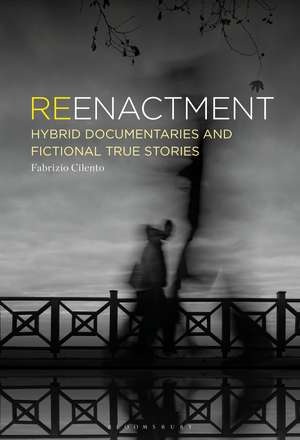
Reenactment: Hybrid Documentaries and Fictional True Stories
Autor Fabrizio Cilentoen Limba Engleză Hardback – 26 noi 2026
From the Pablo Escobar era in Colombia and the Romanian Revolution of 1989 to the Indonesian mass killings of 1965-66 and the conflict in Israel and Palestine, hybrid documentaries and fictionalized true stories have evolved into a global aesthetic tendency. Works by Corneliu Porumboiu, Radu Muntean, Errol Morris, Werner Herzog, Joshua Oppenheimer, Ra'anan Alexandrowicz, Agnès Varda, Justine Triet, and Iranian auteurs such as Abbas Kiarostami, Jafar Panahi, and Mohammad Rasoulof reveal how reenactment has become a tool for reckoning with trauma, authorship, and state power.
Combining André Bazin's realist ontology with Friedrich Nietzsche's perspectivism and integrating them into contemporary media theories, the book argues that cinema today no longer seeks to record reality but to rebuild it. Reenactment emerges as a creative and ethical force, one that exposes the mechanisms of memory and mediation while challenging viewers to evaluate evidence in an age when fact and fabrication dangerously coexist within the same digital ecosystems.
Transnational in scope and interdisciplinary in method, Reenactment illuminates the politics of seeing, the labor of truth-making, and the desire to replay history in a moment when our collective sense of reality, memory, and historical consciousness is being reshaped by the screens that mediate it. For scholars of film, media, philosophy, and contemporary culture, this book offers a new framework for understanding how images shape and reshape our world.
Preț: 581.51 lei
Preț vechi: 862.97 lei
-33% Precomandă
Puncte Express: 872
Carte nepublicată încă
Livrare prin curier în România Precomanda se expediază când titlul devine disponibil.
Transport gratuit pentru acest produs Plată online sau ramburs, în funcție de opțiunile comenzii.
Retur gratuit în 14 zile Comandă securizată și suport în română.
Doresc să fiu notificat când acest titlu va fi disponibil:
Se trimite...
Specificații
ISBN-13: 9798765137888
Pagini: 208
Ilustrații: 19 bw illus
Dimensiuni: 152 x 229 mm
Editura: Bloomsbury Publishing
Colecția Bloomsbury Academic
Locul publicării:New York, United States
Pagini: 208
Ilustrații: 19 bw illus
Dimensiuni: 152 x 229 mm
Editura: Bloomsbury Publishing
Colecția Bloomsbury Academic
Locul publicării:New York, United States
Cuprins
List of Illustrations
Acknowledgements
Introduction: Everything Documented, All Arbitrary
Part I: Cold War Echoes
1. Too Strange to Believe: Magical Realism and Cold War Politics in Narcos
2. Staging the Revolution: Memory and Space in the Romanian New Wave
3. A Half-Empty Glass: Joshua Oppenheimer Between Thought and Expression
Part II: Post-Truth Realities
4. Strangers in Their Land: Conflict and Occupation in Palestinian and Israeli Films
5. Platformed Selves: Social Media, Autofiction and the Aesthetics of Desire
6. Sacred Figs and Invisible Bears: The Art of Endurance in Iranian Film
Filmography
Bibliography
Index
Acknowledgements
Introduction: Everything Documented, All Arbitrary
Part I: Cold War Echoes
1. Too Strange to Believe: Magical Realism and Cold War Politics in Narcos
2. Staging the Revolution: Memory and Space in the Romanian New Wave
3. A Half-Empty Glass: Joshua Oppenheimer Between Thought and Expression
Part II: Post-Truth Realities
4. Strangers in Their Land: Conflict and Occupation in Palestinian and Israeli Films
5. Platformed Selves: Social Media, Autofiction and the Aesthetics of Desire
6. Sacred Figs and Invisible Bears: The Art of Endurance in Iranian Film
Filmography
Bibliography
Index
Recenzii
This book presents an authoritative analysis of a selection of important international hybrid documentaries. The hybrid documentary is a term the author proposes for film and television texts that utilize strategies of conscious mediation and fiction and nonfiction to reimagine trauma, crisis and political violence through reenactment. The analysis presents new and profound insights into the complex discussions on truth and artifice in a technological age. A deeply thoughtful, well researched book that I highly recommend.
Fabrizio Cilento's Reenactment persuasively follows what he calls the "Möbius strip of fiction and nonfiction," where discussion of documentary evidence, fictional reconstruction, political trauma, and mediated memory continually turn into one another. Particularly compelling is his reading of three Romanian films where, by treating them as peak achievements of New Romanian Cinema, Cilento demonstrates how the fall of communism - while obsessively documented - remains profoundly misunderstood. Along with the other chapters, devoted to Cold War Echoes, and followed by equally rich discussions of Post-Truth Realities, Cilento offers his original take on the peculiar interdependence of myths and dire realities in cinematic representations of history.
Reenactment is breathlessly expansive. Cilento's book covers tremendous territory, from the Palestine/Israel conflict to French autofiction to Romanian new wave to Iranian metacinema to the work of American masters of reenactment (namely Errol Morris and Joshua Oppenheimer). His readings are thoughtful and historically-informed. The book weaves a large tapestry of hybrid cinema in the 21st century, demonstrating that much of global cinema today is defined by a politics of truthful fictions, and fictional truths.
Fabrizio Cilento's Reenactment persuasively follows what he calls the "Möbius strip of fiction and nonfiction," where discussion of documentary evidence, fictional reconstruction, political trauma, and mediated memory continually turn into one another. Particularly compelling is his reading of three Romanian films where, by treating them as peak achievements of New Romanian Cinema, Cilento demonstrates how the fall of communism - while obsessively documented - remains profoundly misunderstood. Along with the other chapters, devoted to Cold War Echoes, and followed by equally rich discussions of Post-Truth Realities, Cilento offers his original take on the peculiar interdependence of myths and dire realities in cinematic representations of history.
Reenactment is breathlessly expansive. Cilento's book covers tremendous territory, from the Palestine/Israel conflict to French autofiction to Romanian new wave to Iranian metacinema to the work of American masters of reenactment (namely Errol Morris and Joshua Oppenheimer). His readings are thoughtful and historically-informed. The book weaves a large tapestry of hybrid cinema in the 21st century, demonstrating that much of global cinema today is defined by a politics of truthful fictions, and fictional truths.