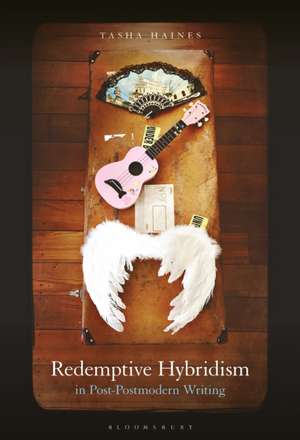
Redemptive Hybridism in Post-Postmodern Writing
Autor Tasha Hainesen Limba Engleză Paperback – 26 iun 2025
Tasha Haines investigates what she calls 'redemptive hybridism' a tendency in post-postmodern writing characterized by possibility. She suggests that near the 21st century, postmodern élitisme gives way to a reparative blending of high-low forms and genre collaborations for challenging and extending the relationship between writer, written material, and reader.
By combining an innovative literary investigation with creative and auto-theoretical strategies, Haines offers valuable new interpretations for texts of 'the modernisms continuum'. Her conversational survey moves among the hybridity of Virginia Woolf, the paratextuality of David Foster Wallace, with Nathalie Sarraute, Édouard Levé, Maggie Nelson and more. In reference to Deleuze and Guattari, Hassan, and others, writers are curated for their approach to form, method, and content, evoking and invoking textual hybridity.
Haines articulates a new way of viewing works via comparisons and close-ups that exemplify the possibility and genre-blending that is Redemptive Hybridism in Post-Postmodern Writing.
Preț: 196.51 lei
Preț vechi: 269.27 lei
-27%
Puncte Express: 295
Carte tipărită la comandă
Livrare economică 08-22 iunie
Specificații
ISBN-13: 9781501394546
ISBN-10: 1501394541
Pagini: 178
Dimensiuni: 152 x 230 x 20 mm
Greutate: 0.27 kg
Editura: BLOOMSBURY ACADEMIC
Locul publicării:New York, United States
ISBN-10: 1501394541
Pagini: 178
Dimensiuni: 152 x 230 x 20 mm
Greutate: 0.27 kg
Editura: BLOOMSBURY ACADEMIC
Locul publicării:New York, United States
Cuprins
Preface
Introduction: The Enemy Within
Taking Enemies In
This Multivariant Plot
The Vitality of Difference
A Lineage of Wariness and Influence
The Terrible Postmodern Party
Part I: Features of Redemptive Hybridism
1. The Redemptive Textual Body
Etymologies
Umbilical Connection, Author to Text
The Word Made Flesh
2. The Hybrid Middle
Pushing out towards Ends
Sarraute as Middle
Parataxis and the Middle
Time and Unfinishedness
3. Family Traits of Fragmentation
The Fragmented Mind
Constraint, Minimalism, and the Caveat
Vestibule and Fringe
Ethics, Alterity, and the Reader
The Ethical, The Moral, and the Difference
High, Low, High Low, It's Off to Blend We Go
Part II: Figures of Redemptive Hybridism
4. Woolf's Atom; The Image of Hybridity
Begin with the Atom, Virginia Woolf
Saturation in Woolf and Wallace
Mrs. Dalloway as Fertile Ground
Inter-genre Woolf
It Ends Where It Begins, with the Atom
5. Finding a Name for Possibility
Postmodernism, Feminism, and Agency
Finding Names and Building Frames
Call Me[a]taxy: Some Recent Pre-fixes
6. The Pale King's Constellation; Factoids, Ghosts, and Boredom
Tell the Truth, David Foster Wallace
Everyday Ghosts, Souls, & Phantoms
Ambiguity & Contradiction in The Pale King
Boredom: Between Crisis & Epiphany
A Conclusion, of Sorts; This Is Not the End
References
Index
Introduction: The Enemy Within
Taking Enemies In
This Multivariant Plot
The Vitality of Difference
A Lineage of Wariness and Influence
The Terrible Postmodern Party
Part I: Features of Redemptive Hybridism
1. The Redemptive Textual Body
Etymologies
Umbilical Connection, Author to Text
The Word Made Flesh
2. The Hybrid Middle
Pushing out towards Ends
Sarraute as Middle
Parataxis and the Middle
Time and Unfinishedness
3. Family Traits of Fragmentation
The Fragmented Mind
Constraint, Minimalism, and the Caveat
Vestibule and Fringe
Ethics, Alterity, and the Reader
The Ethical, The Moral, and the Difference
High, Low, High Low, It's Off to Blend We Go
Part II: Figures of Redemptive Hybridism
4. Woolf's Atom; The Image of Hybridity
Begin with the Atom, Virginia Woolf
Saturation in Woolf and Wallace
Mrs. Dalloway as Fertile Ground
Inter-genre Woolf
It Ends Where It Begins, with the Atom
5. Finding a Name for Possibility
Postmodernism, Feminism, and Agency
Finding Names and Building Frames
Call Me[a]taxy: Some Recent Pre-fixes
6. The Pale King's Constellation; Factoids, Ghosts, and Boredom
Tell the Truth, David Foster Wallace
Everyday Ghosts, Souls, & Phantoms
Ambiguity & Contradiction in The Pale King
Boredom: Between Crisis & Epiphany
A Conclusion, of Sorts; This Is Not the End
References
Index
Recenzii
With humility, skill, and ingenuity, Tasha Haines co-mingles philosophy, theory, and artistic autobiography to approach some of the most complex texts in the modernisms continuum. In Redemptive Hybridism, the hybrid, creative theories of Deleuze and Guattari, Hassan, Lyotard, Eagleton, Bakhtin, and others, flow through Virginia Woolf's atomic saturation, David Foster Wallace's unfinishedness, and Maggie Nelson's fragments. Haines' marriage of form and content is unusually lucid. It is a rare delight to accept Haines' invitation "to engage spaces of possibility in recognition of the fact that nothing ever really dies it simply crosses over, hybridly, redemptively.
A playful, probing text that not only forges new pathways for considering two major figures of the 20th century, but also provocatively invites the reader to reflect on their own role in the process. Reversing and disrupting received wisdom, Haines assembles a ludic and agile critical apparatus that is both critically rigorous and enormously enjoyable to read.
'To be "post" is to hold onto the past while transforming it,' Tasha Haines writes in her introduction. Firmly situating this study in the 21st century, hybridization emerges as a recuperative, exploratory act. Only with the un-mooring that comes with such risk, Haines argues, is real discovery-a re-envisioning of the terrain artists and theorists have covered and recovered-possible.
A discursively daring exploration of the conditions of redemption, sincerity, and literary camaraderie as located both in texts and at the seat of reader engagement.
A playful, probing text that not only forges new pathways for considering two major figures of the 20th century, but also provocatively invites the reader to reflect on their own role in the process. Reversing and disrupting received wisdom, Haines assembles a ludic and agile critical apparatus that is both critically rigorous and enormously enjoyable to read.
'To be "post" is to hold onto the past while transforming it,' Tasha Haines writes in her introduction. Firmly situating this study in the 21st century, hybridization emerges as a recuperative, exploratory act. Only with the un-mooring that comes with such risk, Haines argues, is real discovery-a re-envisioning of the terrain artists and theorists have covered and recovered-possible.
A discursively daring exploration of the conditions of redemption, sincerity, and literary camaraderie as located both in texts and at the seat of reader engagement.