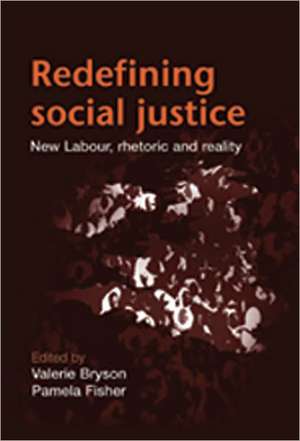
Redefining Social Justice
Editat de Valerie Brysonen Limba Engleză Paperback – noi 2011
Preț: 355.61 lei
Puncte Express: 533
Carte tipărită la comandă
Livrare economică 07-21 decembrie
Livrare prin curier în România Termenul estimat este afișat lângă disponibilitate.
Transport gratuit de la 400.00 lei Plată online sau ramburs, în funcție de opțiunile comenzii.
Retur gratuit în 14 zile Comandă securizată și suport în română.
Specificații
ISBN-13: 9780719082214
ISBN-10: 0719082218
Pagini: 234
Dimensiuni: 156 x 234 x 13 mm
Greutate: 0.36 kg
Editura: MANCHESTER UNIVERSITY PRESS
ISBN-10: 0719082218
Pagini: 234
Dimensiuni: 156 x 234 x 13 mm
Greutate: 0.36 kg
Editura: MANCHESTER UNIVERSITY PRESS
V-ar putea interesa
-
 The Age of ConsentGeorge MonbiotPreț: 75.27 lei
-
 The Social ContractJean-Jacques Rousseau-19%Preț: 46.11 lei56.87 lei
-
 Mastering British PoliticsF.N. FormanPreț: 282.37 lei
-
 Powers of FreedomNikolas RosePreț: 243.56 lei
-
 China's Legal Reforms and Their Political LimitsIngrid Hooghe-18%Preț: 1250.97 lei1525.57 lei
-
 Nonviolence in Political TheoryIain Atack-16%Preț: 185.30 lei219.29 lei
-
 -15%Preț: 437.03 lei514.15 lei
-
 What It Takes to Be FreeSiobhan Nash-MarshallPreț: 95.15 lei
-
 The State: Theories and IssuesColin HayPreț: 317.87 lei
-
 History of Modern Political ThoughtHampsher-MonkPreț: 331.73 lei
-
 Human Rights Watch World Report 2007Human Rights WatchPreț: 116.77 lei
Cuprins
Introduction. Valerie Bryson and Pamela Fisher 1 New Labour, Social Justice and Electoral Strategy. Tim Heppell 2 'Radicalisation' and 'democracy' - a linguistic analysis of rhetorical change. Lesley Jeffries 3 Multiculturalism and the emergence of 'community cohesion'. Paul Thomas 4 Class and Individualisation within post compulsory Education and training. James Avis 5 Social justice and time: the impact of public sector reform on the work of midwives in the National Health Service (NHS). Valerie Bryson and Ruth Deery 6 Promoting social justice, perpetuating social injustice? New Labour and disabled people. Anne Chappell and Chris Gifford 7 An alternative model for social justice and empowerment from the perspective of families with disabled children. Pamela Fisher 8 New Labour and Northern Ireland: delivering peace, prosperity and social justice? Catherine McGlynn and James W. McAuley 9 Colonising law for the poor: access to justice in the new regulatory state. Peter Sanderson and Hilary Sommerlad Findings and conclusions. Valerie Bryson and Pamela Fisher
Notă biografică
Valerie Bryson is Professor of Politics at the University of Huddersfield. Pamela Fisher is Senior Lecturer in Sociology at the University of Huddersfield
Descriere
This interdisciplinary book provides a timely analysis of the practical effects and potential limitations of New Labour rhetoric in the area of social justice and will be essentuial reading for anyone with hopes for the development of a more generous and inclusive vision of social justice for the future.