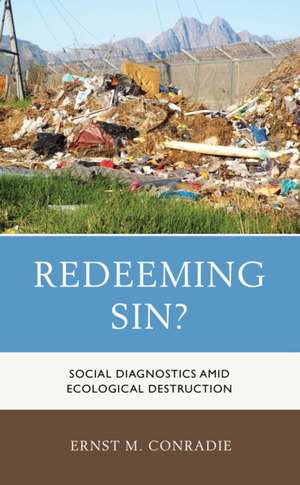
Redeeming Sin?: Social Diagnostics amid Ecological Destruction: Religious Ethics and Environmental Challenges
Autor Ernst M. Conradieen Limba Engleză Hardback – 11 oct 2017


Preț: 677.87 lei
Preț vechi: 1053.36 lei
-36%
Puncte Express: 1017
Carte tipărită la comandă
Livrare economică 08-22 decembrie
Livrare prin curier în România Termenul estimat este afișat lângă disponibilitate.
Transport gratuit pentru acest produs Plată online sau ramburs, în funcție de opțiunile comenzii.
Retur gratuit în 14 zile Comandă securizată și suport în română.
Specificații
ISBN-13: 9781498542456
ISBN-10: 149854245X
Pagini: 290
Dimensiuni: 160 x 236 x 24 mm
Greutate: 0.52 kg
Editura: Bloomsbury Publishing
Colecția Lexington Books
Seria Religious Ethics and Environmental Challenges
Locul publicării:New York, United States
ISBN-10: 149854245X
Pagini: 290
Dimensiuni: 160 x 236 x 24 mm
Greutate: 0.52 kg
Editura: Bloomsbury Publishing
Colecția Lexington Books
Seria Religious Ethics and Environmental Challenges
Locul publicării:New York, United States
Cuprins
Introduction: Sin and Social Diagnostics
1. Penultimate Perspectives on the Roots of Environmental Destruction in Africa
2. Where Have Things Gone Awry in Evolutionary History?
3. How is the Story of What Went Wrong in the World to be Told?
4. Obstacles Thwarting a Retrieval of a Christian Notion of Sin
5. Posse Non Peccare?
Conclusion: Engaging in Social Diagnostics
1. Penultimate Perspectives on the Roots of Environmental Destruction in Africa
2. Where Have Things Gone Awry in Evolutionary History?
3. How is the Story of What Went Wrong in the World to be Told?
4. Obstacles Thwarting a Retrieval of a Christian Notion of Sin
5. Posse Non Peccare?
Conclusion: Engaging in Social Diagnostics
Recenzii
On the back cover of the book well-known theologians Sallie McFague, Mark Douglas, Gijsbert van den Brink and Denis Edwards comment on the scholarship represented in Redeeming Sin and the contribution that the book makes to the field. For Van den Brink and Edwards, the scholarship is perceptive and compelling, written with intellectual rigour and radical honesty and for McFague and Douglas its contribution is powerful, wide raging and pervasive with profound insights. I agree with all of these scholars and would suggest, in addition, that RedeemingSin is relevant and contextual to scholarship in Africa.
Ernst Conradie offers us a book filled with searching questions and profound insights into the nature of human sin in the context of environmental destruction and evolutionary science. With his usual intellectual rigour and radical honesty, he seeks to show how talk of sin can enable a response to the fundamental question: 'What has gone wrong with the world?'
Two decades into the twenty-first century, diagnosing the causes of ecological catastrophes is imperative. Tracing the way Christian understandings of sin have shaped such catastrophes is useful. Attending to the insights of those who have been harmed by such understandings is essential. Reviewing such understandings in light of the best findings of contemporary science is ambitious. And defending an Augustinian conception of sin revised in light of such science to a skeptical public is audacious. Yet in these essays, Ernst Conradie manages to pull all this off through his deeply learned, jaw-droppingly wide-ranging, and profoundly generous scholarship. Social diagnoses are only as good as the diagnostician; in this book, we not only learn of the utility of (some) sin-talk for addressing the crises of the environmental age but observe the types of practices that should guide social diagnosticians everywhere.
In this probing analysis of what is wrong with the world, Ernst Conradie revitalizes the 'outworn' Christian concept of sin by situating it within our evolutionary context and applying it to the problem of ecological destruction. Thus, in a wonderfully perceptive and compelling way he does precisely what contemporary theologians should do: retrieving resources from their tradition and putting them to good use in the public sphere.
Christianity has two great traditions-the Protestant, known for its prophetic 'no' to human involvement in evil and the Catholic, stressing its positive, celebrative side. Ernst Conradie has given us a splendid book in the prophetic tradition, re-imagining the ancient doctrine of sin for a postmodern, climate-change society. It is a powerful, thorough, well-written 'case' for sin, one that I admire and find very persuasive.
Ernst Conradie offers us a book filled with searching questions and profound insights into the nature of human sin in the context of environmental destruction and evolutionary science. With his usual intellectual rigour and radical honesty, he seeks to show how talk of sin can enable a response to the fundamental question: 'What has gone wrong with the world?'
Two decades into the twenty-first century, diagnosing the causes of ecological catastrophes is imperative. Tracing the way Christian understandings of sin have shaped such catastrophes is useful. Attending to the insights of those who have been harmed by such understandings is essential. Reviewing such understandings in light of the best findings of contemporary science is ambitious. And defending an Augustinian conception of sin revised in light of such science to a skeptical public is audacious. Yet in these essays, Ernst Conradie manages to pull all this off through his deeply learned, jaw-droppingly wide-ranging, and profoundly generous scholarship. Social diagnoses are only as good as the diagnostician; in this book, we not only learn of the utility of (some) sin-talk for addressing the crises of the environmental age but observe the types of practices that should guide social diagnosticians everywhere.
In this probing analysis of what is wrong with the world, Ernst Conradie revitalizes the 'outworn' Christian concept of sin by situating it within our evolutionary context and applying it to the problem of ecological destruction. Thus, in a wonderfully perceptive and compelling way he does precisely what contemporary theologians should do: retrieving resources from their tradition and putting them to good use in the public sphere.
Christianity has two great traditions-the Protestant, known for its prophetic 'no' to human involvement in evil and the Catholic, stressing its positive, celebrative side. Ernst Conradie has given us a splendid book in the prophetic tradition, re-imagining the ancient doctrine of sin for a postmodern, climate-change society. It is a powerful, thorough, well-written 'case' for sin, one that I admire and find very persuasive.