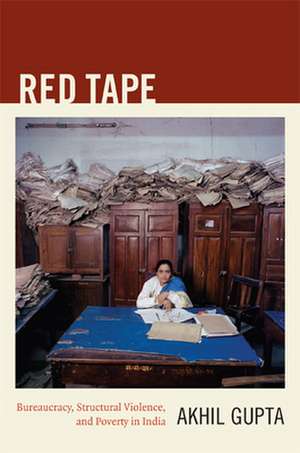
Red Tape
Autor Akhil Guptaen Limba Engleză Paperback – 17 iul 2012
Preț: 283.29 lei
Puncte Express: 425
Carte disponibilă
Livrare economică 11-25 noiembrie
Livrare express 27-31 octombrie pentru 44.32 lei
Livrare prin curier în România Termenul estimat este afișat lângă disponibilitate.
Transport gratuit de la 400.00 lei Plată online sau ramburs, în funcție de opțiunile comenzii.
Retur gratuit în 14 zile Comandă securizată și suport în română.
Specificații
ISBN-13: 9780822351108
ISBN-10: 0822351102
Pagini: 384
Dimensiuni: 156 x 235 x 21 mm
Greutate: 0.59 kg
Editura: Duke University Press
ISBN-10: 0822351102
Pagini: 384
Dimensiuni: 156 x 235 x 21 mm
Greutate: 0.59 kg
Editura: Duke University Press
V-ar putea interesa
-
 -31%Preț: 576.05 lei835.29 lei
 -
 Preț: 266.28 lei
 -
 Indian-MadeErika Marie BsumekPreț: 280.18 lei
 -
 After LoveNoelle M Stout-15%Preț: 660.48 lei777.03 lei
 -
 Anishinaabe Syndicated: A View from the RezJim NorthrupPreț: 115.60 lei
 -
 My Mother Is Now EarthMark Anthony RoloPreț: 139.38 lei
 -
 Mni Sota Makoce: The Land of the DakotaGwen WestermanPreț: 158.10 lei
 -
 Lincoln and the Indians: Civil War Policy and PoliticsDavid A. NicholsPreț: 115.60 lei
 -
 Greet the DawnS. D. NelsonPreț: 118.88 lei
 -
 Anthropology of the StateSharmaPreț: 354.73 lei
 -
 The Aztecs 3eMichael E. SmithPreț: 283.17 lei
 -
 Taos Pueblo & Its Sacred Blue LakeMarcia Keegan-24%Preț: 169.81 lei222.58 lei
 -
 Preț: 394.65 lei
 -
 -25%Preț: 71.05 lei94.73 lei
Recenzii
"This long-awaited book is a masterful achievement, which offers a close look at the culture of bureaucracy in India and through this lens, casts new light on structural violence, liberalization and the paradox of misery in the midst of explosive economic growth. Akhil Gupta's sensitive analysis of the everyday practices of writing, recording, filing and reporting at every level of the Indian state joins a rich literature on the politics of inscription and marks a brilliant new benchmark for political anthropology in India and beyond." Arjun Appadurai, author of Fear of Small Numbers: An Essay on the Geography of Anger"Why has the post-colonial Indian state seemed so incapable of improving the life chances of millions of the countrys poor? Rather than seeing failure residing in policy or neglect - the Indian state after all champions participatory democracy - Akhil Guptas brilliant book Red Tape argues that the structural violence inherent in the state operates as a form of bio-power in which normal bureaucratic procedures depoliticize the killing of the poor - by his account perhaps 2 million annually. Whether exploring corruption, literacy, or population policy, Gupta provides an utterly original account of the deadly operations of state power associated with the ascendancy of new industrial classes and of neoliberal practice in contemporary India. A tour de force." Michael Watts, author of Silent Violence: Food, Famine and Peasantry in Northern Nigeria
"This long-awaited book is a masterful achievement, which offers a close look at the culture of bureaucracy in India and through this lens, casts new light on structural violence, liberalization and the paradox of misery in the midst of explosive economic growth. Akhil Gupta's sensitive analysis of the everyday practices of writing, recording, filing and reporting at every level of the Indian state joins a rich literature on the politics of inscription and marks a brilliant new benchmark for political anthropology in India and beyond." Arjun Appadurai, author of Fear of Small Numbers: An Essay on the Geography of Anger "Why has the post-colonial Indian state seemed so incapable of improving the life chances of millions of the country's poor? Rather than seeing failure residing in policy or neglect - the Indian state after all champions participatory democracy - Akhil Gupta's brilliant book Red Tape argues that the structural violence inherent in the state operates as a form of bio-power in which normal bureaucratic procedures depoliticize the killing of the poor - by his account perhaps 2 million annually. Whether exploring corruption, literacy, or population policy, Gupta provides an utterly original account of the deadly operations of state power associated with the ascendancy of new industrial classes and of neoliberal practice in contemporary India. A tour de force." Michael Watts, author of Silent Violence: Food, Famine and Peasantry in Northern Nigeria
"This long-awaited book is a masterful achievement, which offers a close look at the culture of bureaucracy in India and through this lens, casts new light on structural violence, liberalization and the paradox of misery in the midst of explosive economic growth. Akhil Gupta's sensitive analysis of the everyday practices of writing, recording, filing and reporting at every level of the Indian state joins a rich literature on the politics of inscription and marks a brilliant new benchmark for political anthropology in India and beyond." Arjun Appadurai, author of Fear of Small Numbers: An Essay on the Geography of Anger "Why has the post-colonial Indian state seemed so incapable of improving the life chances of millions of the country's poor? Rather than seeing failure residing in policy or neglect - the Indian state after all champions participatory democracy - Akhil Gupta's brilliant book Red Tape argues that the structural violence inherent in the state operates as a form of bio-power in which normal bureaucratic procedures depoliticize the killing of the poor - by his account perhaps 2 million annually. Whether exploring corruption, literacy, or population policy, Gupta provides an utterly original account of the deadly operations of state power associated with the ascendancy of new industrial classes and of neoliberal practice in contemporary India. A tour de force." Michael Watts, author of Silent Violence: Food, Famine and Peasantry in Northern Nigeria
Cuprins
Acknowledgments ix
Part One. Introduction
1. Poverty as Biopolitics 3
2. The State and the Politics of Poverty 41
Part Two. Corruption
3. Corruption, Politics, and the Imagined State 75
4. Narratives of Corruption 111
Part Three. Inscription
5. "Let the Train Run on Paper": Bureaucratic Writing as State Practice 141
6. Literacy, Bureaucratic Domination, and Democracy 191
Part Four. Governmentality
7. Population and Neoliberal Governmentality 237
Epilogue 279
Notes 295
References Cited 329
Index 355
Part One. Introduction
1. Poverty as Biopolitics 3
2. The State and the Politics of Poverty 41
Part Two. Corruption
3. Corruption, Politics, and the Imagined State 75
4. Narratives of Corruption 111
Part Three. Inscription
5. "Let the Train Run on Paper": Bureaucratic Writing as State Practice 141
6. Literacy, Bureaucratic Domination, and Democracy 191
Part Four. Governmentality
7. Population and Neoliberal Governmentality 237
Epilogue 279
Notes 295
References Cited 329
Index 355
Descriere
Presents a major new theory of the state developed by the renowned anthropologist Akhil Gupta