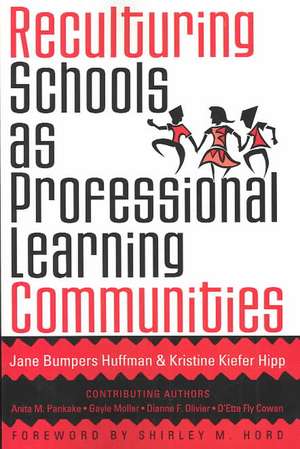
Reculturing Schools as Professional Learning Communities
Autor Jane Bumpers Huffman, Kristine Kiefer Hipp Shirley M. Hord Contribuţii de Anita M. Pankake, Gayle Moller, Dianne F. Olivier, D'Ette Fly Cowanen Limba Engleză Paperback – 22 oct 2003
A PLC organizer (PLCO) is introduced, which realigns with Shirley Hord's original 1997 research. The organizer provides the framework to explain the five PLC dimensions and related critical attributes. The PLCO also merges Fullan's model, Phases of Change (1985), which includes initiation, implementation, and institutionalization.
The authors provide extensive evidence of the progressive development of a PLC from initiation to implementation using exemplars and non-exemplars from interviews that either hinder or facilitate creating and sustaining PLCs. A new assessment tool, the Professional Learning Community Assessment (PLCA), is also presented and can be used for diagnosis and evaluation of schools as they work toward school reform efforts. Readers are also presented with information that connects professional learning community work to a new approach to school improvement. Five case studies are included that can be used in schools and university classrooms for the purpose of engaging educators in reflection, open dialogue, problem finding, and problem solving. This first-hand documented information provides readers with unique issues as they wrestle with the challenges of transforming schools into organizations that meet diverse students needs.
Lessons learned from this problem-based learning can easily transfer to the readers' own experiences and schools. The authors conclude by highlighting significant findings, reviewing the most recent related research that addresses sustaining such efforts, and offering suggestions for school leaders to
Preț: 347.70 lei
Preț vechi: 461.36 lei
-25%
Puncte Express: 522
Carte tipărită la comandă
Livrare economică 27 noiembrie-11 decembrie
Livrare prin curier în România Termenul estimat este afișat lângă disponibilitate.
Transport gratuit de la 400.00 lei Plată online sau ramburs, în funcție de opțiunile comenzii.
Retur gratuit în 14 zile Comandă securizată și suport în română.
Specificații
ISBN-13: 9781578860531
ISBN-10: 1578860539
Pagini: 192
Dimensiuni: 154 x 232 x 12 mm
Greutate: 0.3 kg
Ediția:New.
Editura: Bloomsbury Publishing
Colecția R&L Education
Locul publicării:New York, United States
ISBN-10: 1578860539
Pagini: 192
Dimensiuni: 154 x 232 x 12 mm
Greutate: 0.3 kg
Ediția:New.
Editura: Bloomsbury Publishing
Colecția R&L Education
Locul publicării:New York, United States
Cuprins
Part 1 Part 1: The Challenge of Developing PLCs
Chapter 2 Overview of Professional Learning Communities
Chapter 3 Responding to the Challenge
Part 4 Part 2: From Initiation to Implementation: Dimensions of a PLC
Chapter 5 Shared and Supportive Leadership
Chapter 6 Shared Values and Vision
Chapter 7 Collective Learning and Application
Chapter 8 Shared Personal Practice
Chapter 9 Supportive Conditions
Part 10 Part 3: Assessing and Reculturing Schools
Chapter 11 Assessing Schools as PLCs
Chapter 12 The PLC Connection to School Improvement
Part 13 Part 4: Five Case Studies
Chapter 14 Case Study Overview
Chapter 15 Case Study #1: Role Expectations in Schools Moving to Site-Based Leadership
Chapter 16 Case Study #2: Nurturing the Human Side: A Crucial Component for PLCs
Chapter 17 Case Study #3: Trust as a Foundation in Building a Learning Community
Chapter 18 Case Study #4: The Role of Principal Commitment in Creating Learning Communities
Chapter 19 Case Study #5: Reculturing a School in Crisis
Part 20 Part 5: From Implementation to Institutionalization
Chapter 21 Lessons Learned
Chapter 2 Overview of Professional Learning Communities
Chapter 3 Responding to the Challenge
Part 4 Part 2: From Initiation to Implementation: Dimensions of a PLC
Chapter 5 Shared and Supportive Leadership
Chapter 6 Shared Values and Vision
Chapter 7 Collective Learning and Application
Chapter 8 Shared Personal Practice
Chapter 9 Supportive Conditions
Part 10 Part 3: Assessing and Reculturing Schools
Chapter 11 Assessing Schools as PLCs
Chapter 12 The PLC Connection to School Improvement
Part 13 Part 4: Five Case Studies
Chapter 14 Case Study Overview
Chapter 15 Case Study #1: Role Expectations in Schools Moving to Site-Based Leadership
Chapter 16 Case Study #2: Nurturing the Human Side: A Crucial Component for PLCs
Chapter 17 Case Study #3: Trust as a Foundation in Building a Learning Community
Chapter 18 Case Study #4: The Role of Principal Commitment in Creating Learning Communities
Chapter 19 Case Study #5: Reculturing a School in Crisis
Part 20 Part 5: From Implementation to Institutionalization
Chapter 21 Lessons Learned
Recenzii
A lot has been written about Professional Learning Communities (PLCs), but no book dissects the concept with such clarity and utility as does Huffman and Hipp's Reculturing Schools. This compact book has it all: 1) a clear delineation of six powerful dimensions of a PLC; 2) a portrayal of flow from initiation to institutionalization; 3) a practical instrument for assessing PLCs; 4) five case studies that provide further clarity of PLCs in action; and 5) a summary of lessons learned. All and all, this book provides a clear and practical, evidence-based resource for working productively with one of the most powerful concepts we know of for improving schools.
Huffman and Hipp's book is neither a scholarly tome nor a "quick fix" how-to-do-it manual. Instead, it presents a clear but nuanced overview of current thinking about how teachers and administrators learn and work together, along with useful tools for development. Their survey instrument should be useful for school self-assessment as well as research, and the real-life cases are presented with guides for discussion that will undoubtedly stimulate thoughtful practice. This is a must-read for those who have responsibility for fostering high performance work teams in schools.
Huffman and Hipp's book is neither a scholarly tome nor a "quick fix" how-to-do-it manual. Instead, it presents a clear but nuanced overview of current thinking about how teachers and administrators learn and work together, along with useful tools for development. Their survey instrument should be useful for school self-assessment as well as research, and the real-life cases are presented with guides for discussion that will undoubtedly stimulate thoughtful practice. This is a must-read for those who have responsibility for fostering high performance work teams in schools.