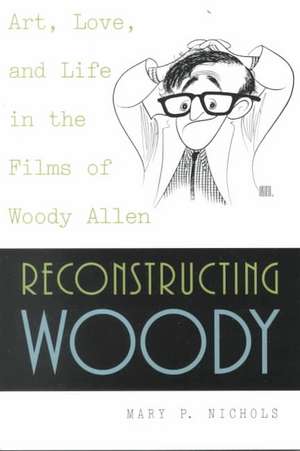
Reconstructing Woody: Art, Love, and Life in the Films of Woody Allen
Autor Mary P. Nicholsen Limba Engleză Paperback – 23 aug 2000
Preț: 131.88 lei
Preț vechi: 160.06 lei
-18%
Puncte Express: 198
Preț estimativ în valută:
23.34€ • 27.28$ • 20.26£
23.34€ • 27.28$ • 20.26£
Carte tipărită la comandă
Livrare economică 19 februarie-05 martie
Preluare comenzi: 021 569.72.76
Specificații
ISBN-13: 9780847689903
ISBN-10: 0847689905
Pagini: 272
Dimensiuni: 150 x 227 x 15 mm
Greutate: 0.36 kg
Ediția:0272
Editura: Bloomsbury Publishing
Colecția Rowman & Littlefield Publishers
Locul publicării:New York, United States
ISBN-10: 0847689905
Pagini: 272
Dimensiuni: 150 x 227 x 15 mm
Greutate: 0.36 kg
Ediția:0272
Editura: Bloomsbury Publishing
Colecția Rowman & Littlefield Publishers
Locul publicării:New York, United States
V-ar putea interesa
-
 The Oxford Handbook of Dance and the Popular ScreenMelissa Blanco Borelli-14%Preț: 1000.25 lei1163.08 lei
 -
 Lady in the Dark – Iris Barry and the Art of FilmRobert SittonPreț: 232.70 lei
 -
 Preț: 339.72 lei
 -
 Small Cinemas in Global Markets: Genres, Identities, NarrativesJosé Cláudio Siqueira Castanheira-34%Preț: 677.90 lei1021.95 lei
 -
 Raoul Peck: Power, Politics, and the Cinematic ImaginationToni Pressley-Sanon-34%Preț: 628.99 lei948.07 lei
 -
 Citizens and Statesmen: A Study of Aristotle's PoliticsMary P. Nichols-19%Preț: 341.50 lei420.65 lei
 -
 The Star Trek Universe: Franchising the Final FrontierDouglas Brode-34%Preț: 525.47 lei791.30 lei
 -
 1939: Hollywood's Greatest YearThomas Hischak-18%Preț: 337.17 lei409.02 lei
 -
 -18%Preț: 332.98 lei406.48 lei
 -
 Picture ThisMolly Bang-16%Preț: 111.93 lei133.04 lei
 -
 Shaping Indian Diaspora: Literary Representations and Bollywood Consumption away from the DesiCristina M. Gámez-Fernández-34%Preț: 542.15 lei817.98 lei
Cuprins
Chapter 1 Acknowledgements
Chapter 2 Preface
Chapter 3 The Interpreter and the Artist
Chapter 4 The Hero and the Klutz (Play It Again, Sam)
Chapter 5 The Anhedonist and the Singer (Annie Hall)
Chapter 6 The Interior Decorator and the Vulgerian (Interiors)
Chapter 7 The Director and the Fan (Stardust Memories)
Chapter 8 The Empiricist and the Image-Maker (A Midsummer Night's Sex Comedy)
Chapter 9 The Changing Man and the Psychiatrist (Zelig)
Chapter 10 The Actor and the Character (The Purple Rose of Cairo)
Chapter 11 The Eavesdropper and the Patient (Another Woman)
Chapter 12 The Ophthamologist and the Filmmaker (Crimes and Misdemeanors)
Chapter 13 The Detectives (Manhattan Murder Mystery)
Chapter 14 The Sportswriter and the Whore (Mighty Aphrodite)
Chapter 15 The Comic
Chapter 16 Notes
Chapter 17 Bibliography
Chapter 2 Preface
Chapter 3 The Interpreter and the Artist
Chapter 4 The Hero and the Klutz (Play It Again, Sam)
Chapter 5 The Anhedonist and the Singer (Annie Hall)
Chapter 6 The Interior Decorator and the Vulgerian (Interiors)
Chapter 7 The Director and the Fan (Stardust Memories)
Chapter 8 The Empiricist and the Image-Maker (A Midsummer Night's Sex Comedy)
Chapter 9 The Changing Man and the Psychiatrist (Zelig)
Chapter 10 The Actor and the Character (The Purple Rose of Cairo)
Chapter 11 The Eavesdropper and the Patient (Another Woman)
Chapter 12 The Ophthamologist and the Filmmaker (Crimes and Misdemeanors)
Chapter 13 The Detectives (Manhattan Murder Mystery)
Chapter 14 The Sportswriter and the Whore (Mighty Aphrodite)
Chapter 15 The Comic
Chapter 16 Notes
Chapter 17 Bibliography
Recenzii
It's about time we had the kind of in-depth study Nichols has written, with such rewarding insights.
Reconstructing Woody is an important contribution to the field of film criticism because few critics delve into the philosophical underpinnings of Woody Allen's scripts-and Nichols does this masterfully, with great perception, care, and depth.
All film collections should include this title.
What began as a diversion provoked a larger revelation. In both works Nichols discovered a writer mocking the pretensions of philosophers whose words prove to be empty as, well, clouds. Is this similarity enough to make Manhattan's Allen a modern-day Aristophanes?
Her focus is always on Allen the filmmaker and never on Allen the home-wrecker. More importantly, it is her conviction that Allen's real on-screen preoccupation is not his sex-life, but the interrelationships between art and life.
Miss Nichols' approach to the topic of Woody Allen is peculiar, as she is a professor of political science, not film studies. What she brings to Mr. Allen's films is a way of thinking and analyzing that is unavailable to the run-of-the-mill film studies professor or critic.
Is full of valuable insights, especially in the way it examines the philosophical nature of a number of Woody Allen's films. Offers the reader a strong foundation on which to build an understanding of Allen and his work.
Reconstructing Woody is an important contribution to the field of film criticism because few critics delve into the philosophical underpinnings of Woody Allen's scripts-and Nichols does this masterfully, with great perception, care, and depth.
All film collections should include this title.
What began as a diversion provoked a larger revelation. In both works Nichols discovered a writer mocking the pretensions of philosophers whose words prove to be empty as, well, clouds. Is this similarity enough to make Manhattan's Allen a modern-day Aristophanes?
Her focus is always on Allen the filmmaker and never on Allen the home-wrecker. More importantly, it is her conviction that Allen's real on-screen preoccupation is not his sex-life, but the interrelationships between art and life.
Miss Nichols' approach to the topic of Woody Allen is peculiar, as she is a professor of political science, not film studies. What she brings to Mr. Allen's films is a way of thinking and analyzing that is unavailable to the run-of-the-mill film studies professor or critic.
Is full of valuable insights, especially in the way it examines the philosophical nature of a number of Woody Allen's films. Offers the reader a strong foundation on which to build an understanding of Allen and his work.