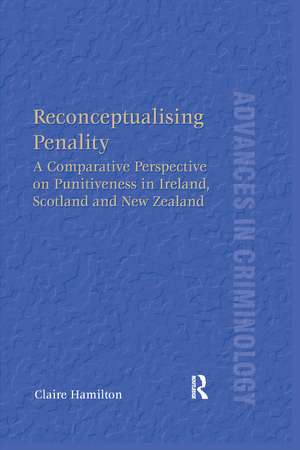
Reconceptualising Penality: A Comparative Perspective on Punitiveness in Ireland, Scotland and New Zealand: New Advances in Crime and Social Harm
Autor Claire Hamiltonen Limba Engleză Paperback – 30 iun 2020
Din seria New Advances in Crime and Social Harm
- 11%
 Preț: 314.07 lei
 - 17%
 Preț: 278.45 lei
 -
 Preț: 377.74 lei
 -
 Preț: 464.18 lei
 -
 Preț: 381.24 lei
 - 17%
 Preț: 333.93 lei
 - 15%
 Preț: 422.39 lei
 - 15%
 Preț: 416.24 lei
 -
 Preț: 456.80 lei
 -
 Preț: 464.18 lei
 - 18%
 Preț: 1079.67 lei
 - 18%
 Preț: 1071.76 lei
 -
 Preț: 464.18 lei
 - 17%
 Preț: 272.53 lei
 -
 Preț: 371.89 lei
 -
 Preț: 387.09 lei
 - 18%
 Preț: 1013.74 lei
 - 21%
 Preț: 196.97 lei
 - 26%
 Preț: 343.48 lei
 - 29%
 Preț: 844.58 lei
 - 29%
 Preț: 871.64 lei
 - 29%
 Preț: 931.51 lei
 - 29%
 Preț: 1885.86 lei
Preț: 279.92 lei
Preț vechi: 353.18 lei
-21%
Puncte Express: 420
Preț estimativ în valută:
49.56€ • 57.70$ • 43.05£
49.56€ • 57.70$ • 43.05£
Carte indisponibilă temporar
Doresc să fiu notificat când acest titlu va fi disponibil:
Se trimite...
Preluare comenzi: 021 569.72.76
Specificații
ISBN-13: 9780367600501
ISBN-10: 0367600501
Pagini: 252
Dimensiuni: 156 x 234 mm
Greutate: 0.47 kg
Ediția:1
Editura: Taylor & Francis
Colecția Routledge
Seria New Advances in Crime and Social Harm
Locul publicării:Oxford, United Kingdom
ISBN-10: 0367600501
Pagini: 252
Dimensiuni: 156 x 234 mm
Greutate: 0.47 kg
Ediția:1
Editura: Taylor & Francis
Colecția Routledge
Seria New Advances in Crime and Social Harm
Locul publicării:Oxford, United Kingdom
V-ar putea interesa
Cuprins
Reconceptualising Penality
Notă biografică
Dr Claire Hamilton LLB. (Ling. Franc.); Barrister-at-Law; M.Litt; Dip EurCon in Human Rights; Diploma in Third Level Learning and Teaching practised as a barrister in criminal law until 2004 when she became a full time academic. She is currently a Lecturer in Criminology in the School of Sociology, Social Policy and Social Work in Queen’s University Belfast.
Recenzii
'Overall, this book offers an important expansion and corrective to the current body of work on punitiveness...This book will be a valuable addition to the field for those with an academic interest in globalisation of criminal justice or in the 'punitive turn'. For the more general reader, this offers a means for critical reflection on developments in policy and practice, with all of the complexity and contradictions, opportunities and threats that entails.'
Dr Jamie Bennett, Governor of HMP Grendon & Springhill
’The study of punitive criminal justice policy has been badly lacking in comparative international research and Hamilton has chosen some ideal case studies to contrast here in a mixed-method tour de force - a real model for how criminology can and should be done.’ Shadd Maruna, author of Making Good: How Ex-Convicts Reform and Rebuild Their Lives ’Hamilton has moved the analysis of punitiveness within penology beyond a reliance on the shorthands often used hitherto. By developing a new framework of punitiveness, this work demonstrates the importance of the local and the global in patterns of punitiveness in small jurisdictions.’ Katrina Morrison, Edinburgh Napier University, UK ’Dr Hamilton’s book provides an excellent examination of the extent to which the criminal justice systems of Ireland, Scotland, and New Zealand are becoming increasingly punitive. She demonstrates an excellent ability to engage with contemporary penological and criminological accounts of structural changes in criminal justice practices, and displays a strong commitment to evidence-based analysis, constantly tacking back and forth between generalised accounts and local and particular practices. Trading in careful analysis and nuanced insights, the book provides a wealth of diverse materials for the reader to consider in determining the extent to which a new punitiveness has emerged. The result of her endeavours is an excellent book, one that revels in the messiness of the present, a contested site where central and peripheral penal practices cannot easily be compartmentalised.’ Shane Kilcommins, University of Limerick, Ireland
Dr Jamie Bennett, Governor of HMP Grendon & Springhill
’The study of punitive criminal justice policy has been badly lacking in comparative international research and Hamilton has chosen some ideal case studies to contrast here in a mixed-method tour de force - a real model for how criminology can and should be done.’ Shadd Maruna, author of Making Good: How Ex-Convicts Reform and Rebuild Their Lives ’Hamilton has moved the analysis of punitiveness within penology beyond a reliance on the shorthands often used hitherto. By developing a new framework of punitiveness, this work demonstrates the importance of the local and the global in patterns of punitiveness in small jurisdictions.’ Katrina Morrison, Edinburgh Napier University, UK ’Dr Hamilton’s book provides an excellent examination of the extent to which the criminal justice systems of Ireland, Scotland, and New Zealand are becoming increasingly punitive. She demonstrates an excellent ability to engage with contemporary penological and criminological accounts of structural changes in criminal justice practices, and displays a strong commitment to evidence-based analysis, constantly tacking back and forth between generalised accounts and local and particular practices. Trading in careful analysis and nuanced insights, the book provides a wealth of diverse materials for the reader to consider in determining the extent to which a new punitiveness has emerged. The result of her endeavours is an excellent book, one that revels in the messiness of the present, a contested site where central and peripheral penal practices cannot easily be compartmentalised.’ Shane Kilcommins, University of Limerick, Ireland
Descriere
Although developments such as the drastic increase in the use of imprisonment and restrictions on parole suggest a new, harsher punitive era, Hamilton’s empirical data based on examination of penal policies in Ireland, Scotland and New Zealand, suggests criminal justice and penal policies vary. This study is critical of the way in which punitivenes