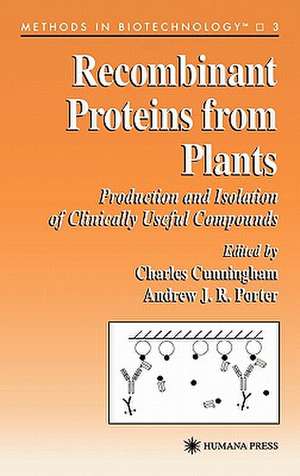
Recombinant Proteins from Plants
Editat de Charles Cunningham, Andrew J R Porteren Limba Engleză Hardback – 24 dec 1997
Preț: 674.11 lei
Preț vechi: 793.07 lei
-15%
Puncte Express: 1011
Carte tipărită la comandă
Livrare economică 30 noiembrie-14 decembrie
Livrare prin curier în România Termenul estimat este afișat lângă disponibilitate.
Transport gratuit pentru acest produs Plată online sau ramburs, în funcție de opțiunile comenzii.
Retur gratuit în 14 zile Comandă securizată și suport în română.
Specificații
ISBN-13: 9780896033900
ISBN-10: 0896033902
Pagini: 308
Ilustrații: XI, 308 p.
Dimensiuni: 161 x 236 x 25 mm
Greutate: 0.68 kg
Ediția:1998 edition
Editura: Humana Press Inc.
Locul publicării:Totowa, NJ, United States
ISBN-10: 0896033902
Pagini: 308
Ilustrații: XI, 308 p.
Dimensiuni: 161 x 236 x 25 mm
Greutate: 0.68 kg
Ediția:1998 edition
Editura: Humana Press Inc.
Locul publicării:Totowa, NJ, United States
V-ar putea interesa
-
 -28%Preț: 523.18 lei721.91 lei
 -
 Anatomy of the Monocotyledons Volume X: OrchidaceaeWilliam Louis Stern-33%Preț: 1143.69 lei1699.34 lei
 -
 Ecology of Plant-Derived Smoke: Its Use in Seed GerminationLara Jefferson-32%Preț: 533.24 lei781.16 lei
 -
 Plant Pathogen Resistance BiotCollinge-9%Preț: 1295.85 lei1424.01 lei
 -
 Plant Developmental BiologyLars Hennig-18%Preț: 954.82 lei1164.41 lei
 -
 Photosynthesis Research ProtocolsRobert Carpentier-18%Preț: 1133.53 lei1382.36 lei
 -
 Fungal GenomicsJin-Rong Xu-15%Preț: 675.34 lei794.52 lei
 -
 Plant Transcription FactorsLing Yuan-19%Preț: 657.09 lei811.22 lei
 -
 Plant MetabolomicsNigel W. Hardy-18%Preț: 993.64 lei1211.75 lei
 -
 Plant Cell Culture ProtocolsVíctor M. Loyola-Vargas-18%Preț: 1168.53 lei1425.04 lei
 -
 Plant Salt ToleranceSergey Shabala-15%Preț: 684.95 lei805.83 lei
 -
 High-Throughput Phenotyping in PlantsJennifer Normanly-15%Preț: 680.32 lei800.38 lei
 -
 Mutation Breeding in Chickpea:Imran Kozgar-15%Preț: 532.41 lei626.37 lei
Public țintă
ResearchCuprins
Rice Transformation by Agrobacterium Infection.- Barley as a Producer of Heterologous Protein.- Introducing and Expressing Genes in Legumes.- Use of the GUS Reporter Gene.- Expression of Recombinant Proteinase Inhibitors in Plants.- Detection of Recombinant Viral Coat Protein in Transgenic Plants.- Synthesis of Recombinant Human Cytokine GM-CSF in the Seeds of Transgenic Tobacco Plants.- Tobamovirus Vectors for Expression of Recombinant Genes in Plants.- Single-Chain Fv Antibodies Expressed in Plants.- Characterization and Applications of Plant-Derived Recombinant Antibodies.- Production of Recombinant Antibodies in Plant Suspension Cultures.- Production of Foreign Proteins in Tobacco Cell Suspension Culture.- Transient Gene Expression in Plant Protoplasts.- Stability of Recombinant Proteins in Plants.- Trafficking and Stability of Heterologous Proteins in Transgenic Plants.- Screening for Transgenic Lines with Stable and Suitable Accumulation Levels of a Heterologous Protein.- Manipulation of Photosynthetic Metabolism.- Quantification of Heterologous Protein Levels in Transgenic Plants by ELISA.- Analysis of N- and O-Glycosylation of Plant Proteins.- Two-Dimensional Electrophoresis.
Textul de pe ultima copertă
In Recombinant Proteins from Plants, leading researchers from around the world present the latest molecular and classical approaches to the separation, analysis, and characterization of recombinant plant proteins. Focusing on the large-scale, cost-effective production of such proteins for use as specialist industrial or therapeutic biomolecules, these authoritative scientists also include promising experimental techniques that will become increasingly important in the future-such techniques as those for the efficient transformation of monocots with Agrobacterium tumefaciens, for optimizing the stability of recombinant proteins, and for exploiting the immunotherapeutic potential of plant-expressed proteins.
Recombinant Proteins from Plants provides a comprehensive and detailed handbook of essential techniques that will benefit both scientists new to the field and established laboratories. It will become the standard reference for even highly skilled researchers working in this most exciting and fast developing field of biology.
Recombinant Proteins from Plants provides a comprehensive and detailed handbook of essential techniques that will benefit both scientists new to the field and established laboratories. It will become the standard reference for even highly skilled researchers working in this most exciting and fast developing field of biology.