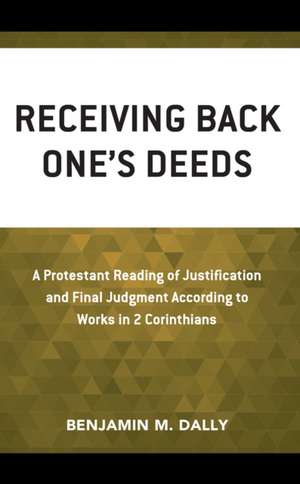
Receiving Back One’s Deeds: A Protestant Reading of Justification and Final Judgment According to Works in 2 Corinthians
Autor Benjamin M. Dallyen Limba Engleză Hardback – 16 noi 2022
Preț: 578.08 lei
Preț vechi: 906.71 lei
-36%
Puncte Express: 867
Carte tipărită la comandă
Livrare economică 17 noiembrie-01 decembrie
Livrare prin curier în România Termenul estimat este afișat lângă disponibilitate.
Transport gratuit pentru acest produs Plată online sau ramburs, în funcție de opțiunile comenzii.
Retur gratuit în 14 zile Comandă securizată și suport în română.
Specificații
ISBN-13: 9781978708730
ISBN-10: 1978708734
Pagini: 280
Dimensiuni: 157 x 238 x 22 mm
Greutate: 0.58 kg
Editura: Bloomsbury Publishing
Colecția Fortress Academic
Locul publicării:New York, United States
ISBN-10: 1978708734
Pagini: 280
Dimensiuni: 157 x 238 x 22 mm
Greutate: 0.58 kg
Editura: Bloomsbury Publishing
Colecția Fortress Academic
Locul publicării:New York, United States
Descriere
This book investigates the relationship between justification by faith and final judgment according to works as found in Paul's second epistle to the Corinthians within a Protestant theological framework. Benjamin M. Dally first demonstrates the diversity and breadth of mainstream Protestant soteriology and eschatology beginning at the time of the Reformation by examining the confessional standards of its four primary ecclesial/theological streams: Lutheran, Reformed, Anabaptist, and Anglican. The soteriological structure of each is assessed (i.e., how each construes the relationship between justification and final judgment), with particular attention given to how each speaks of the place of good works at the final judgment. This initial examination outlines the theological boundaries within which the exegesis of Second Corinthians can legitimately proceed, and illuminates language and conceptual matrices that will be drawn upon throughout the remainder of thebook. Then, drawing upon the narrative logic of Paul's Early Jewish thought-world, Dally examines the text of Second Corinthians to discern its own soteriological framework, paying particular attention to both the meaning and rhetorical function of the "judgment according to works" motif as it is utilized throughout the letter. The book concludes by offering a Protestant synthesis of the relationship between justification and final judgment according to works in Second Corinthians, giving an explanation of the role of works at the final judgment that arguably alleviates a number of tensions often perceived in other readings devoted to this key aspect of Pauline exegesis and theology.
Dally ultimately argues a three-fold thesis: (1) For the believer one's earthly conduct, taken as a whole, is best spoken of in the language of inferior/secondary "cause" and/or "basis" as far as its import at the last judgment. (2) One's earthly conduct, again taken as a whole, is soteriologically necessary (not solely, but secondarily nonetheless) and not simply of importance for the bestowal of non-soteriological, eschatological rewards. (3) There are crucial resources from within mainstream Protestantism to authorize such ways of speaking and to simultaneously affirm these contentions in conjunction with a robust, strictly forensic/imputational, "traditional" Protestant understanding of the doctrine of justification by faith alone.
Dally ultimately argues a three-fold thesis: (1) For the believer one's earthly conduct, taken as a whole, is best spoken of in the language of inferior/secondary "cause" and/or "basis" as far as its import at the last judgment. (2) One's earthly conduct, again taken as a whole, is soteriologically necessary (not solely, but secondarily nonetheless) and not simply of importance for the bestowal of non-soteriological, eschatological rewards. (3) There are crucial resources from within mainstream Protestantism to authorize such ways of speaking and to simultaneously affirm these contentions in conjunction with a robust, strictly forensic/imputational, "traditional" Protestant understanding of the doctrine of justification by faith alone.
Cuprins
1.Introduction
2.Justification and Final Judgment in the Protestant Confessions
3.The Narrative Logic of Early Jewish Restoration Theology
4.The Shape of Justification in Second Corinthians
5.Judgment according to Works in Second Corinthians
6.Conclusion and Synthesis
2.Justification and Final Judgment in the Protestant Confessions
3.The Narrative Logic of Early Jewish Restoration Theology
4.The Shape of Justification in Second Corinthians
5.Judgment according to Works in Second Corinthians
6.Conclusion and Synthesis
Recenzii
Receiving Back One's Deeds is the most exhaustive attempt I have ever seen to resolve the 'theological tension' between 'how one might be justified by faith alone and yet ultimately judged according to one's works.'
Benjamin M. Dally provides a way forward for Protestant readings of Paul arguing, in this careful study of Second Corinthians, that a forensic view of justification by faith and a robust understanding of judgment by works can harmoniously coexist. According to Dally, a Protestant solution to the perceived tension between these two doctrines is found on the plane of Paul's narrative logic (à la, Richard B. Hays) of Early Jewish restoration theology which permeates Paul first-century Jewish context. Daily's thesis relieves the disequilibrium in Protestant studies of Paul created by the relationship between the seemingly contradictory messages of justification by faith alone, sola fide, and eschatological judgment by works.
The relationship of justification by faith and judgment according to works in Paul and in Scripture generally has been a perennial issue since the Reformation. Benjamin M. Dally examines this issue as it surfaces in 2 Corinthians. The book offers careful and detailed exegetical work in the text but is especially notable for its robust description of, and interaction with, the broad Protestant theological tradition. Whether agreeing with the book's conclusions or not, anyone working on this topic will have to take account of Dally's arguments.
Here Ben Dally makes a couple of contributions to ongoing discussions of justification and final judgment. He gives careful attention to oft-neglected 2 Corinthians, addressing it in the context of early Jewish restoration theology. He also gives careful attention to early Protestant soteriological traditions, addressing their subtle variations on how justification works. While it will be obvious where Reformed theology diverges from Dally's conclusions, his theologically-interested exegesis shows that Protestants can take seriously the role of works at the final judgment.
A nuanced assessment of the complex dance between justification and final judgment in Paul's thought has not always been seen as a strength of Protestant biblical and theological studies. To the dance floor Ben Dally brings both a historical reconsideration of Protestant confessions of faith and an assessment of Paul's 2 Corinthians. The latter, read in light of motifs from Early Jewish Restoration Theology, contributes fresh insights on the intricate interplay between Pauline soteriology and eschatology as read within the Protestant tradition.
Dally's work exemplifies the best of a cross-disciplined integrative approach to biblical, historical, and theological scholarship. His elucidation of judgment according to works in relationship to a Protestant doctrine of justification by faith alone is exegetically sound, historically aware, and theologically satisfying. This book is sure to resonate with biblical scholars, church historians, and pastoral theologians.
Benjamin M. Dally provides a way forward for Protestant readings of Paul arguing, in this careful study of Second Corinthians, that a forensic view of justification by faith and a robust understanding of judgment by works can harmoniously coexist. According to Dally, a Protestant solution to the perceived tension between these two doctrines is found on the plane of Paul's narrative logic (à la, Richard B. Hays) of Early Jewish restoration theology which permeates Paul first-century Jewish context. Daily's thesis relieves the disequilibrium in Protestant studies of Paul created by the relationship between the seemingly contradictory messages of justification by faith alone, sola fide, and eschatological judgment by works.
The relationship of justification by faith and judgment according to works in Paul and in Scripture generally has been a perennial issue since the Reformation. Benjamin M. Dally examines this issue as it surfaces in 2 Corinthians. The book offers careful and detailed exegetical work in the text but is especially notable for its robust description of, and interaction with, the broad Protestant theological tradition. Whether agreeing with the book's conclusions or not, anyone working on this topic will have to take account of Dally's arguments.
Here Ben Dally makes a couple of contributions to ongoing discussions of justification and final judgment. He gives careful attention to oft-neglected 2 Corinthians, addressing it in the context of early Jewish restoration theology. He also gives careful attention to early Protestant soteriological traditions, addressing their subtle variations on how justification works. While it will be obvious where Reformed theology diverges from Dally's conclusions, his theologically-interested exegesis shows that Protestants can take seriously the role of works at the final judgment.
A nuanced assessment of the complex dance between justification and final judgment in Paul's thought has not always been seen as a strength of Protestant biblical and theological studies. To the dance floor Ben Dally brings both a historical reconsideration of Protestant confessions of faith and an assessment of Paul's 2 Corinthians. The latter, read in light of motifs from Early Jewish Restoration Theology, contributes fresh insights on the intricate interplay between Pauline soteriology and eschatology as read within the Protestant tradition.
Dally's work exemplifies the best of a cross-disciplined integrative approach to biblical, historical, and theological scholarship. His elucidation of judgment according to works in relationship to a Protestant doctrine of justification by faith alone is exegetically sound, historically aware, and theologically satisfying. This book is sure to resonate with biblical scholars, church historians, and pastoral theologians.