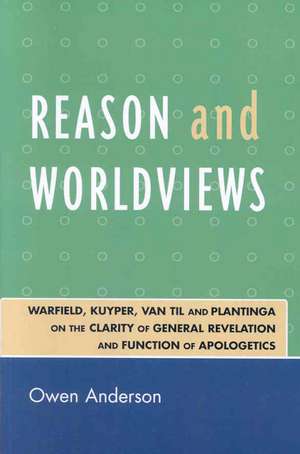
Reason and Worldviews: Warfield, Kuyper, Van Til and Plantinga on the Clarity of General Revelation and Function of Apologetics
Autor Owen Andersonen Limba Engleză Paperback – 11 mar 2008
Preț: 272.92 lei
Preț vechi: 378.23 lei
-28%
Puncte Express: 409
Carte tipărită la comandă
Livrare economică 27 noiembrie-11 decembrie
Livrare prin curier în România Termenul estimat este afișat lângă disponibilitate.
Transport gratuit de la 400.00 lei Plată online sau ramburs, în funcție de opțiunile comenzii.
Retur gratuit în 14 zile Comandă securizată și suport în română.
Specificații
ISBN-13: 9780761840381
ISBN-10: 0761840389
Pagini: 152
Dimensiuni: 153 x 231 x 13 mm
Greutate: 0.23 kg
Ediția:New.
Editura: Bloomsbury Publishing
Colecția University Press of America
Locul publicării:New York, United States
ISBN-10: 0761840389
Pagini: 152
Dimensiuni: 153 x 231 x 13 mm
Greutate: 0.23 kg
Ediția:New.
Editura: Bloomsbury Publishing
Colecția University Press of America
Locul publicării:New York, United States
Cuprins
Part 1 Foreword
Part 2 Preface
Chapter 3 Introduction
Chapter 4 Princeton Theological Seminary and Common Sense Philosophy
Chapter 5 Benjamin Warfield and Reason
Chapter 6 Abraham Kuyper and Worldviews
Chapter 7 Cornelius Van Til and Presuppositions
Chapter 8 Alvin Plantinga and Warranted Christian Belief
Chapter 9 On the Necessity for Natural Theology
Chapter 10 Conclusion
Part 11 Endnotes
Part 12 Glossary
Part 13 Index
Part 2 Preface
Chapter 3 Introduction
Chapter 4 Princeton Theological Seminary and Common Sense Philosophy
Chapter 5 Benjamin Warfield and Reason
Chapter 6 Abraham Kuyper and Worldviews
Chapter 7 Cornelius Van Til and Presuppositions
Chapter 8 Alvin Plantinga and Warranted Christian Belief
Chapter 9 On the Necessity for Natural Theology
Chapter 10 Conclusion
Part 11 Endnotes
Part 12 Glossary
Part 13 Index
Recenzii
Anderson's book is an admirable history and discussion of the issues surrounding Reformed apologetics for the last 250 years. His analysis and evaluations are well worth considering by those on all sides of the controversies.
Dr. Owen Anderson has ably analyzed the epistemology of B.B. Warfield in contrast to that of Abraham Kuyper and Cornelius Van Til. He has done this in order to draw attention to the necessity of clarity and inexcusability if the claims of historic Christian theism are to be meaningfully understood. Any thoughtful Christian apologetic must therefore begin with showing the clarity of general revelation in order to establish the inexcusability of unbelief. In philosophy, this intellectual endeavor has been the domain of natural theology. Dr. Anderson's analysis of Warfield has therefore shown the necessity for the project of natural theology. Dr. Anderson's analysis of recent contributors to this dialogue is therefore both valuable and timely.
This book is written with a clarity and focus that is most welcome. Anyone working in Reformed circles or interested in the question of natural theology or those engaged in worldview analysis will find it very useful and challenging.
Owen Anderson has done a well-rounded job in [his book] by providing a clear understanding of the issue at hand when it comes to the field of apologetics....Anderson was fair in his assessment of each of the methods mentioned and offers some good insight as to how we can begin to think more in-depth regarding apologetics...This text isn't only for Reformed readers but will include very helpful insight for those outside the halls of Reformed Orthodoxy.
Dr. Owen Anderson has ably analyzed the epistemology of B.B. Warfield in contrast to that of Abraham Kuyper and Cornelius Van Til. He has done this in order to draw attention to the necessity of clarity and inexcusability if the claims of historic Christian theism are to be meaningfully understood. Any thoughtful Christian apologetic must therefore begin with showing the clarity of general revelation in order to establish the inexcusability of unbelief. In philosophy, this intellectual endeavor has been the domain of natural theology. Dr. Anderson's analysis of Warfield has therefore shown the necessity for the project of natural theology. Dr. Anderson's analysis of recent contributors to this dialogue is therefore both valuable and timely.
This book is written with a clarity and focus that is most welcome. Anyone working in Reformed circles or interested in the question of natural theology or those engaged in worldview analysis will find it very useful and challenging.
Owen Anderson has done a well-rounded job in [his book] by providing a clear understanding of the issue at hand when it comes to the field of apologetics....Anderson was fair in his assessment of each of the methods mentioned and offers some good insight as to how we can begin to think more in-depth regarding apologetics...This text isn't only for Reformed readers but will include very helpful insight for those outside the halls of Reformed Orthodoxy.