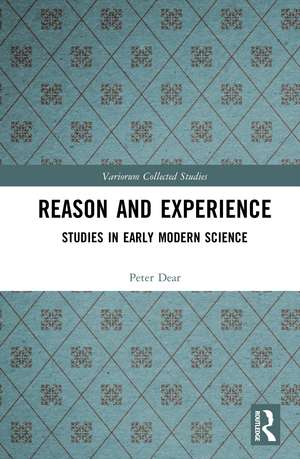
Reason and Experience: Studies in Early Modern Science: Variorum Collected Studies
Autor Peter Dearen Limba Engleză Hardback – 16 dec 2026
Scientifically usable experience came in the seventeenth century to take on the characteristic form of the experimental report, in which an historical account of some event or process was processed in such a way as to render it universalizable, and hence conformable to well-understood Aristotelian accounts of scientific knowledge. The result was a new style of experimental science that emphasized reportable events, typically shareable with a wider community of natural philosophers. At the same time, self-conscious philosophical understandings of “reason” served as the means of justifying the necessary universalizability of experimental reports.
The studies on these themes that make up the book will be of interest to historians and philosophers of science, as well as scholars concerned with the practical historical development of scientific practices.
Din seria Variorum Collected Studies
- 18%
 Preț: 817.97 lei
 - 27%
 Preț: 1406.25 lei
 - 18%
 Preț: 1370.02 lei
 - 18%
 Preț: 1349.92 lei
 -
 Preț: 352.37 lei
 - 18%
 Preț: 1354.95 lei
 - 18%
 Preț: 1347.90 lei
 - 18%
 Preț: 819.40 lei
 -
 Preț: 472.65 lei
 -
 Preț: 442.70 lei
 -
 Preț: 504.76 lei
 - 18%
 Preț: 1348.23 lei
 -
 Preț: 398.09 lei
 - 11%
 Preț: 404.81 lei
 - 8%
 Preț: 462.54 lei
 - 18%
 Preț: 819.06 lei
 - 18%
 Preț: 819.40 lei
 - 27%
 Preț: 1001.46 lei
 - 18%
 Preț: 819.76 lei
 -
 Preț: 403.82 lei
 - 18%
 Preț: 818.25 lei
 -
 Preț: 391.83 lei
 - 18%
 Preț: 819.59 lei
 - 18%
 Preț: 713.80 lei
 - 18%
 Preț: 1120.96 lei
 - 18%
 Preț: 1256.11 lei
 -
 Preț: 418.73 lei
 -
 Preț: 370.06 lei
 - 18%
 Preț: 1112.48 lei
 - 18%
 Preț: 728.90 lei
 - 18%
 Preț: 726.26 lei
 - 18%
 Preț: 902.77 lei
 - 18%
 Preț: 1066.58 lei
 - 18%
 Preț: 713.80 lei
 -
 Preț: 384.94 lei
 - 18%
 Preț: 1255.93 lei
 - 18%
 Preț: 749.58 lei
 - 18%
 Preț: 1261.45 lei
 - 23%
 Preț: 1750.26 lei
 - 18%
 Preț: 1303.18 lei
 - 15%
 Preț: 680.93 lei
 - 18%
 Preț: 1013.62 lei
 - 18%
 Preț: 1071.02 lei
 - 18%
 Preț: 725.21 lei
 - 18%
 Preț: 1003.26 lei
 - 18%
 Preț: 1006.44 lei
 - 18%
 Preț: 1008.16 lei
 - 18%
 Preț: 726.95 lei
 - 18%
 Preț: 1012.93 lei
Preț: 1127.70 lei
Preț vechi: 1484.56 lei
-24% Precomandă
Puncte Express: 1692
Carte nepublicată încă
Livrare prin curier în România Precomanda se expediază când titlul devine disponibil.
Transport gratuit pentru acest produs Plată online sau ramburs, în funcție de opțiunile comenzii.
Retur gratuit în 14 zile Comandă securizată și suport în română.
Doresc să fiu notificat când acest titlu va fi disponibil:
Se trimite...
Specificații
ISBN-13: 9781032643403
ISBN-10: 1032643404
Pagini: 268
Ilustrații: 4
Dimensiuni: 156 x 234 mm
Greutate: 0.45 kg
Ediția:1
Editura: Taylor & Francis
Colecția Routledge
Seria Variorum Collected Studies
Locul publicării:Oxford, United Kingdom
ISBN-10: 1032643404
Pagini: 268
Ilustrații: 4
Dimensiuni: 156 x 234 mm
Greutate: 0.45 kg
Ediția:1
Editura: Taylor & Francis
Colecția Routledge
Seria Variorum Collected Studies
Locul publicării:Oxford, United Kingdom
Public țintă
AcademicCuprins
Introduction
I. Experience and Argumentative Forms.
1. “Totius in verba: Rhetoric and Authority in the Early Royal Society,” Isis 76 (1985), pp. 145- 161.
2. “Miracles, Experiments, and the Ordinary Course of Nature,” Isis 81 (1990), pp. 663-683.
3. “From Truth to Disinterestedness in the Seventeenth Century,” Social Studies of Science 22 (1992), pp. 619-631.
4. “The Meanings of Experience,” in Katherine Park and Lorraine Daston (eds.), The Cambridge History of Science, vol.3, Early Modern Science (Cambridge: Cambridge University Press, 2006), pp. 106-131.
II. The Authority of Mathematics.
5. “Mersenne’s Suggestion: Cartesian Meditation and the Mathematical Model of Knowledge in the Seventeenth Century,” in Marjorie Grene and Roger Ariew (eds.), Descartes and His Contemporaries: Meditations, Objections, and Replies (University of Chicago Press, 1995), pp. 44-62.
6. “A Mechanical Microcosm: Bodily Passions, Good Manners, and Cartesian Mechanism,” in Christopher Lawrence and Steven Shapin (eds.), Science Incarnate: Historical Embodiments of Natural Knowledge (Chicago: University of Chicago Press, 1998), pp. 51- 82.
7. “Mysteries of State, Mysteries of Nature: Authority, Knowledge and Expertise in the Seventeenth Century,” in Sheila Jasanoff (ed.), States of Knowledge: The Co-Production of Science and Social Order (London: Routledge, 2004), pp. 206-224.
III. The Ineffability of Reason.
8. “Divine Illumination, Mechanical Calculators, and the Roots of Modern Reason,” Science in Context 23 (2010), pp. 351-366.
9. Essay-review of Robert S. Westman, The Copernican Question (University of California Press, 2011), for a review symposium in Metascience 23 (2014), pp. 208-212.
10. “Reason and Common Culture in Early Modern Natural Philosophy: Variations on an Epistemic Theme,” in Tamàs Demeter, Kathryn Murphy, and Klaus Zittel (eds.), Conflicting Values of Inquiry: Ideologies of Epistemology in Early Modern Europe (Leiden: Koninklijke Brill NV, 2015), pp. 10-38.
IV. The Roots of Modern Science.
11. “What is the History of Science the History of? Early Modern Roots of the Ideology of Modern Science,” Isis 96 (2005), pp. 390-406.
12. “Science is Dead; Long Live Science,” Osiris 27 (2012), pp. 37-55.
I. Experience and Argumentative Forms.
1. “Totius in verba: Rhetoric and Authority in the Early Royal Society,” Isis 76 (1985), pp. 145- 161.
2. “Miracles, Experiments, and the Ordinary Course of Nature,” Isis 81 (1990), pp. 663-683.
3. “From Truth to Disinterestedness in the Seventeenth Century,” Social Studies of Science 22 (1992), pp. 619-631.
4. “The Meanings of Experience,” in Katherine Park and Lorraine Daston (eds.), The Cambridge History of Science, vol.3, Early Modern Science (Cambridge: Cambridge University Press, 2006), pp. 106-131.
II. The Authority of Mathematics.
5. “Mersenne’s Suggestion: Cartesian Meditation and the Mathematical Model of Knowledge in the Seventeenth Century,” in Marjorie Grene and Roger Ariew (eds.), Descartes and His Contemporaries: Meditations, Objections, and Replies (University of Chicago Press, 1995), pp. 44-62.
6. “A Mechanical Microcosm: Bodily Passions, Good Manners, and Cartesian Mechanism,” in Christopher Lawrence and Steven Shapin (eds.), Science Incarnate: Historical Embodiments of Natural Knowledge (Chicago: University of Chicago Press, 1998), pp. 51- 82.
7. “Mysteries of State, Mysteries of Nature: Authority, Knowledge and Expertise in the Seventeenth Century,” in Sheila Jasanoff (ed.), States of Knowledge: The Co-Production of Science and Social Order (London: Routledge, 2004), pp. 206-224.
III. The Ineffability of Reason.
8. “Divine Illumination, Mechanical Calculators, and the Roots of Modern Reason,” Science in Context 23 (2010), pp. 351-366.
9. Essay-review of Robert S. Westman, The Copernican Question (University of California Press, 2011), for a review symposium in Metascience 23 (2014), pp. 208-212.
10. “Reason and Common Culture in Early Modern Natural Philosophy: Variations on an Epistemic Theme,” in Tamàs Demeter, Kathryn Murphy, and Klaus Zittel (eds.), Conflicting Values of Inquiry: Ideologies of Epistemology in Early Modern Europe (Leiden: Koninklijke Brill NV, 2015), pp. 10-38.
IV. The Roots of Modern Science.
11. “What is the History of Science the History of? Early Modern Roots of the Ideology of Modern Science,” Isis 96 (2005), pp. 390-406.
12. “Science is Dead; Long Live Science,” Osiris 27 (2012), pp. 37-55.
Notă biografică
Peter Dear is emeritus professor of history at Cornell University. The recipient of numerous grants and fellowships, including a Guggenheim Memorial Fellowship, he is the author of several books, including Discipline and Experience: The Mathematical Way in the Scientific Revolution I1995), Revolutionizing the Sciences: European Knowledge and Its Ambitions, 1500-1700 (first edition 2001), and The World as we Know It: From Natural Philosophy to Modern Science (2025).
Descriere
Early modern Europe witnessed the rise of new ways of creating knowledge of the natural world, ways often encapsulated by historians under the label “Scientific Revolution.” This book investigate some of the most fundamental of these novelties, concentrating especially on the epistemological themes of “experience” and “reason.”