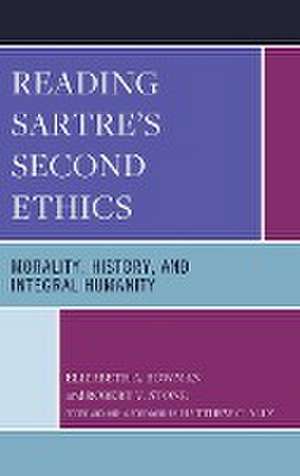
Reading Sartre's Second Ethics: Morality, History, and Integral Humanity
Autor Elizabeth A. Bowman, Robert V. Stone Cu Matthew C. Allyen Limba Engleză Hardback – 30 mar 2023
Preț: 625.26 lei
Preț vechi: 961.23 lei
-35%
Puncte Express: 938
Carte tipărită la comandă
Livrare economică 27 noiembrie-11 decembrie
Livrare prin curier în România Termenul estimat este afișat lângă disponibilitate.
Transport gratuit pentru acest produs Plată online sau ramburs, în funcție de opțiunile comenzii.
Retur gratuit în 14 zile Comandă securizată și suport în română.
Specificații
ISBN-13: 9781793646514
ISBN-10: 1793646511
Pagini: 424
Dimensiuni: 157 x 236 x 30 mm
Greutate: 0.79 kg
Editura: Bloomsbury Publishing
Colecția Lexington Books
Locul publicării:New York, United States
ISBN-10: 1793646511
Pagini: 424
Dimensiuni: 157 x 236 x 30 mm
Greutate: 0.79 kg
Editura: Bloomsbury Publishing
Colecția Lexington Books
Locul publicării:New York, United States
Cuprins
Introduction: Reading Sartre's Later Ethical Writings Today
Abbreviations
Part I: The Second Ethics: A Heuristic and Critical Prospectus
Chapter 1: Unveiling Socialism's "Ethical Structure"
Part II: The Phenomenological Moment: What Morality is Made of
Chapter 2: The Everyday Experience of Morality
Chapter 3: The Types of Norms and What they Share
Part III: The Regressive Moment: How Morality is Lived
Chapter 4: The Livability of Norms I: Casuistry and Moral Comfort
Chapter 5: The Livability of Norms II: Morality Is Impossible Today
Chapter 6: Invention I: The Moral Moment in Historical Action
Chapter 7: Invention II: The Vocation of Praxis for the Ethical Unconditional
Part IV: The Progressive Moment: The Paradox of Ethos and the Means Beyond It
Chapter 8: The Paradox of Ethos I: The Two Sides of Norms
Chapter 9: The Paradox of Ethos II: The Actuality and Historicity of Norms
Chapter 10: The Root of Ethics I: Colonist Morality as Alienated Humanity
Chapter 11: The Root of Et
Abbreviations
Part I: The Second Ethics: A Heuristic and Critical Prospectus
Chapter 1: Unveiling Socialism's "Ethical Structure"
Part II: The Phenomenological Moment: What Morality is Made of
Chapter 2: The Everyday Experience of Morality
Chapter 3: The Types of Norms and What they Share
Part III: The Regressive Moment: How Morality is Lived
Chapter 4: The Livability of Norms I: Casuistry and Moral Comfort
Chapter 5: The Livability of Norms II: Morality Is Impossible Today
Chapter 6: Invention I: The Moral Moment in Historical Action
Chapter 7: Invention II: The Vocation of Praxis for the Ethical Unconditional
Part IV: The Progressive Moment: The Paradox of Ethos and the Means Beyond It
Chapter 8: The Paradox of Ethos I: The Two Sides of Norms
Chapter 9: The Paradox of Ethos II: The Actuality and Historicity of Norms
Chapter 10: The Root of Ethics I: Colonist Morality as Alienated Humanity
Chapter 11: The Root of Et
Recenzii
Does Sartre speak to us today? "Our answer is an emphatic, Yes!" Thus begins Bowman and Stone's detailed reading of Sartre's Second Ethics. Across the arc of their remarkable study a regressive-progressive movement reveals that our individual actions are saturated with morality. Thus, our individual qua collective life's goal is unveiled as a free and shared commitment. Whether we read this lifelong study from beginning to end, or merely open it here or there, we are always reminded of Sartre's own lifelong moral commitment: that we are free, free to share in the goal of inventing ourselves as fully human.
Long and eagerly anticipated by students of late twentieth century intellectual life, this is a unique, pioneering, and magisterial treatment of Sartre's linchpin thinking about ethics and the possibility of a more humane future society as it evolved during the mid-1960s. Bowman and Stone combine expert scholarly analyses of an important lecture that Sartre gave in Rome and another that he had prepared to present (but withheld out of opposition to U.S. Vietnam policy) at Cornell University, together with hundreds of other pages of his unpublished notes, with their own careful, well-documented, well-structured treatment of central philosophical discussions about the nature of morality and, indeed, of humanity itself.
Reading Elizabeth Bowman and Robert Stone's book on Sartre's second ethics is a good starting point to familiarize yourself with the ideas Sartre formulated in the 1960s. Their book is in line with the many essays they have previously written on Sartre's second ethics, which have earned them so much respect. It is to be hoped that Bowman/Stone's new book will find many eager-and hopefully critical-readers.
I strongly recommend Reading Sartre's Second Ethics to anyone interested in gaining a better understanding of the relationship between the ethics of engagement and the politics of social movements, and the history-making attempts to consolidate what had been achieved in the revolutionary event. Bowman and Stone make an important contribution to Sartre studies in their account of the necessity of both political struggle and philosophical reflection.
A most worthy contribution to the Sartre literature as well as to philosophical thinking . Many thanks to our sterling authors, and warmest congratulations to them.
Long and eagerly anticipated by students of late twentieth century intellectual life, this is a unique, pioneering, and magisterial treatment of Sartre's linchpin thinking about ethics and the possibility of a more humane future society as it evolved during the mid-1960s. Bowman and Stone combine expert scholarly analyses of an important lecture that Sartre gave in Rome and another that he had prepared to present (but withheld out of opposition to U.S. Vietnam policy) at Cornell University, together with hundreds of other pages of his unpublished notes, with their own careful, well-documented, well-structured treatment of central philosophical discussions about the nature of morality and, indeed, of humanity itself.
Reading Elizabeth Bowman and Robert Stone's book on Sartre's second ethics is a good starting point to familiarize yourself with the ideas Sartre formulated in the 1960s. Their book is in line with the many essays they have previously written on Sartre's second ethics, which have earned them so much respect. It is to be hoped that Bowman/Stone's new book will find many eager-and hopefully critical-readers.
I strongly recommend Reading Sartre's Second Ethics to anyone interested in gaining a better understanding of the relationship between the ethics of engagement and the politics of social movements, and the history-making attempts to consolidate what had been achieved in the revolutionary event. Bowman and Stone make an important contribution to Sartre studies in their account of the necessity of both political struggle and philosophical reflection.
A most worthy contribution to the Sartre literature as well as to philosophical thinking . Many thanks to our sterling authors, and warmest congratulations to them.