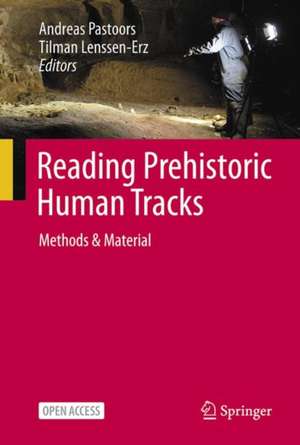
Reading Prehistoric Human Tracks
Editat de Andreas Pastoors, Tilman Lenssen-Erzen Limba Engleză Hardback – 27 feb 2021
Considerăm că Reading Prehistoric Human Tracks reprezintă un punct de cotitură în cercetarea arheologică contemporană, impunând o abordare interdisciplinară care îmbină arheologia de teren, antropologia culturală și ecologia. Volumul corectează o omisiune istorică în studiul artei rupestre: neglijarea contextului natural și a amprentelor umane care însoțesc adesea manifestările artistice din peșteri. Elementul distinctiv al acestei lucrări este fuziunea inovatoare între rigoarea științifică occidentală și expertiza ancestrală a vânătorilor-culegători indigeni, transformând „citirea urmelor” dintr-o abilitate de supraviețuire într-o metodă validată de analiză academică. Structura volumului reflectă o progresie logică de la teorie la aplicație practică. Prima parte explorează diversitatea metodologică, de la analize statistice pedobarografice la experimente de recreare a contextului depozițional. Partea a doua oferă o compilație globală de studii de caz, fiind prima dată când situri cruciale de pe tot globul sunt analizate unitar. Ultima secțiune documentează experiențele cercetătorilor care au lucrat direct cu experți în urmărire, demonstrând modul în care intuiția acestora poate ghida ipotezele arheologice. Această lucrare completează perspectiva oferită de Human Footprints: Fossilised Locomotion? de Matthew R. Bennett, adăugând o dimensiune culturală și indigenă esențială acolo unde volumul menționat se concentra preponderent pe biomecanică și evoluția mersului hominizilor. De asemenea, spre deosebire de Working with Rock Art, care abordează arta rupestră dintr-o perspectivă teoretică, volumul editat de Andreas Pastoors și Tilman Lenssen-Erz oferă instrumente tehnice și metodologice aplicate pentru documentarea urmelor fizice din proximitatea artei preistorice.
Preț: 413.97 lei
Carte disponibilă
Livrare economică 10-24 noiembrie
Livrare express 24-30 octombrie pentru 58.99 lei
Specificații
ISBN-10: 3030604055
Pagini: 452
Ilustrații: XIII, 436 p. 126 illus., 101 illus. in color.
Dimensiuni: 160 x 241 x 29 mm
Greutate: 0.87 kg
Ediția:1st ed. 2021
Editura: Springer
Locul publicării:Cham, Switzerland
De ce să citești această carte
Recomandăm această carte profesioniștilor și studenților la arheologie sau antropologie care doresc să depășească limitele metodelor tradiționale de excavare. Cititorul câștigă acces la un inventar global de urme preistorice și, mai ales, învață cum să integreze cunoștințele comunităților indigene în proiecte de cercetare moderne. Este o resursă rară care tratează amprenta umană nu doar ca pe un rest biologic, ci ca pe un document narativ complex al comportamentului social preistoric.
Despre autor
Andreas Pastoors și Tilman Lenssen-Erz sunt cercetători de renume specializați în arheologia preistorică și arta rupestră, cu o activitate susținută în cadrul unor instituții academice de prestigiu din Germania. Tilman Lenssen-Erz este cunoscut pentru studiile sale extinse asupra ecologiei umane și a peisajelor arheologice din Africa, în timp ce Andreas Pastoors s-a remarcat prin analizele detaliate ale siturilor din Europa paleolitică. Împreună, aceștia au promovat o viziune holistică asupra siturilor arheologice, integrând colaborarea cu experți San din Namibia în descifrarea urmelor umane din peșterile europene, o metodologie care stă la baza acestui volum.
Descriere scurtă
The book gathers first the methodological diversity in the analysis of human tracks. Here major representatives of anthropological, statistical and traditional approaches feature the multi-layered methods available for the analysis of human tracks. Second it compiles case studies from around the globe of prehistoric human tracks. For the first time, the most important sites which have been found worldwide are published in a single publication. The third focus of this book is on firsthand experiences of researchers with indigenous tracking experts from around the globe, expounding on how archaeological sciencecan benefit from the ancestral knowledge.
This book will be of interest to professional archaeologists, graduate students, ecologists, cultural anthropologists and laypeople, especially those focussing on hunting-gathering and pastoralist communities and who appreciate indigenous knowledge.
Cuprins
Notă biografică
Since 2015 he is working at the FAU in Erlangen-Nuremberg as a lecturer and researcher. Among the many excavations and research projects he has led, the co-leadership of the project combining indigenous knowledge with archaeology, "Tracking in Caves" is notable. He publishes his research promptly, which has led not only to a rapid dissemination of the results, but also to an impressive list of publications. In addition to many articles in high-ranking international journals, he has also repeatedly published monographs, which are still considered "great" works within the discipline, since they deal intensively with a specific topic. In addition to his dissertation and habilitation, the genre of sustainable publications, which will certainly retain their value decades after their publication, includes the three fundamental books on the Volp Caves which he co-edited, as well as a number of other conference proceedings published under his direction.
Tilman Lenssen-Erz has a background in African Studies and in Prehistoric Archaeology from which he developed a specialization in African rock art, particularly in Namibia and the Eastern Sahara. Since 1986 he is head of rock art research at the African Archaeology at the University of Cologne, since 2012 he leads the open online African Archaeology Archive Cologne. Besides projects in research data management he is also co-leader of two projects combining indigenous knowledge with archaeology, "Tracking in Caves" and "Indigenous Knowledge and Archaeoinformatics". His research always aims at cooperation with and training of local communities for capacity building.
He has published widely on rock art research with a focus on theoretical and methodological aspects, but also compiling and editing the unique six-tomed catalogue series "The Rock Paintings of the Upper Brandberg".
Caracteristici
Here major representatives of anthropological, statistical and traditional approaches will feature the multi-layered methods available for the analysis of human tracks
the compilation of famous sites on a global scale is an outstanding feature of the book