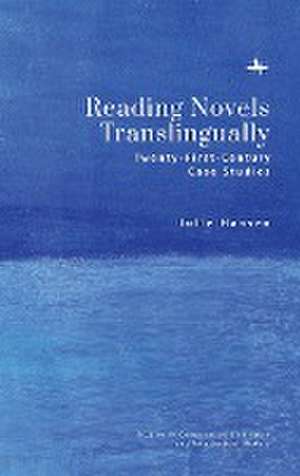
Reading Novels Translingually: Twenty-First-Century Case Studies: Studies in Comparative Literature and Intellectual History
Autor Julie Hansenen Limba Engleză Hardback – 16 ian 2024


Preț: 591.85 lei
Preț vechi: 799.17 lei
-26%
Puncte Express: 888
Carte disponibilă
Livrare economică 06-20 noiembrie
Livrare express 22-28 octombrie pentru 97.83 lei
Livrare prin curier în România Termenul estimat este afișat lângă disponibilitate.
Transport gratuit pentru acest produs Plată online sau ramburs, în funcție de opțiunile comenzii.
Retur gratuit în 14 zile Comandă securizată și suport în română.
Specificații
ISBN-13: 9781644698778
ISBN-10: 1644698773
Pagini: 218
Dimensiuni: 156 x 234 x 14 mm
Greutate: 0.49 kg
Editura: Academic Studies Press
Colecția Academic Studies Press
Seria Studies in Comparative Literature and Intellectual History
ISBN-10: 1644698773
Pagini: 218
Dimensiuni: 156 x 234 x 14 mm
Greutate: 0.49 kg
Editura: Academic Studies Press
Colecția Academic Studies Press
Seria Studies in Comparative Literature and Intellectual History
Cuprins
Acknowledgments
Chapter 1: Introduction: Translingual Reading
Chapter 2: Implied Readers in the Translingual Text: The Case of Olga Grushin’s The Dream Life of Sukhanov
Chapter 3: Translingual Protagonists Go Global
Chapter 4: The Translingual Narrator and Language Gaps: The Case of Zinaida Lindén’s Many Countries Ago
Chapter 5: The Literary Translator as Reader: The Case of Rabih Aladmeddine’s An Unnecessary Woman
Chapter 6: Suspicion and the Suspension of Disbelief in Multilingual Fiction: The Case of a Nordic Suspense Novel
Chapter 7: Code-Switching and Language-Mixing in Lev Tolstoy’s War and Peace
Chapter 8: Reading Between Medieval and Modern: The Case of Eugene Vodolazkin’s Laurus
Chapter 9: Concluding Remarks
Bibliography
Chapter 1: Introduction: Translingual Reading
Chapter 2: Implied Readers in the Translingual Text: The Case of Olga Grushin’s The Dream Life of Sukhanov
Chapter 3: Translingual Protagonists Go Global
Chapter 4: The Translingual Narrator and Language Gaps: The Case of Zinaida Lindén’s Many Countries Ago
Chapter 5: The Literary Translator as Reader: The Case of Rabih Aladmeddine’s An Unnecessary Woman
Chapter 6: Suspicion and the Suspension of Disbelief in Multilingual Fiction: The Case of a Nordic Suspense Novel
Chapter 7: Code-Switching and Language-Mixing in Lev Tolstoy’s War and Peace
Chapter 8: Reading Between Medieval and Modern: The Case of Eugene Vodolazkin’s Laurus
Chapter 9: Concluding Remarks
Bibliography
Recenzii
“Julie Hansen reads novels—by Olga Grushin, Andreï Makine, Michael Idov, Olga Grjasnowa, Zinaida Lindén, Rabih Alameddine, Leo Tolstoy, and Eugene Vodolazkin—translingually, in readings that are incisive, subtle, and supple. Navigating among overlapping instances of multilingualism, translingualism, and translation, she shifts the usual focus from authors to the reading experience. Her novel accounts of how multiple languages challenge and enrich our reading propel Hansen to the forefront of the burgeoning international community of scholars of literary multilingualism.”
— Steven G. Kellman, Author, The Translingual Imagination and Nimble Tongues; Professor of Comparative Literature, University of Texas at San Antonio
“At a moment when we are told that AI and machine translation will wipe away linguistic difference, Julie Hansen points to the importance of literary translingualism: the fertile clash and interaction of languages as her selected authors think and write. Writers are crossing ever more geographical and cultural borders in a globalizing world. Elegantly written, enriched with theoretical sophistication and thoughtful moves of interpretation, Reading Novels Translingually ‘calls on the reader to reflect on language itself.’”
— Sibelan Forrester, Susan W. Lippincott Professor of Modern and Classical Languages and Russian, Swarthmore College
“Julie Hansen’s book makes a significant and original contribution to the growing scholarly debate on literary multilingualism. By bringing to bear concepts of estrangement and reader response to the analysis of multilingual and translingual novels, Hansen opens up a welcome new theoretical perspective. Her wide linguistic repertoire includes not only English, French, German, and Russian, but also the ‘minor’ language Swedish, and her insights apply equally to celebrated literary classics and the popular genre of crime fiction. Another original feature is the attention to translation as an essential component of translingual literature, which brings the book into dialogue with contemporary theories of translation and self-translation.”
— Adrian J. Wanner, Liberal Arts Professor of Slavic Languages and Comparative Literature, Pennsylvania State University
— Steven G. Kellman, Author, The Translingual Imagination and Nimble Tongues; Professor of Comparative Literature, University of Texas at San Antonio
“At a moment when we are told that AI and machine translation will wipe away linguistic difference, Julie Hansen points to the importance of literary translingualism: the fertile clash and interaction of languages as her selected authors think and write. Writers are crossing ever more geographical and cultural borders in a globalizing world. Elegantly written, enriched with theoretical sophistication and thoughtful moves of interpretation, Reading Novels Translingually ‘calls on the reader to reflect on language itself.’”
— Sibelan Forrester, Susan W. Lippincott Professor of Modern and Classical Languages and Russian, Swarthmore College
“Julie Hansen’s book makes a significant and original contribution to the growing scholarly debate on literary multilingualism. By bringing to bear concepts of estrangement and reader response to the analysis of multilingual and translingual novels, Hansen opens up a welcome new theoretical perspective. Her wide linguistic repertoire includes not only English, French, German, and Russian, but also the ‘minor’ language Swedish, and her insights apply equally to celebrated literary classics and the popular genre of crime fiction. Another original feature is the attention to translation as an essential component of translingual literature, which brings the book into dialogue with contemporary theories of translation and self-translation.”
— Adrian J. Wanner, Liberal Arts Professor of Slavic Languages and Comparative Literature, Pennsylvania State University