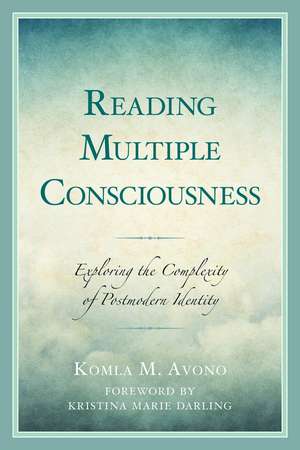
Reading Multiple Consciousness: Exploring the Complexity of Postmodern Identity
Autor Komla M. Avono Cuvânt înainte de Kristina Marie Darlingen Limba Engleză Hardback – 15 dec 2024
Preț: 500.03 lei
Preț vechi: 713.01 lei
-30%
Puncte Express: 750
Carte tipărită la comandă
Livrare economică 30 noiembrie-14 decembrie
Livrare prin curier în România Termenul estimat este afișat lângă disponibilitate.
Transport gratuit pentru acest produs Plată online sau ramburs, în funcție de opțiunile comenzii.
Retur gratuit în 14 zile Comandă securizată și suport în română.
Specificații
ISBN-13: 9781666960730
ISBN-10: 166696073X
Pagini: 110
Dimensiuni: 150 x 230 x 12 mm
Greutate: 0.32 kg
Editura: Bloomsbury Publishing
Colecția Lexington Books
Locul publicării:New York, United States
ISBN-10: 166696073X
Pagini: 110
Dimensiuni: 150 x 230 x 12 mm
Greutate: 0.32 kg
Editura: Bloomsbury Publishing
Colecția Lexington Books
Locul publicării:New York, United States
Cuprins
Acknowledgments
Foreword: Beyond the Self/Other Binary, Kristina Marie Darling
Introduction
Chapter One: Multiple Consciousness: Laye Camara's The Dark Child and Richard Wright's Black Boy
Chapter Two: Audience, Double-Consciousness, and African Teachers of American Literature
Chapter Three: A Hungry Man is a Negro Man: Racializing Poverty in Richard Wright's Black Boy
Chapter Four: The Weakness of Power in Richard Wright's Native Son: Lesson Learned in the Context of American Exceptionalism
Chapter Five: The Black Man's Construction of his Own Invisibility in Ralph Ellison's Invisible Man
Chapter Six: Collecting, Connecting, and Correcting: Vital Steps at the Heart of the Harlem Renaissance
Conclusion: The Poetry of Langston Hughes: An Exceptional Critical Realism
Bibliography
About the Author
Foreword: Beyond the Self/Other Binary, Kristina Marie Darling
Introduction
Chapter One: Multiple Consciousness: Laye Camara's The Dark Child and Richard Wright's Black Boy
Chapter Two: Audience, Double-Consciousness, and African Teachers of American Literature
Chapter Three: A Hungry Man is a Negro Man: Racializing Poverty in Richard Wright's Black Boy
Chapter Four: The Weakness of Power in Richard Wright's Native Son: Lesson Learned in the Context of American Exceptionalism
Chapter Five: The Black Man's Construction of his Own Invisibility in Ralph Ellison's Invisible Man
Chapter Six: Collecting, Connecting, and Correcting: Vital Steps at the Heart of the Harlem Renaissance
Conclusion: The Poetry of Langston Hughes: An Exceptional Critical Realism
Bibliography
About the Author