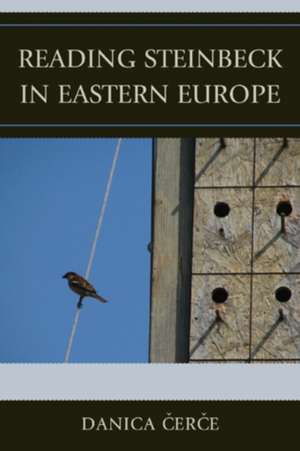
Reading John Steinbeck in Eastern Europe
Autor Danica Cerceen Limba Engleză Paperback – 25 aug 2011
Preț: 304.10 lei
Preț vechi: 402.60 lei
-24%
Puncte Express: 456
Carte tipărită la comandă
Livrare economică 08-22 iunie
Specificații
ISBN-13: 9780761856252
ISBN-10: 0761856250
Pagini: 129
Dimensiuni: 155 x 231 x 8 mm
Greutate: 0.23 kg
Editura: Bloomsbury Publishing
Colecția University Press of America
Locul publicării:New York, United States
ISBN-10: 0761856250
Pagini: 129
Dimensiuni: 155 x 231 x 8 mm
Greutate: 0.23 kg
Editura: Bloomsbury Publishing
Colecția University Press of America
Locul publicării:New York, United States
V-ar putea interesa
-
 Penelope FitzgeraldHermione Lee-19%Preț: 84.96 lei104.72 lei
 -
 -11%Preț: 236.60 lei267.13 lei
 -
 -34%Preț: 705.29 lei1065.94 lei
 -
 The Oxford Handbook of Science FictionRob Latham-29%Preț: 1008.39 lei1423.86 lei
 -
 The Complete Poems of Philip LarkinPhilip LarkinPreț: 188.22 lei
 -
 Writing HomeAlan BennettPreț: 119.28 lei
 -
 The Science Fiction of Cordwainer SmithKaren HelleksonPreț: 221.74 lei
 -
 Ramsey Campbell: Critical Essays on the Modern Master of HorrorGary William Crawford-37%Preț: 644.52 lei1019.99 lei
 -
 Some Desperate GloryMax Egremont-19%Preț: 84.14 lei104.22 lei
 -
 Preț: 89.81 lei
 -
 After the Storm: The Cultural Politics of Hurricane KatrinaSimon Dickel PhD-24%Preț: 250.29 lei327.52 lei
Cuprins
Part 1 Preface
Part 2 Acknowledgments
Part 3 Introduction
Part 4 Part One: Steinbeck and Eastern Europe
Chapter 5 Chapter 1: A Political Reading of Steinbeck's Works in Eastern Europe
Chapter 6 Chapter 2: Steinbeck in the Slovene Cultural Arena: An Overview of Steinbeck Criticism
Chapter 7 Chapter 3: Steinbeck's Influence on Slovene Social Realism
Chapter 8 Chapter 4: About the Slovene Translations
Chapter 9 Chapter 5: The Language of Of Mice and Men as a Challenge for a Translator
Part 10 Part Two: On Specific Works
Chapter 11 Chapter 6: The Grapes of Wrath as Communist Propaganda
Chapter 12 Chapter 7: In Dubious Battle as a lesson of Blind Commitment
Chapter 13 Chapter 8: The Status of East of Eden in Slovenia and the Former Yugoslavia
Part 14 Part Three: A Comparative Reading of John Steinbeck and Frank Hardy
Chapter 15 Chapter 9: Between Admiration and Rejection: On the Parallels between Steinbeck's The Grapes of Wrath and Hardy's Power without Glory
Chapter 16 Chapter 10: The Portrayal of Otherness in Steinbeck's Tortilla Flat and Hardy's 'Borker Stories'
Part 17 Conclusion
Part 18 Works Cited
Part 19 A Bibliography of Works by John Steinbeck
Part 20 Index
Part 2 Acknowledgments
Part 3 Introduction
Part 4 Part One: Steinbeck and Eastern Europe
Chapter 5 Chapter 1: A Political Reading of Steinbeck's Works in Eastern Europe
Chapter 6 Chapter 2: Steinbeck in the Slovene Cultural Arena: An Overview of Steinbeck Criticism
Chapter 7 Chapter 3: Steinbeck's Influence on Slovene Social Realism
Chapter 8 Chapter 4: About the Slovene Translations
Chapter 9 Chapter 5: The Language of Of Mice and Men as a Challenge for a Translator
Part 10 Part Two: On Specific Works
Chapter 11 Chapter 6: The Grapes of Wrath as Communist Propaganda
Chapter 12 Chapter 7: In Dubious Battle as a lesson of Blind Commitment
Chapter 13 Chapter 8: The Status of East of Eden in Slovenia and the Former Yugoslavia
Part 14 Part Three: A Comparative Reading of John Steinbeck and Frank Hardy
Chapter 15 Chapter 9: Between Admiration and Rejection: On the Parallels between Steinbeck's The Grapes of Wrath and Hardy's Power without Glory
Chapter 16 Chapter 10: The Portrayal of Otherness in Steinbeck's Tortilla Flat and Hardy's 'Borker Stories'
Part 17 Conclusion
Part 18 Works Cited
Part 19 A Bibliography of Works by John Steinbeck
Part 20 Index
Recenzii
Cerce's contributions to the world of Steinbeck scholarship have been significant..This book is a most welcome continuation of this insightful author's views on Steinbeck. I recommend it with enthusiasm.
Cerce, a brilliant torchbearer in Steinbeck studies in Slovenia..discloses her unique insight.and analyzes [Steinbeck's works] to find out, beyond ideology, the writer's profound feelings of empathy, compassion and love to the humankind.
Cerce brings in her study a very serious critical attention to John Steinbeck's fiction and discusses it with intelligent conciseness. She throws light on many ethical questions that appear in his works.provid[ing] a relevant commentary on the aesthetic value of Steinbeck's novels and explain[ing]why they have been so popular among our readers.
Cerce, a brilliant torchbearer in Steinbeck studies in Slovenia..discloses her unique insight.and analyzes [Steinbeck's works] to find out, beyond ideology, the writer's profound feelings of empathy, compassion and love to the humankind.
Cerce brings in her study a very serious critical attention to John Steinbeck's fiction and discusses it with intelligent conciseness. She throws light on many ethical questions that appear in his works.provid[ing] a relevant commentary on the aesthetic value of Steinbeck's novels and explain[ing]why they have been so popular among our readers.