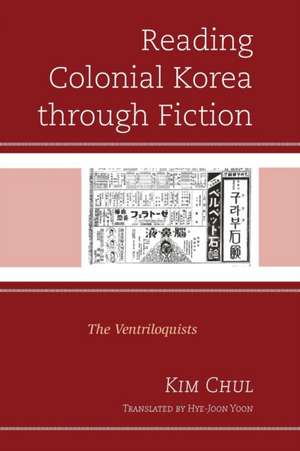
Reading Colonial Korea through Fiction: The Ventriloquists: Critical Studies in Korean Literature and Culture in Translation
De (artist) Kim Chulen Limba Engleză Paperback – 13 aug 2020

Preț: 267.77 lei
Preț vechi: 367.81 lei
-27%
Puncte Express: 402
Carte tipărită la comandă
Livrare economică 23 noiembrie-07 decembrie
Livrare prin curier în România Termenul estimat este afișat lângă disponibilitate.
Transport gratuit de la 400.00 lei Plată online sau ramburs, în funcție de opțiunile comenzii.
Retur gratuit în 14 zile Comandă securizată și suport în română.
Specificații
ISBN-13: 9781498565707
ISBN-10: 1498565700
Pagini: 140
Dimensiuni: 153 x 226 x 10 mm
Greutate: 0.21 kg
Editura: Bloomsbury Publishing
Colecția Lexington Books
Seria Critical Studies in Korean Literature and Culture in Translation
Locul publicării:New York, United States
ISBN-10: 1498565700
Pagini: 140
Dimensiuni: 153 x 226 x 10 mm
Greutate: 0.21 kg
Editura: Bloomsbury Publishing
Colecția Lexington Books
Seria Critical Studies in Korean Literature and Culture in Translation
Locul publicării:New York, United States
V-ar putea interesa
-
 Fiction and the Weave of LifeJohn Gibson-13%Preț: 299.51 lei345.25 lei
 -
 Ruined by Design: Shaping Novels and Gardens in the Culture of SensibilityInger Sigrun BrodeyPreț: 488.38 lei
 -
 Preț: 501.74 lei
 -
 The Cambridge Introduction to Gabriel Garcia MarquezGerald MartinPreț: 214.80 lei
 -
 Preț: 295.25 lei
 -
 Preț: 370.74 lei
 -
 Who's Who in the Western Fiction of Zane GreyJohn DonahuePreț: 389.24 lei
 -
 The Poetry of Thought: From Hellenism to CelanGeorge SteinerPreț: 175.37 lei
 -
 Hit LitJames W. HallPreț: 118.61 lei
 -
 Thomas Pynchon and the Dark Passages of HistoryDavid Cowart-27%Preț: 706.63 lei967.99 lei
 -
 Thomas Pynchon & the Dark Passages of HistoryDavid CowartPreț: 223.23 lei
 -
 The Mystery Fancier (Vol. 5 No. 4) July/August 1981Guy M. TownsendPreț: 62.62 lei
 -
 Postmodern Science Fiction and Temporal ImaginationDr Elana Gomel-25%Preț: 276.19 lei368.54 lei
 -
 Hemingway, Race, and ArtDudleyPreț: 307.56 lei
 -
 Conversations with James EllroyJames Ellroy-23%Preț: 648.87 lei842.69 lei
 -
 For Love and MoneyLaura VivancoPreț: 164.10 lei
 -
 Preț: 120.24 lei
 -
 Read with Me: Best Books for PreschoolersStephanie ZvirinPreț: 190.09 lei
 -
 Hobbit Place-namesRainer NagelPreț: 178.00 lei
 -
 The Broken ScytheRoberto ArduiniPreț: 177.02 lei
Cuprins
Preface, Kim Chul
Note on Romanization
Foreword, Theodore Jun Yoo
Chapter 1: Yo-dokari Tablet: The "Modernity" of Korean Language
Chapter 2: "Oily touches on a canvas, stroking and scattering the pigments": Train Travel and Korean Fiction
Chapter 3: "No o?? yogi wan?" What Brings you here?": Korean Fiction and the Standard Language
Chapter 4: "The law is not afraid of yangban, is it?": Korean Fiction and Modern Law
Chapter 5: "To talk it over in English": Korean Fiction and English
Chapter 6: "Love is blind": Korean Fiction and Eroticism
Chapter 7: "I wish to marry a mainland damsel": Korean Fiction and the "Mainland-Choson Marriage"
Chapter 8: "She who returned like a return postcard": Korean Fiction and the Postal System
Chapter 9: Coffee, Purande, Love Candy, and Nanjji: Culinary Lifestyle and Colonial Modernity
Chapter 10: "The agitators are ?ing me": The Birth of Korean Language
Chapter 11: "Is there any power greater than gold?": Gold and Korean Fiction
Chapter 12: The Colonial Ventriloquists: Choson Writers Writing in Japanese
Chapter 13: "When they've all been stripped naked, no part was good for beating": Korean Fiction and the August 15 Liberation
Afterword, Theodore Hughes
Note on Romanization
Foreword, Theodore Jun Yoo
Chapter 1: Yo-dokari Tablet: The "Modernity" of Korean Language
Chapter 2: "Oily touches on a canvas, stroking and scattering the pigments": Train Travel and Korean Fiction
Chapter 3: "No o?? yogi wan?" What Brings you here?": Korean Fiction and the Standard Language
Chapter 4: "The law is not afraid of yangban, is it?": Korean Fiction and Modern Law
Chapter 5: "To talk it over in English": Korean Fiction and English
Chapter 6: "Love is blind": Korean Fiction and Eroticism
Chapter 7: "I wish to marry a mainland damsel": Korean Fiction and the "Mainland-Choson Marriage"
Chapter 8: "She who returned like a return postcard": Korean Fiction and the Postal System
Chapter 9: Coffee, Purande, Love Candy, and Nanjji: Culinary Lifestyle and Colonial Modernity
Chapter 10: "The agitators are ?ing me": The Birth of Korean Language
Chapter 11: "Is there any power greater than gold?": Gold and Korean Fiction
Chapter 12: The Colonial Ventriloquists: Choson Writers Writing in Japanese
Chapter 13: "When they've all been stripped naked, no part was good for beating": Korean Fiction and the August 15 Liberation
Afterword, Theodore Hughes
Recenzii
Reading Colonial Korea through Fiction: The Ventriloquists introduces to the English-speaking world the work of Kim Chul, one of the leading scholars of modern Korean literature, who has helped to reshape the field of Korean studies on both sides of the Pacific. The thirteen essays anthologized together in the volume give the reader a glimpse into Kim Chul's pioneering scholarship that effectively puts modern 'Korea' under erasure through his unrelenting exploration of 'Korea's' multiplicity, paradoxicality, ambivalence, and contradictions that stem from the imbrications of colonization, modernization, nation-building, and empires. This study, which combines Kim's expansive insights about colonial modernity with his razor-sharp close readings of amazing colonial literary works, is eminently teachable and will make an indispensable companion to numerous related college courses.
Brilliant, learned, provocative-and yes, political and controversial-at last we have an English-language translation of essays by one of the world's most influential and ingenious scholars of Korean language and literature. From train travel and the postal service, to the telephone and the production of the national language, punctuation and dialects; from eroticism to love, intermarriage, and eating, and even the gold rush under total war mobilization-through his highly original readings of these and other traces of everyday life embedded in colonial literature, Kim Chul unveils the impossibility of discovering an unadulterated national language, literature, or culture. His perceptive and deeply informed readings demonstrate that while necessary, critiques of colonialism need not, in fact must not, succumb to the nationalist desire for authenticity and the national pristine. This is a critical and yet hopeful book that should be read by not only those with an interest in the colonial modern in Korea, but by anyone seeking to navigate out of the predicaments of the postcolonial present.
Brilliant, learned, provocative-and yes, political and controversial-at last we have an English-language translation of essays by one of the world's most influential and ingenious scholars of Korean language and literature. From train travel and the postal service, to the telephone and the production of the national language, punctuation and dialects; from eroticism to love, intermarriage, and eating, and even the gold rush under total war mobilization-through his highly original readings of these and other traces of everyday life embedded in colonial literature, Kim Chul unveils the impossibility of discovering an unadulterated national language, literature, or culture. His perceptive and deeply informed readings demonstrate that while necessary, critiques of colonialism need not, in fact must not, succumb to the nationalist desire for authenticity and the national pristine. This is a critical and yet hopeful book that should be read by not only those with an interest in the colonial modern in Korea, but by anyone seeking to navigate out of the predicaments of the postcolonial present.