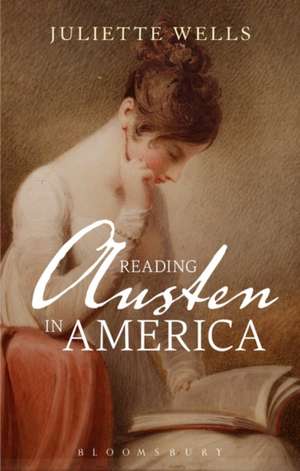
Reading Austen in America: Bloomsbury 3PL
Autor Juliette Wellsen Limba Engleză Paperback – 5 oct 2017
| Toate formatele și edițiile | Preț | Express |
|---|---|---|
| Paperback (1) | 156.58 lei 3-5 săpt. | |
| Bloomsbury Publishing – 5 oct 2017 | 156.58 lei 3-5 săpt. | |
| Hardback (1) | 448.87 lei 6-8 săpt. | |
| BLOOMSBURY 3PL – 5 oct 2017 | 448.87 lei 6-8 săpt. |
Din seria Bloomsbury 3PL
- 46%
 Preț: 503.55 lei
 - 22%
 Preț: 245.25 lei
 - 34%
 Preț: 734.15 lei
 - 21%
 Preț: 154.28 lei
 - 14%
 Preț: 127.89 lei
 - 19%
 Preț: 147.54 lei
 - 23%
 Preț: 257.89 lei
 - 34%
 Preț: 794.74 lei
 - 34%
 Preț: 796.90 lei
 - 34%
 Preț: 797.12 lei
 - 34%
 Preț: 736.16 lei
 - 24%
 Preț: 167.38 lei
 - 34%
 Preț: 734.25 lei
 - 34%
 Preț: 733.41 lei
 - 18%
 Preț: 309.72 lei
 - 46%
 Preț: 503.74 lei
 - 52%
 Preț: 70.20 lei
 - 44%
 Preț: 71.43 lei
 - 14%
 Preț: 121.03 lei
 - 46%
 Preț: 967.69 lei
 - 34%
 Preț: 734.63 lei
 - 34%
 Preț: 796.95 lei
 - 18%
 Preț: 163.96 lei
 - 18%
 Preț: 165.41 lei
 - 34%
 Preț: 796.92 lei
 - 19%
 Preț: 311.53 lei
 - 49%
 Preț: 62.95 lei
 - 34%
 Preț: 795.27 lei
 - 19%
 Preț: 74.75 lei
 - 34%
 Preț: 794.11 lei
 - 19%
 Preț: 318.31 lei
 - 34%
 Preț: 795.09 lei
 - 26%
 Preț: 264.65 lei
 - 23%
 Preț: 267.52 lei
 - 46%
 Preț: 502.66 lei
 - 23%
 Preț: 162.66 lei
 - 46%
 Preț: 505.01 lei
 - 19%
 Preț: 147.73 lei
 - 21%
 Preț: 222.40 lei
 - 20%
 Preț: 229.43 lei
 - 34%
 Preț: 798.52 lei
 - 34%
 Preț: 796.90 lei
 - 23%
 Preț: 163.21 lei
 - 34%
 Preț: 735.55 lei
 - 23%
 Preț: 178.43 lei
 - 23%
 Preț: 264.64 lei
 - 34%
 Preț: 793.17 lei
 - 34%
 Preț: 737.01 lei
 - 34%
 Preț: 795.06 lei
 - 34%
 Preț: 736.10 lei
Preț: 156.58 lei
Preț vechi: 192.00 lei
-18%
Puncte Express: 235
Preț estimativ în valută:
27.69€ • 32.49$ • 24.02£
27.69€ • 32.49$ • 24.02£
Carte disponibilă
Livrare economică 17 februarie-03 martie
Specificații
ISBN-13: 9781350012042
ISBN-10: 1350012041
Pagini: 256
Ilustrații: 17 bw illus
Dimensiuni: 138 x 214 x 10 mm
Greutate: 0.3 kg
Editura: Bloomsbury Publishing
Colecția Bloomsbury 3PL
Seria Bloomsbury 3PL
Locul publicării:London, United Kingdom
ISBN-10: 1350012041
Pagini: 256
Ilustrații: 17 bw illus
Dimensiuni: 138 x 214 x 10 mm
Greutate: 0.3 kg
Editura: Bloomsbury Publishing
Colecția Bloomsbury 3PL
Seria Bloomsbury 3PL
Locul publicării:London, United Kingdom
V-ar putea interesa
-
 Charlotte MewPenelope FitzgeraldPreț: 75.38 lei
 -
 The Bronte MythLucasta Miller-21%Preț: 70.64 lei88.96 lei
 -
 W. B. Yeats, A Life I: The Apprentice Mage 1865-1914R. F. Foster-12%Preț: 274.37 lei311.04 lei
 -
 -24%Preț: 348.05 lei456.73 lei
 -
 Romanticism: An Oxford GuideNicholas Roe-18%Preț: 398.43 lei485.76 lei
 -
 Charlotte Brontë: The Imagination in HistoryHeather Glen-14%Preț: 326.57 lei378.83 lei
 -
 A Rage To Live: A Biography of Richard and Isabel BurtonMary S. Lovell-26%Preț: 103.17 lei139.73 lei
 -
 Preț: 55.29 lei
 -
 Fiery HeartNicholas RoePreț: 121.63 lei
 -
 Wuthering Heights: Character StudiesDr Melissa Fegan-19%Preț: 148.11 lei182.51 lei
 -
 York Notes Companions: Romantic LiteratureJohn GilroyPreț: 87.66 lei
 -
 From Balzac to Zola: Selected Short StoriesRichard Hobbs-18%Preț: 155.21 lei190.14 lei
 -
 The PoemsW. B. YeatsPreț: 142.65 lei
Cuprins
List of Illustrations
List of Abbreviations
Introduction
Part 1: The 1816 Philadelphia Emma and Its Readers
Chapter One The Origins of the First Austen Novel Printed in America
What did it mean to "reprint" Emma?
Who was "M. Carey," and why did he choose Emma?
When in 1816 was Carey's Emma published, and how many copies were issued?
How did the Philadelphia Emma compare to the London edition, and why have so few copies of the American edition survived?
How did readers first become aware of Carey's Emma?
How did Americans first learn of Austen's authorship?
Chapter Two Tales of Three Copies: Books, Owners, and Readers
Lovers of books, if not of Austen: the du Pont sisters of Delaware
A careful and curious reader: Jeremiah Smith of New
Hampshire
Unimpressed by Emma: subscribers to a Rhode Island circulating
library
Chapter Three An Accomplished Scotswoman Reads Austen Abroad:
Christian, Countess of Dalhousie in British North America
Plants, drawing, reading, riddles: girlhood education
A literary marriage
Encounters with Austen's novels during a "transatlantic life"
Reading tastes and book acquisition
Part 2: Transatlantic Austen Conversations
Chapter Four Enthusiasts Connected Through the "Electric Telegraph of Genius":
The Quincy Sisters of Boston and the Francis W. Austen family of Portsmouth
Recommended reading and fertile imaginations
Admirers, rewarded with a relic, envision a society of devotees
Two families meet during Anna's literary pilgrimage
Americans contribute to Austen's international fame
Chapter Five Collectors and Bibliographers:
Alberta H. Burke of Baltimore and David J. Gilson of Oxford
Unusual approaches to collecting Austen
Balancing erudition with enthusiasm
Appendix: Census of Surviving Copies of the 1816 Philadelphia Emma
Bibliography
List of Abbreviations
Introduction
Part 1: The 1816 Philadelphia Emma and Its Readers
Chapter One The Origins of the First Austen Novel Printed in America
What did it mean to "reprint" Emma?
Who was "M. Carey," and why did he choose Emma?
When in 1816 was Carey's Emma published, and how many copies were issued?
How did the Philadelphia Emma compare to the London edition, and why have so few copies of the American edition survived?
How did readers first become aware of Carey's Emma?
How did Americans first learn of Austen's authorship?
Chapter Two Tales of Three Copies: Books, Owners, and Readers
Lovers of books, if not of Austen: the du Pont sisters of Delaware
A careful and curious reader: Jeremiah Smith of New
Hampshire
Unimpressed by Emma: subscribers to a Rhode Island circulating
library
Chapter Three An Accomplished Scotswoman Reads Austen Abroad:
Christian, Countess of Dalhousie in British North America
Plants, drawing, reading, riddles: girlhood education
A literary marriage
Encounters with Austen's novels during a "transatlantic life"
Reading tastes and book acquisition
Part 2: Transatlantic Austen Conversations
Chapter Four Enthusiasts Connected Through the "Electric Telegraph of Genius":
The Quincy Sisters of Boston and the Francis W. Austen family of Portsmouth
Recommended reading and fertile imaginations
Admirers, rewarded with a relic, envision a society of devotees
Two families meet during Anna's literary pilgrimage
Americans contribute to Austen's international fame
Chapter Five Collectors and Bibliographers:
Alberta H. Burke of Baltimore and David J. Gilson of Oxford
Unusual approaches to collecting Austen
Balancing erudition with enthusiasm
Appendix: Census of Surviving Copies of the 1816 Philadelphia Emma
Bibliography
Recenzii
Juliette Wells creates living portraits of Austen's earliest American readers and admirers and of their devotion to a novelist who would gradually become known and beloved around the world.
Combining the narrative history of biography with the detail of the collector, Wells weaves a story that charms and interests even despite (and likely because of) its rather immediate, dare one say, nerdiness (and one says such a thing with both respect and appreciation) . It is an intriguing mode of both history and historiography, and one that the young Jane Austen would likely have found rather compelling.
Austenites and bibliophiles will enjoy this survey from Wells (Everybody's Jane) of the early American response to Jane Austen . Details about early American publishing make up a great deal of the book's early sections and provide fascinating insight into the reading habits of the country . There's.much to delight in throughout this book.
With useful notes, appendixes, and fascinating photos, this book is sure to appeal to Jane Austen Society of North America members, students, academics, and anyone interested in a case study of early American publishing and readers.
Wells has produced a ?ne analysis of the Philadelphia Emma from 1816, of which only six copies are known to have survived ... Wells has contributed a fascinating and fruitful piece of research into the history of the American reception of Austen's novels.
In presenting facets of Wells' current scholarship, readers will welcome this 'collected' volume. Judging from the 'fandom' of the Quincys and library patrons, reader reception can provide fascinating insights. These entertaining personal histories will open more eyes to the possibilities behind unearthing copies of the 1816 Philadelphia Emma.
Through meticulous research into how an audience for Austen's writings developed and spread, [Wells] details the responses made by a diverse readership - the passionate, the obsessive, the bewildered and the unenthusiastic ... I encourage you to buy this book and read every word.
This is a very accessible book, written with a clear and engaging style,
with enough scholarly detail to interest the academic, and references and
endnotes a-plenty for those interested in following up her research, but
with a strong focus on individual stories of American readers that would
prove interesting even to those with no enthusiasm for Austen herself.
More readers of Jane Austen live outside of Great Britain than within its borders; more Austen novels circulate around the globe than within the island of her birth. Juliette Wells's fascinating Reading Austen in America sets the standard for Austen studies for coming decades, as we begin to reckon Austen's influence and legacy outside of Britain. Wells handles with grace a blend of archival research, book history and delightful anecdote, reshaping as she does so many long-held assumptions about Austen, the novel and the commitments a reader makes.
A welcome addition to Austen scholarship, Juliette Wells' Reading Austen in America contributes to book history, history of the book trade, and reception history. Painstakingly following the first publication of Austen's in America-the 1816 Philadelphia Emma-through its various owners and readers over the next century and a half, Wells contributes to our understanding of the growth of Austen's international reputation. Meticulously researched and lavishly illustrated, Reading Austen in America is a pleasure to read.
Combining the narrative history of biography with the detail of the collector, Wells weaves a story that charms and interests even despite (and likely because of) its rather immediate, dare one say, nerdiness (and one says such a thing with both respect and appreciation) . It is an intriguing mode of both history and historiography, and one that the young Jane Austen would likely have found rather compelling.
Austenites and bibliophiles will enjoy this survey from Wells (Everybody's Jane) of the early American response to Jane Austen . Details about early American publishing make up a great deal of the book's early sections and provide fascinating insight into the reading habits of the country . There's.much to delight in throughout this book.
With useful notes, appendixes, and fascinating photos, this book is sure to appeal to Jane Austen Society of North America members, students, academics, and anyone interested in a case study of early American publishing and readers.
Wells has produced a ?ne analysis of the Philadelphia Emma from 1816, of which only six copies are known to have survived ... Wells has contributed a fascinating and fruitful piece of research into the history of the American reception of Austen's novels.
In presenting facets of Wells' current scholarship, readers will welcome this 'collected' volume. Judging from the 'fandom' of the Quincys and library patrons, reader reception can provide fascinating insights. These entertaining personal histories will open more eyes to the possibilities behind unearthing copies of the 1816 Philadelphia Emma.
Through meticulous research into how an audience for Austen's writings developed and spread, [Wells] details the responses made by a diverse readership - the passionate, the obsessive, the bewildered and the unenthusiastic ... I encourage you to buy this book and read every word.
This is a very accessible book, written with a clear and engaging style,
with enough scholarly detail to interest the academic, and references and
endnotes a-plenty for those interested in following up her research, but
with a strong focus on individual stories of American readers that would
prove interesting even to those with no enthusiasm for Austen herself.
More readers of Jane Austen live outside of Great Britain than within its borders; more Austen novels circulate around the globe than within the island of her birth. Juliette Wells's fascinating Reading Austen in America sets the standard for Austen studies for coming decades, as we begin to reckon Austen's influence and legacy outside of Britain. Wells handles with grace a blend of archival research, book history and delightful anecdote, reshaping as she does so many long-held assumptions about Austen, the novel and the commitments a reader makes.
A welcome addition to Austen scholarship, Juliette Wells' Reading Austen in America contributes to book history, history of the book trade, and reception history. Painstakingly following the first publication of Austen's in America-the 1816 Philadelphia Emma-through its various owners and readers over the next century and a half, Wells contributes to our understanding of the growth of Austen's international reputation. Meticulously researched and lavishly illustrated, Reading Austen in America is a pleasure to read.