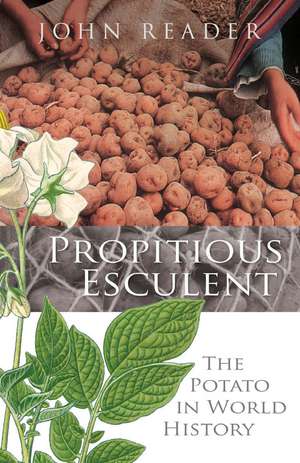
Reader, J: Propitious Esculent
Autor John Readeren Limba Engleză Paperback – 6 feb 2008
Baked, roasted, boiled, mashed, steamed, french-fried — the potato is one of the most familiar and ubiquitous foods we have, and part of our sense of humble, mundane normality. But the story of the solarum tuberosum is one of struggle, disease and survival.
Naturally fat-free, potatoes consist mainly of energy-giving carbohydrates, as well as protein and half of our RDA of Vitamin C and Potassium. People have been known to sustain active lives for months fuelled only by potatoes and a little margarine. These bundles of nutrition, which grow safely and cheaply underground in almost any weather and soil conditions, have fuelled industrial revolutions and population explosions. Reader follows the potato’s fascinating journey, from its origins and evolution in the Andes thousands of years ago, to its slightly mysterious arrival in Europe where it became a crucial part of the gastronomic and social fabric.
2008 has been designated International Year of the Potato by the UN and, as global population swells and famine remains a constant risk, Reader asks what role the spud still has to play.
Preț: 115.35 lei
Puncte Express: 173
Carte disponibilă
Livrare economică 06-20 august
Livrare express 22-28 iulie pentru 32.17 lei
Livrare prin curier în România Termenul estimat este afișat lângă disponibilitate.
Transport gratuit de la 400.00 lei Plată online sau ramburs, în funcție de opțiunile comenzii.
Retur gratuit în 14 zile Comandă securizată și suport în română.
Specificații
ISBN-13: 9780434018369
ISBN-10: 0434018368
Pagini: 336
Ilustrații: 16 ILLUSTRATIONS
Dimensiuni: 152 x 233 x 26 mm
Greutate: 0.48 kg
Editura: Cornerstone
ISBN-10: 0434018368
Pagini: 336
Ilustrații: 16 ILLUSTRATIONS
Dimensiuni: 152 x 233 x 26 mm
Greutate: 0.48 kg
Editura: Cornerstone
V-ar putea interesa
-
 The Untold History of the PotatoJohn Reader-39%Preț: 72.90 lei119.15 lei
 -
 Plant PathologyGeorge N. Agrios-21%Preț: 591.93 lei749.28 lei
 -
 AfricaJohn Reader-19%Preț: 110.28 lei135.90 lei
 -
 Social Motivations for Codeswitching: Evidence from AfricaCarol Myers-Scotton-20%Preț: 430.88 lei535.32 lei
 -
 Plant Biotechnology: The genetic manipulation of plantsAdrian Slater-22%Preț: 407.23 lei520.58 lei
 -
 Lichens of North AmericaIrwin M. Brodo-9%Preț: 855.95 lei940.61 lei
 -
 The Names of PlantsDavid GledhillPreț: 451.73 lei
 -
 Plant BiologyAlison M. Smith-9%Preț: 669.20 lei735.38 lei
 -
 Preț: 306.45 lei
Notă biografică
John Reader is an author and photojournalist. He holds fellowships in the Department of Anthropology at University College London, the Royal Anthropological Institute and the Royal Geographic Society.