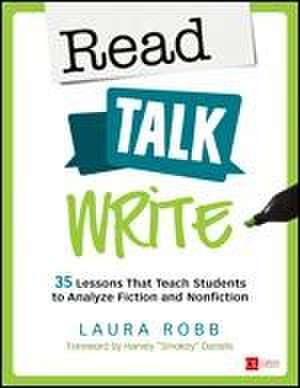
Read, Talk, Write
Autor Laura Robben Limba Engleză Paperback – 16 sep 2016
Evoluția metodologiilor educaționale din ultimele decenii indică o tranziție clară de la predarea fragmentată a competențelor lingvistice către un model integrat, în care alfabetizarea este privită ca un proces fluid. În acest context, considerăm că lucrarea Read, Talk, Write semnată de Laura J Robb reprezintă un instrument esențial pentru cadrele didactice care doresc să depășească barierele tradiționale dintre lectură și producția de text. Notăm cu interes modul în care autoarea structurează interacțiunea din sala de clasă, plasând dialogul („talk”) ca element central care facilitează trecerea de la descifrarea sensului la articularea propriilor idei în scris. Această ediție publicată de SAGE Publications oferă un cadru metodologic riguros, axat pe strategii care încurajează elevii să exploreze textele în profunzime înainte de a trece la redactare. Putem afirma că volumul este comparabil cu Using Talk to Support Writing de Ros Fisher în ceea ce privește rigoarea analizei interfeței dintre limbajul oral și cel scris, dar Read, Talk, Write este actualizat pentru cerințele curriculare contemporane, punând un accent sporit pe autonomia elevului și pe diversitatea genurilor textuale abordate. Spre deosebire de abordările pur tehnice, Laura J Robb propune o pedagogie a sensului, transformând scrierea dintr-o obligație școlară într-un act de comunicare autentic.
Preț: 274.88 lei
Carte tipărită la comandă
Livrare economică 28 decembrie 26 - 11 ianuarie 27
Specificații
ISBN-10: 1506339573
Pagini: 274
Dimensiuni: 216 x 280 x 15 mm
Greutate: 0.7 kg
Editura: Corwin
De ce să citești această carte
Această resursă este esențială pentru profesorii și studenții la pedagogie care caută metode practice de a integra lectura și scrierea prin dialog. Cititorul câștigă strategii concrete pentru a activa gândirea critică a elevilor și pentru a îmbunătăți calitatea textelor produse la clasă. Este o recomandare solidă pentru cine dorește să transforme ora de limba engleză sau literatură într-un spațiu de învățare colaborativ și dinamic.
Notă biografică
Cuprins
Acknowledgments
Aim 1. Introduce Students to Six Types of Comprehension-Building Conversations
Chapter 1. Talking About Texts: Getting Started
Lessons and Texts to Take Students From Talk to Literary Conversation
Five Benefits of Student-Centered Talk
Benefit 1: Talk Supports Recall and Comprehension
Benefit 2: Talk Engages and Motivates
Benefit 3: Interactive Talk Becomes a Model for In-the-Head Conversations
Benefit 4: Talk Activates Ideas for Writing About Reading
Benefit 5: Talk Changes How Students Think and Feel About Fiction and Nonfiction
The Research Support
Coming Full Circle With Literature Circles
Types of Talk and How They Fit Into the Lessons
Initiating Talk With Questions and Prompts
How to Craft Guiding Questions
How to Teach Students to Compose Interpretive Questions
Making Student Talk Productive
How to Build Trust
How to Help Students Initiate Discussion
How to Teach Students to Listen Actively
How to Use the Fishbowl Technique
How to Use Smart Notebooks
What's Ahead
Reflect on Your Teaching
Chapter 2. Lessons for Teaching Six Types of Talk
How Literary Conversations Help Students
Texts for Talk-Based Reading Lessons
When to Use the Six Types
Tips for Managing Literary Conversations
Offer Prompts That Keep a Discussion Moving Forward
Provide a Timeframe
Reflect and Intervene
Set a Signal for Closing a Discussion
Lesson 2.1: Turn-and-Talk
Lesson in Action: Turn-and-Talk
Lesson 2.2: Whole-Class Discussions
Lesson in Action: Whole-Class Discussions
Lesson 2.3: Partner Talk
Lesson in Action: Partner Talk
Lesson 2.4: Small-Group Discussions
Lesson in Action: Small-Group Discussions
Lesson 2.5: In-the-Head Conversations
Lesson in Action: In-the-Head Conversations
Lesson 2.6: Teacher-Student Discussions
Lesson in Action: Teacher-Student Discussions
Chapter 3. Lessons That Build Comprehension Skills in Any Genre
Step 1: Mine Texts for Teaching Topics
Step 2: Plan Lessons
Step 3: Develop Effective Assessments
Ten Top-Notch Short Texts and Lessons
Getting-Ready Tips
Lesson 3.1: Inferring With Informational Text
Lesson 3.2: Exploring Interpretative Questions: Biography
Lesson 3.3: Determining the Author's Purpose: Informational Text
Lesson 3.4: Why Characters Change: Small-Group Discussion Using a Short Story
Lesson 3.5: Prompting In-the-Head Conversations: Biography
Lesson 3.6: Teacher-Student Talk: Conferring
Reproducible Fiction and Nonfiction Texts
"Coming Clean" by Anina Robb
"Defying Gravity: Mae Jemison" by Anina Robb
"Hoops Tryouts" by Anina Robb
"How Ada Lovelace Leaped Into History" by Kathleen Krull
"How Athens Got Its Name" Retelling by Joanna Davis-Swing
"Isaac Newton and the Day He Discovered the Rainbow" by Kathleen Krull
"Making Scientists Into Climbers" (Excerpt From Secrets of the Sky Caves: Danger and Discovery on Nepal's Mustang Cliffs) by Sandra Athans
"New Horizons in Space" by Seymour Simon
"Snow Day" by Priscilla Cummings
"Who Climbs Everest?" (Excerpt From Tales From the Top of the World: Climbing Mount Everest With Pete Athans) by Sandra Athans
Aim 2. Teach Students to Read, Talk, and Write About Fiction
Chapter 4. Taking the Plunge: How to Talk and Write About Fiction
Exploring and Analyzing Fiction With Literary Elements
Building Knowledge of Key Literary Techniques
Some Key Literary Devices
Encouraging Students to Discuss Literary Elements and Techniques
Characteristics of Fictional Genres
From Talk to Writing
Brief Writing Tasks to Follow Talk
Writing About Reading
Model Lesson: The Importance of Inferring: "Snow Day" by Priscilla Cummings
Reflect on Your Teaching
Chapter 5. Going Deeper: How to Analyze Literary Elements
Offer Students Guided Practice
Moving From Talking to Writing
Literary Elements and Five Kinds of Conflict
Bundling Literary Elements
Teaching Tips for Literature-Based Lessons
Lesson 5.1: Protagonist and Antagonists
Model Lesson 5.1: Teaching Protagonist and Antagonists: "Hoops Tryouts" by Anina Robb
Lesson 5.2: Conflict, Plot, and Setting
Model Lesson 5.2: Teaching Conflict, Plot, and Setting: "Coming Clean" by Anina Robb
Lesson 5.3: Identifying Themes
Model Lesson 5.3: Teaching Theme: "Snow Day" by Priscilla Cummings
Lesson 5.4: Planning and Writing a Summary: Fiction
Model Lesson 5.4: Teaching Summary: Fiction: "Hoops Tryouts" by Anina Robb
Lesson 5.5: Compare and Contrast Notes
Model Lesson 5.5: Teaching Compare and Contrast Notes: "How Athens Got Its Name" Retelling by Joanna Davis-Swing
Aim 3. Teach Students to Read, Talk, and Write About Nonfiction
Chapter 6. Taking the Plunge: How to Talk and Write About Nonfiction
Seven Tips for Inspiring Students to Have Literary Conversations About Nonfiction
Teach Six Kinds of Context Clues
Lesson 6.1: Mining Text Features for Information
Identifying Text Structures to Build Understanding
Lesson 6.2: Teaching Text Structures
From Talk to Writing
Understanding the Structure of Nonfiction Genres
Reflect on Your Teaching
Chapter 7. Going Deeper: How to Analyze Nonfiction
Teaching Tips for Text-Based Lessons
Lesson 7.1: Taking Heading Notes and Finding a Main Idea
Model Lesson 7.1: Taking Heading Notes and Finding a Main Idea: "Who Climbs Everest?" (Excerpt From Tales From the Top of the World) by Sandra Athans
Lesson 7.2: Thinking About Issues: Obstacles
Model Lesson 7.2: Teaching About Obstacles: "How Ada Lovelace Leaped Into History" by Kathleen Krull
Lesson 7.3: Teaching the Problem-Solution Text Structure
Model Lesson 7.3: Teaching Problem-Solution: "New Horizons in Space" by Seymour Simon
Lesson 7.4: Personality Traits and a Person's Achievements: Biography
Model Lesson 7.4: Teaching Personality Traits: "Defying Gravity: Mae Jemison" by Anina Robb and "Isaac Newton and the Day He Discovered the Rainbow" by Kathleen Krull
Lesson 7.5: Identifying Main Ideas
Model Lesson 7.5a: Teaching Explicitly Stated Main Ideas: "Who Climbs Everest?" (Excerpt From Tales From the Top of the World) by Sandra Athans
Model Lesson 7.5b: Teaching How to Infer Main Ideas: "Defying Gravity: Mae Jemison" by Anina Robb
Chapter 8. Reflecting on the Process of Read, Talk, Write
Four Key Skills
Skill 1: Taking Risks
Skill 2: Creativity
Skill 3: Empathy
Skill 4: The Ability to Negotiate
Writing Is Knowing
Making the Changeover
Take the First Steps
Climb That First Hill
Start Slowly Down the Hill
Continue Moving Along the Path
Picture Your Destination
Make a Teaching Investment With Student Paybacks
List of Top-Notch Books for Instruction and Class Libraries
Bibliography of Professional Materials
Index