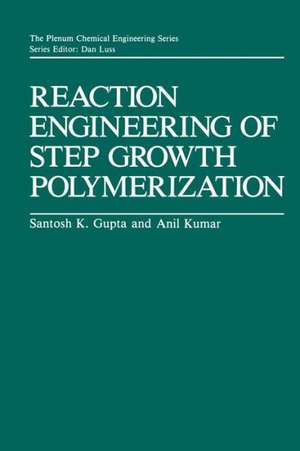
Reaction Engineering of Step Growth Polymerization: The Plenum Chemical Engineering Series
Autor Santosh K. Gupta, Ajit Kumaren Limba Engleză Paperback – 21 dec 2011
Preț: 384.13 lei
Puncte Express: 576
Carte tipărită la comandă
Livrare economică 16-30 noiembrie
Livrare prin curier în România Termenul estimat este afișat lângă disponibilitate.
Transport gratuit de la 400.00 lei Plată online sau ramburs, în funcție de opțiunile comenzii.
Retur gratuit în 14 zile Comandă securizată și suport în română.
Specificații
ISBN-13: 9781461290087
ISBN-10: 1461290082
Pagini: 448
Ilustrații: 444 p.
Dimensiuni: 152 x 229 x 25 mm
Greutate: 0.64 kg
Ediția:Softcover reprint of the original 1st ed. 1987
Editura: Springer
Colecția The Plenum Chemical Engineering Series
Seria The Plenum Chemical Engineering Series
Locul publicării:New York, NY, United States
ISBN-10: 1461290082
Pagini: 448
Ilustrații: 444 p.
Dimensiuni: 152 x 229 x 25 mm
Greutate: 0.64 kg
Ediția:Softcover reprint of the original 1st ed. 1987
Editura: Springer
Colecția The Plenum Chemical Engineering Series
Seria The Plenum Chemical Engineering Series
Locul publicării:New York, NY, United States
V-ar putea interesa
-
 Electronic and Optical Properties of Conjugated PolymersWilliam Barford-23%Preț: 459.73 lei593.21 lei
 -
 Interfacial Science: An IntroductionGeoffrey Barnes-22%Preț: 394.35 lei503.73 lei
 -
 The Equilibrium Theory of Inhomogeneous PolymersGlenn Fredrickson-25%Preț: 597.69 lei797.98 lei
 -
 Polymer Dynamics and RelaxationRichard BoydPreț: 388.40 lei
 -
 -9%Preț: 1216.53 lei1336.84 lei
 -
 Surface Chemistry of SurfactanKronberg-8%Preț: 681.77 lei741.06 lei
 -
 Polyurethane Casting PrimerI.R. Clemitson-18%Preț: 1467.42 lei1789.53 lei
 -
 Polymer Phase BehaviorTimothy P Ehlers-26%Preț: 1255.05 lei1706.19 lei
Public țintă
ResearchCuprins
1. Introduction.- 1.1. Step and Chain Growth Polymerizations.- 1.2. Step Growth Polymerization.- 1.3. Molecular Weight Distribution.- 1.4. Measurement of MWD and Its Moments.- 1.5. Types of Reactors.- 1.6. Conclusions.- References.- Exercises.- 2. Linear Step Growth Polymerization Following the Equal Reactivity Hypothesis.- 2.1. Introduction.- 2.2. Rate Constants for Elementary Step Growth Polymerization Reactions.- 2.3. Equal Reactivity Hypothesis.- 2.4. Kinetic Model of Irreversible Step Growth Polymerization under the Equal Reactivity Hypothesis.- 2.5. Experimental Verification of the Kinetic Model.- 2.6. Irreversible ARB Polymerizations with Monofunctional Compounds in Batch Reactors.- 2.7. Polymerization in Plug Flow Reactors (PFR) with Recycle.- 2.8. ARB Polymerization in Homogeneous Continuous-Flow Stirred Tank Reactors (HCSTRs).- 2.9. Reversible ARB Polymerization.- 2.10. Conclusions.- Appendix 2.1. Moment Generation Function.- References.- Exercises.- 3. Linear Step Growth Polymerization Violating the Equal Reactivity Hypothesis.- 3.1. Introduction.- 3.2. Irreversible ARB Polymerization with Oligomers Having Chain Length Dependent Reactivity.- 3.3. Reversible Step Growth Polymerization with Oligomers Having Chain Length Dependent Reactivity.- 3.4. Step Growth Polymerization Involving Asymmetric Functional Groups.- 3.5. Conclusions.- References.- Exercises.- 4. Nonlinear Step Growth Polymerization.- 4.1. Introduction.- 4.2. Average Molecular Weights and the Onset of Gelation in Batch Reactors.- 4.3. Postgel Properties for Nonlinear Polymerizations in Batch Reactors.- 4.4. Effect of Unequal Reactivity of Functional Groups.- 4.5. Experimental Results.- 4.6. Kinetic Approach in the Polymerization of RAf in Batch Reactors.- 4.7. Intramolecular Reactions in NonlinearPolymerization.- 4.8. Nonlinear Step Growth Polymerization in HCSTRs.- 4.9. Conclusions.- References.- Exercises.- 5. Mass Transfer in Step Growth Polymerization.- 5.1. Introduction.- 5.2. Polymerization with Negligible Mass Transfer Resistance (Semibatch Reactors).- 5.3. Polymerization with Finite Mass Transfer Resistance.- 5.4. Finishing Reactors.- 5.5. Step Growth Polymerizations at High Conversions.- 5.6. Conclusions.- References.- Exercises.- 6. Optimal Control of Step Growth Polymerizations.- 6.1. Introduction.- 6.2. The Basic Algorithm.- 6.3. Optimization of ARB Polymerization in Batch Reactors.- 6.4. Optimization of Irreversible ARB Polymerizations in HCSTRs.- 6.5. Periodic Operation of HCSTRs.- 6.6. Conclusions.- References.- Exercises.- 7. Nylon Reactors.- 7.1. Introduction.- 7.2. Polymerization of ?-Caprolactam.- 7.3. Hydrolytic Polymerization of ?-Caprolactam in Batch Reactors.- 7.4. Nylon 6 Polymerization in Isothermal Recycle Reactors.- 7.5. Nylon 6 Polymerization in HCSTRs and in Cascades of Reactors.- 7.6. Effect of Nonidealities.- 7.7. Simulation of Industrial Reactors.- 7.8. Optimization of Nylon 6 Reactors.- 7.9. Cyclization Reactions in Nylon 6 Polymerization.- 7.10. Polymerization of Nylon-6,6.- 7.11. Conclusions.- References.- Exercises.- 8. Polyester Reactors.- 8.1. Introduction.- 8.2. Transesterification Stage of PET Formation from Dimethyl Terephthalate.- 8.3. Optimization of Ester Interchange Reactor.- 8.4. Direct Esterification of Terephthalic Acid.- 8.5. Polycondensation Step (Second Stage) of PET Formation.- 8.6. Wiped Film Reactors for the Final Stages of PET Formation.- 8.7. Unsaturated Polyester.- 8.8. Conclusions.- Appendix 8.1. Orthogonal Collocation Technique for the Solution of Partial Differential Equations.- References.-Exercises.- 9. Urethane Polymers and Reaction Injection Molding.- 9.1. Introduction.- 9.2. Modeling of Cross-Linked Polyurethane Formation.- 9.3. Gelation.- 9.4. Approximate Rate Expression for Urethane Formation.- 9.5. Reaction Injection Molding.- 9.6. Impingement Mixing in RIM.- 9.7. Filling and Curing in Molds in RIM.- 9.8. Conclusions.- References.- Exercises.- 10. Epoxy Polymers.- 10.1. Introduction.- 10.2. Taffy Process.- 10.3. Advancement Process.- 10.4. Curing of Epoxies.- 10.5. Conclusions.- References.- Exercises.- 11. Polymerization with Formaldehyde.- 11.1. Introduction.- 11.2. Modeling of Novolac Reactors.- 11.3. Concentrations of Sites oeT, oi, pi, and pe in Novolac Formation.- 11.4. Molecular Weight Distributions in Novolac Polymer Formation.- 11.5. Modeling of Resole Reactors.- 11.6. Conclusions.- References.- Exercises.