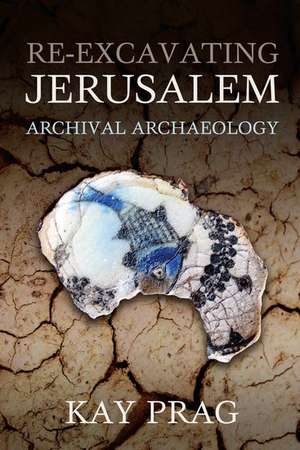
Re-Excavating Jerusalem: Archival Archaeology: Schweich Lectures on Biblical Archaeology
Autor Kay Pragen Limba Engleză Hardback – 13 dec 2018
Din seria Schweich Lectures on Biblical Archaeology
-
 Preț: 170.84 lei
 -
 Preț: 351.23 lei
 -
 Preț: 491.94 lei
 - 19%
 Preț: 441.08 lei
 -
 Preț: 250.96 lei
 - 18%
 Preț: 140.06 lei
 - 21%
 Preț: 179.08 lei
 -
 Preț: 153.00 lei
 -
 Preț: 210.33 lei
 - 30%
 Preț: 175.16 lei
 - 21%
 Preț: 346.78 lei
 -
 Preț: 155.49 lei
 - 31%
 Preț: 495.54 lei
 - 22%
 Preț: 302.93 lei
 - 22%
 Preț: 337.82 lei
 - 34%
 Preț: 390.30 lei
 - 37%
 Preț: 522.14 lei
Preț: 399.58 lei
Puncte Express: 599
Carte disponibilă
Livrare economică 30 octombrie-13 noiembrie
Livrare prin curier în România Termenul estimat este afișat lângă disponibilitate.
Transport gratuit de la 400.00 lei Plată online sau ramburs, în funcție de opțiunile comenzii.
Retur gratuit în 14 zile Comandă securizată și suport în română.
Specificații
ISBN-13: 9780197266427
ISBN-10: 0197266428
Pagini: 150
Ilustrații: 80 black and white figures and 3 colour figures
Dimensiuni: 164 x 241 x 19 mm
Greutate: 0.54 kg
Editura: OUP OXFORD
Colecția OUP Oxford
Seria Schweich Lectures on Biblical Archaeology
Locul publicării:Oxford, United Kingdom
ISBN-10: 0197266428
Pagini: 150
Ilustrații: 80 black and white figures and 3 colour figures
Dimensiuni: 164 x 241 x 19 mm
Greutate: 0.54 kg
Editura: OUP OXFORD
Colecția OUP Oxford
Seria Schweich Lectures on Biblical Archaeology
Locul publicării:Oxford, United Kingdom

Recenzii
Built upon these archives, the book is one of the most comprehensive summaries of the archaeology and history of Kenyon's excavations, in which the views of the author intertwine with Kenyon's conclusions, and later findings by other researchers... To summarise, this is a most comprehensive and invaluable synthesis of the stratigraphic puzzles that Jerusalem presents to researchers, written by someone who has been immersed in this subject for many years.
The strength of this book is in the presentation of archaeological data and hypotheses in chapters three through five which brings Kenyon's data alongside or sometimes in contrast to conclusions from more recent excavations. ... Overall, this volume is helpful for the reader who wishes to understand what archaeologists have uncovered and what the data means to a present-day understanding of ancient Jerusalem.
The strength of this book is in the presentation of archaeological data and hypotheses in chapters three through five which brings Kenyon's data alongside or sometimes in contrast to conclusions from more recent excavations. ... Overall, this volume is helpful for the reader who wishes to understand what archaeologists have uncovered and what the data means to a present-day understanding of ancient Jerusalem.
Notă biografică
Dr Kay Prag studied Near Eastern archaeology at the Universities of Sydney, London, and Oxford. She was a field supervisor on Kathleen Kenyon's Jerusalem excavation in the 1960s, has curated the archive since 1980, and works on the publication of the final reports. As well as research and teaching, she has led field surveys in Jordan and Lebanon, directed excavations at Tell Iktanu in Jordan, and was Honorary Editor of the journal Levant for many years. Her principal publications concern the later third millennium in the Near East, and Jerusalem.