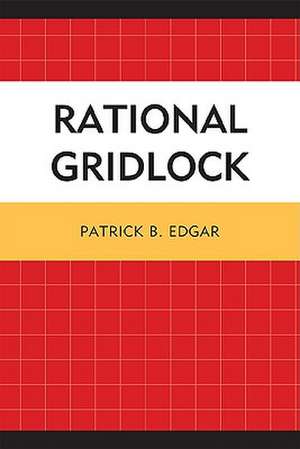
Rational Gridlock
Autor Patrick B. Edgaren Limba Engleză Paperback – 20 mai 2011
Preț: 275.28 lei
Preț vechi: 377.48 lei
-27%
Puncte Express: 413
Carte tipărită la comandă
Livrare economică 23 noiembrie-07 decembrie
Livrare prin curier în România Termenul estimat este afișat lângă disponibilitate.
Transport gratuit de la 400.00 lei Plată online sau ramburs, în funcție de opțiunile comenzii.
Retur gratuit în 14 zile Comandă securizată și suport în română.
Specificații
ISBN-13: 9780761851653
ISBN-10: 0761851658
Pagini: 167
Dimensiuni: 158 x 235 x 13 mm
Greutate: 0.23 kg
Editura: Bloomsbury Publishing
Colecția University Press of America
Locul publicării:New York, United States
ISBN-10: 0761851658
Pagini: 167
Dimensiuni: 158 x 235 x 13 mm
Greutate: 0.23 kg
Editura: Bloomsbury Publishing
Colecția University Press of America
Locul publicării:New York, United States
V-ar putea interesa
-
 Rebuilding War-Torn States: The Challenge of Post-Conflict Economic ReconstructionGraciana del Castillo-21%Preț: 544.72 lei688.93 lei
 -
 Jobs with EqualityLane Kenworthy-11%Preț: 319.56 lei357.43 lei
 -
 Understanding Policy Success: Rethinking Public PolicyAllen McConnellPreț: 338.51 lei
 -
 Public Value: Theory and PracticeJohn BeningtonPreț: 384.37 lei
 -
 Preț: 406.80 lei
 -
 Frontiers of GovernanceL. PalPreț: 407.08 lei
 -
 -24%Preț: 38.56 lei50.90 lei
 -
 Preț: 79.07 lei
 -
 -23%Preț: 252.29 lei327.62 lei
Cuprins
Chapter 1: Public Disconnectedness
Chapter 2: Overview of the Rational Model
Chapter 3: The Organizational Level: Analyzing Administrative Strategies
Chapter 4: Moving to Outcome-Bases Strategies
Chapter 5: Locus of Control, Procedures, and Human Service Outcomes
Chapter 6: Outcome-Based Models and Public Administration
Chapter 7: The Human Sacrifices to Rationalism: The Decay of Community, Responsibility, and Reason
Chapter 8: Various Attempts at Reform within Rationalism
Chapter 9: An Emerging Paradigm: Chaos Theory
Chapter 10: Applying the New Paradigm
Chapter 2: Overview of the Rational Model
Chapter 3: The Organizational Level: Analyzing Administrative Strategies
Chapter 4: Moving to Outcome-Bases Strategies
Chapter 5: Locus of Control, Procedures, and Human Service Outcomes
Chapter 6: Outcome-Based Models and Public Administration
Chapter 7: The Human Sacrifices to Rationalism: The Decay of Community, Responsibility, and Reason
Chapter 8: Various Attempts at Reform within Rationalism
Chapter 9: An Emerging Paradigm: Chaos Theory
Chapter 10: Applying the New Paradigm
Recenzii
In this book, Edgar (Southern Arkansas Univ.) reviews existing models of bureaucratic organization and suggests ways to improve the effectiveness and responsiveness of bureaucracies. Broadly critiquing the basic paradigm behind strategies of administration, which he terms rational, Edgar suggests instead that bureaucratic actors look to scientific theories of chaos as the basis for agency operation and organization. The author makes an admirable attempt to systematize and categorize different means of organizing an administrative system, and wisely draws from his experiences as a consultant and upon an impressive array of research from the natural and social sciences. However, the book gets bogged down in reviews of the literature and details of organizational design, and the effort to tie the subject to broader issues of political disillusionment is unsuccessful. The result is a somewhat confusing medley of theory, history, literature review, and case studies. Nonetheless, the book may serve as a useful introduction to theories of public administration.