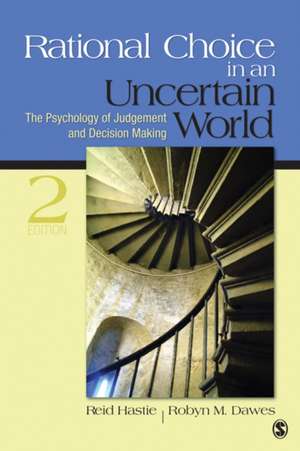
Rational Choice in an Uncertain World
Autor Reid Hastie, Robyn M. Dawesen Limba Engleză Paperback – 17 noi 2009
Aplicabilitatea practică a teoriei alegerii raționale este punctul central al acestui volum, transformând concepte abstracte în instrumente de navigare pentru o lume marcată de incertitudine. În Rational Choice in an Uncertain World, autorii Reid Hastie și Robyn M. Dawes propun o analiză riguroasă, dar accesibilă, a modului în care ne fundamentăm deciziile, comparând normele logice cu erorile cognitive sistematice pe care le manifestăm în realitate. Observăm o tranziție fluidă de la fundamentele psihologiei cognitive către aplicații în drept sau economie, volumul fiind conceput special pentru studenții avansați care au nevoie de o bază solidă în procesele de judecată. Această a doua ediție aduce completări esențiale, integrând descoperiri recente din neuroștiințe și explorând modul în care starea de bine și emoțiile influențează alegerea, dincolo de calculul pur matematic. Reținem îmbunătățirea suportului vizual, prin utilizarea extinsă a arborilor decizionali și a diagramelor Venn, elemente care facilitează înțelegerea modelelor computaționale ale minții. Subliniem că, spre deosebire de lucrările anterioare ale lui Reid Hastie, precum Person Memory (PLE: Memory), care se concentrau pe mecanismele stricte ale memoriei sociale, volumul de față extinde perspectiva către decizia strategică și calitatea alegerii. Ca alternativă la Thinking and Deciding de Jonathan Baron pentru cursurile de psihologie cognitivă, această lucrare are avantajul unei abordări mai puțin tehnice, bazându-se pe anecdote și exemple practice pentru a ilustra eșecurile raționalității. În timp ce Blackwell Handbook of Judgment and Decision Making oferă o perspectivă enciclopedică de cercetare, Rational Choice in an Uncertain World rămâne un manual pedagogic superior prin structura sa logică, de la definirea deciziei ca abilitate, până la succesul surprinzător al modelelor statistice în fața judecății umane.
Preț: 924.66 lei
Preț vechi: 1200.86 lei
-23%
Carte tipărită la comandă
Livrare economică 07-21 decembrie
Specificații
ISBN-10: 1412959039
Pagini: 392
Dimensiuni: 152 x 229 x 21 mm
Greutate: 0.57 kg
Ediția:2. Auflage
Editura: Sage Publications, Inc
Locul publicării:Thousand Oaks, United States
V-ar putea interesa
-
 Punitive Damages: How Juries DecideCass R. SunsteinPreț: 305.38 lei
 -
 Inside the JurorReid HastiePreț: 464.08 lei
 -
 Inside the JuryReid HastiePreț: 501.72 lei
 -
 Preț: 99.54 lei
 -
 WiserCass R SunsteinPreț: 150.33 lei
 -
 The Handbook of StressCheryl D ConradPreț: 443.88 lei
De ce să citești această carte
Această carte este esențială pentru oricine dorește să înțeleagă de ce mintea umană deviază de la logică în condiții de risc. Cititorul va câștiga un set de instrumente analitice pentru a evalua calitatea propriilor decizii, învățând să identifice costurile nerecuperabile și să utilizeze modele statistice simple pentru a îmbunătăți predicțiile zilnice. Este o resursă valoroasă pentru studenții la psihologie, economie și științe politice.
Despre autor
Reid Hastie este profesor de științe comportamentale la Graduate School of Business, University of Chicago. Expertiza sa acoperă domenii diverse, de la memoria socială până la psihologia juridică, fiind coautor al unor lucrări de referință precum Punitive Damages. Interesul său constant pentru procesele de judecată și decizie se reflectă și în lucrarea Wiser, unde explorează dinamica grupurilor. În Rational Choice in an Uncertain World, Hastie își folosește vasta experiență de cercetător pentru a traduce mecanismele cognitive complexe într-un limbaj accesibil mediului academic și profesional.
Descriere scurtă
- more coverage on the role of emotions, happiness, and general well-being in decisions
- a summary of the new research on the neuroscience of decision processes
- more discussion of the adaptive value of (non-rational heuristics)
- expansion of the graphics for decision trees, probability trees, and Venn diagrams.
Cuprins
1.1 Decision Making Is a Skill
1.2 Thinking: automatic and Controlled
1.3 The Computational Model of the Mind
1.4 Through the Darkest Psychoanalytical Theory and Behaviorism to Cognition
1.5 Quality of Choice: Rationality
1.6 The Invention of Modern Decision Theory
Chapter 2 - What Is Decision Making?
2.1 Definition of a Decision
2.2 Picturing Decisions
2.3 Decision Quality, Revisited
2.4 Incomplete Thinking: A Legal Example
2.5 Over-Inclusive Thinking: Sunk Costs
2.6 The Rationality of Considering Only the Future
2.7 The Rest of This Book
Chapter 3 - A General Framework for Judgment
3.1 A Conceptual Framework for Judgment and Prediction
3.2 Research With the Lens Model Framework
3.3 Capturing Judgment in Statistical Models
3.4 How Do Statistical Models Beat Human Judgment?
3.5 Practical Implications of the Surprising Success of the Linear Model
3.6 Objections and Rebuttals
3.7 The Role of Judgment in Choices and Decisions
Chapter 4 - The Fundamental Judgment Strategy: Anchoring and Adjustment
4.1 Salient Values
4.2 Anchoring and (Insufficient) Adjustment
4.3 Anchoring on Ourselves
4.4 Anchoring the Past in the Present
Chapter 5 - Judging Heuristically
5.1 Going Beyond the Information Given
5.2 Estimating Frequencies and probabilities
5.3 Availability of Memories
5.4 Biased Samples in Memory
5.5 Biased Sampling From Memory
5.6 Availability to the Imagination
5.7 From Availability to Probablility and Causality
5.8 Judgment by Similarity: Same Old Things
5.9 Representative Thinking
5.10 The Ratio Rule
Chapter 6 - Explanation-Based Judgments
6.1 Everyone Likes a Good Story
6.2 The Conjunction Probabliity Error (Again)
6.3 Judging From Explanations
6.4 Legal Scenarios: The Best Story Wins in the Courtroom
6.5 Scenarios About Ourselves
6.6 Scenarios About the Unthinkable
6.7 Hindsight: Reconstructing the Past
6.8 Sometimes It's Better to Forget
Chapter 7 - Chance and Cause
7.1 Misconceptions About Chance
7.2 Illusions of Control
7.3 Seeing Causal Structure Where It Isn't
7.4 Regression Toward the Mean
7.5 Reflections on Our Inability to Accept Randomness
Chapter 8 - Thinking Rationally About Uncertainty
8.1 What to Do About the Biases
8.2 Getting Started Thinking in Terms of Probabilities
8.3 Comprehending the Situation Being Judged
8.4 Testing for Rationality
8.5 How to Think About Inverse Probabilities
8.6 Avoiding Subadditivity and Conjunction Errors
8.7 The Other Side of the Coin: The Probability of a Disjunction of Events
8.8 Changing Our Minds: Bayes's Theorem
8.9 Statistical Decision Theory
8.10 Concluding Comment on Rationality
Chapter 9 - Evaluating Consequences: Fundamental Preferences
9.1 What Good is Happiness?
9.2 The Role of Emotions in Evaluations
9.3 The Value of Money
9.4 Decision Utility -- Predicting What We will Value
9.5 Constructing Values
Chapter 10 - From Preferences to Choices
10.1 Deliberate Choices Among Complex Alternatives
10.2 Ordering Alternatives
10.3 Grouping Alternatives
10.4 Choosing Alternatives
10.5 How to Make Good Choices
Chapter 11 - A Rational Decision Theory
11.1 Formally Defining Rationality
11.2 Making Theories Understandable -- The Axiomatic Method
11.3 Defining Rationality: Expected Utility Theory
11.4 Traditional Objections to the Axioms
11.5 The Shoulds and Dos of the System
11.6 Some Bum Raps for Decision Analysis
Chapter 12 - A Descriptive Decision Theory
12.1 Non-expected Utility Theories
12.2 Gain-Loss Framing Effects
12.3 Loss Aversion
12.4 Look to the Future
Chapter 13 - What's Next? New Directions in Research on Judgment and Decision Making
13.1 The Neuroscience of Decisions
13.2 Emotions in Decision Making
13.3 The Rise of Experimental Methods to Study Dynamic Decisions
13.4 Do We Really Know Where We're Headed?
Chapter 14 - In Praise of Uncertainty
14.1 Uncertainty as Negative
14.2 The Illusion of Hedonic Certainty
14.3 The Price of Denying Uncertainty
14.4 Two Cheers for Uncertainty
14.5 Living With Uncertainty