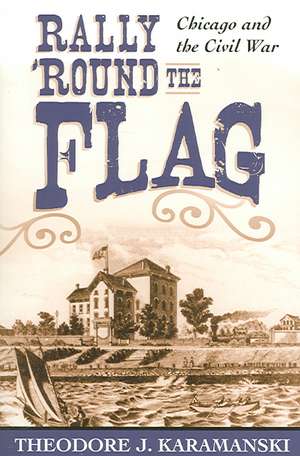
Rally 'Round the Flag: Chicago and the Civil War
Autor Theodore J. Karamanskien Limba Engleză Paperback – 10 mar 2006
From the great Republican convention of 1860 in the "Wigwam," to the dismal life of Confederate prisoners in Camp Douglas on the South Side of Chicago, Rally 'Round the Flag paints a vivid picture of the Midwest city vigorously involved in the national conflict.
Preț: 268.88 lei
Preț vechi: 352.60 lei
-24%
Puncte Express: 403
Carte tipărită la comandă
Livrare economică 08-22 iunie
Livrare express 01-07 mai pentru 122.08 lei
Specificații
ISBN-13: 9780742551374
ISBN-10: 0742551377
Pagini: 292
Dimensiuni: 148 x 226 x 22 mm
Greutate: 0.48 kg
Editura: Bloomsbury Publishing
Colecția Rowman & Littlefield
Locul publicării:New York, United States
ISBN-10: 0742551377
Pagini: 292
Dimensiuni: 148 x 226 x 22 mm
Greutate: 0.48 kg
Editura: Bloomsbury Publishing
Colecția Rowman & Littlefield
Locul publicării:New York, United States
V-ar putea interesa
-
 -31%Preț: 350.58 lei506.59 lei
 -
 -26%Preț: 97.80 lei132.32 lei
 -
 Boon IslandStephen A. ERICKSONPreț: 128.65 lei
 -
 Rez LifeDavid TreuerPreț: 101.31 lei
 -
 Rainbow Bridge to Monument ValleyThomas J. HarveyPreț: 173.32 lei
 -
 Packtrains & Airplanes: Memories of Lonesome LakeTrudy TurnerPreț: 167.67 lei
 -
 -14%Preț: 224.20 lei261.13 lei
 -
 Season of the WitchDavid TalbotPreț: 127.22 lei
 -
 Preț: 133.27 lei
 -
 Another Country, Another LifeJ Patrick BoyerPreț: 137.40 lei
 -
 From Meteorite Impact to Constellation CityOiva W SaarinenPreț: 329.89 lei
 -
 American Indian Tribes of the SouthwestMichael G Johnson-34%Preț: 62.62 lei94.32 lei
 -
 Fallen Timbers 1794John F Winkler-33%Preț: 83.94 lei124.59 lei
Cuprins
Introduction
Chapter 1: The Irrespressible Candidate
Chapter 2: A House Divided
Chapter 3: The First Blood
Chapter 4: "God Bless the Sanitary Commission!"
Chapter 5: Camp Douglas
Chapter 6: "Wonder of the Nineteenth Century"
Chapter 7: "A Fire in the Rear"
Chapter 8: A City in Sable
Chapter 1: The Irrespressible Candidate
Chapter 2: A House Divided
Chapter 3: The First Blood
Chapter 4: "God Bless the Sanitary Commission!"
Chapter 5: Camp Douglas
Chapter 6: "Wonder of the Nineteenth Century"
Chapter 7: "A Fire in the Rear"
Chapter 8: A City in Sable
Recenzii
Deeply researched and wide-ranging. . . . A welcome discussion of the central individuals and events in Civil War Chicago.
Rally 'Round the Flag is an impressive, informative, and scholarly history of Chicago history following the years of the American Civil War. Karamanski draws from diaries, letters, and newspapers to reveal how Chicago's public opinions on the war evolved from a romantic and patriotic naiveté to a clarion recognition of the brutality of the conflict.
A good read and a useful summary of events.
Rally 'Round the Flag is an impressive, informative, and scholarly history of Chicago history following the years of the American Civil War. Karamanski draws from diaries, letters, and newspapers to reveal how Chicago's public opinions on the war evolved from a romantic and patriotic naiveté to a clarion recognition of the brutality of the conflict.
A good read and a useful summary of events.