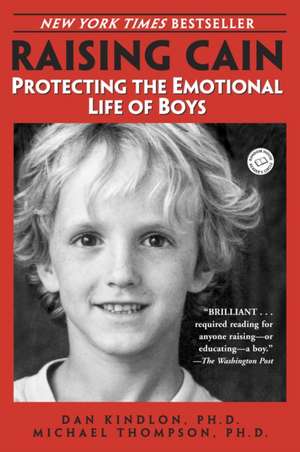
Raising Cain
Autor Dan Kindlon, Michael Thompsonen Limba Engleză Paperback – 4 apr 2000
Observăm în ultimele decenii o evoluție semnificativă în psihologia dezvoltării, marcată de trecerea de la modelele biologice rigide către o înțelegere profundă a ecosistemului emoțional al copilului. Raising Cain se situează în centrul acestei transformări, fiind rezultatul a peste 35 de ani de experiență clinică acumulată de Dan Kindlon și Michael Thompson. Autorii demontează teoriile depășite care puneau comportamentul dificil al băieților exclusiv pe seama testosteronului sau a influenței materne, propunând în schimb conceptul de „miseducație emoțională”. Subliniem rigoarea cu care lucrarea analizează prețul tăcerii și al stoicismului impus social, elemente care îi transformă pe tinerii aflați în formare în adolescenți izolați sau furioși. Ediția de față, publicată de Random House, oferă o structură clară ce ghidează cititorul prin dificultățile specifice mediului școlar și social. Reținem abordarea empatică a autorilor, care nu se limitează la diagnoză, ci oferă instrumente practice pentru cultivarea alfabetizării emoționale, considerată cel mai valoros dar pe care un părinte îl poate oferi fiului său. Această lucrare completează perspectiva oferită de How to Raise a Boy de Michael C Reichert, adăugând o analiză mai detaliată a modului în care instituțiile educaționale și normele culturale tradiționale contribuie activ la suprimarea vulnerabilității masculine. În timp ce alte titluri se concentrează pe etape de dezvoltare, Raising Cain prioritizează conexiunea umană și sprijinul necesar pentru a naviga presiunile sociale, fiind o resursă academică și practică de referință în psihologia modernă.
Preț: 112.07 lei
Carte disponibilă
Livrare economică 17 noiembrie-01 decembrie
Specificații
ISBN-10: 0345434854
Pagini: 320
Dimensiuni: 140 x 209 x 17 mm
Greutate: 0.29 kg
Ediția:Trade Pbk.
Editura: Random House
V-ar putea interesa
-
 Mind in the MakingEllen GalinskyPreț: 95.74 lei
 -
 Preț: 136.72 lei
 -
 How to Raise a Healthy Child in Spite of Your DoctorRobert S MendelsohnPreț: 56.22 lei
 -
 Best Friends, Worst EnemiesMichael ThompsonPreț: 128.87 lei
 -
 It's a Boy!Michael ThompsonPreț: 121.80 lei
 -
 Telling LiesPaul EkmanPreț: 104.34 lei
 -
 The Ideal WifeMary BaloghPreț: 47.75 lei
 -
 Multiple Intelligences: New Horizons in Theory and PracticeHoward Gardner-13%Preț: 139.29 lei159.57 lei
 -
 Raising An Emotionally Intelligent ChildDaniel GolemanPreț: 103.10 lei
 -
 Preț: 132.45 lei
 -
 Preț: 121.41 lei
 -
 Raising Drug-Free Kids: 100 Tips for ParentsAletha SolterPreț: 117.93 lei
 -
 The Power of Full EngagementJim LoehrPreț: 103.29 lei
 -
 -46%Preț: 65.48 lei121.03 lei
 -
 How Did I Begin?Mick ManningPreț: 66.24 lei
 -
 Your Child's Growing MindJane HealyPreț: 118.71 lei
 -
 I Am an Emotional CreatureEve Ensler-20%Preț: 78.97 lei99.08 lei
 -
 Tears and TantrumsAletha Jauch SolterPreț: 87.53 lei
 -
 Five Minds for the FutureHoward GardnerPreț: 148.46 lei
 -
 And the Mountains EchoedKhaled HosseiniPreț: 176.38 lei
De ce să citești această carte
Recomandăm această carte părinților, educatorilor și psihologilor care doresc să înțeleagă universul interior al băieților dincolo de stereotipuri. Cititorul va câștiga o perspectivă nouă asupra „alfabetizării emoționale”, învățând cum să sprijine dezvoltarea empatiei și a rezilienței la copii. Este un instrument esențial pentru oricine dorește să construiască o punte de comunicare reală cu tinerii care se confruntă cu presiunea de a părea mereu puternici.
Despre autor
Dan Kindlon, PhD, este un psiholog clinician și cercetător de renume, specializat în problemele de comportament ale copiilor și adolescenților. Predă psihologia copilului la universitatea Harvard și este un conferențiar căutat de asociații de părinți și profesioniști în sănătate mentală. Coautor al bestsellerului Raising Cain, Kindlon a publicat numeroase articole în jurnale științifice și trei cărți de referință în domeniu. Expertiza sa academică, dublată de practica clinică vastă lângă Boston, îi conferă autoritatea necesară pentru a aborda teme complexe precum sănătatea emoțională a băieților în societatea contemporană.
Notă biografică
Michael Thompson, Ph.D., is a preeminent child psychologist who lectures widely on topics pertaining to the development of boys and also conducts problem-solving workshops with parents, teachers, and students around the country. A highly sought-after consultant to schools, Dr. Thompson is currently the staff psychologist of an all-boys independent school in the Boston area. The coauthor with Edward Hallowell, M.D., of Finding the Heart of the Child, Dr. Thompson has worked for more than fifteen years as a child and family therapist.
From the Hardcover edition.
Extras
Turning Boys Away from Their Inner Life
A young man is so strong, so mad, so certain, and so lost. He has everything and he is able to use nothing."
--Thomas Wolfe, Of Time and the River
Luke, thirteen, pauses at the office door, undecided whether to take his baseball cap off or leave it alone; he pulls it off and steps in the room--the school psychologist's office.
"Come on in, Luke. Have a seat in the big chair."
An oversized, ancient, leathery brown Naugahyde chair dwarfs all but the largest athletes at this all-boy school. Some boys sink deep into the chair as if hoping to distance themselves from scrutiny; others sit stiffly on its edge, clearly uncomfortable with the unnerving assignment to look inward. In our work with boys at schools and in private practice, we see this body language all the time. Boys approach their emotionswith much the same awkwardness, alternately sinking into the depths or sitting stiffly on the edge of feelings threaten to overwhelm them.
Luke's a "good kid." He plays drums in the school band and makes fair grades, though they've dropped lately. At school he's not part of the popular clique, but he does have friends. He's not in the jock crowd and mostly steers clear of them. So what brings him here? In the past few months Luke has grown increadingly sarcastic and sullen, and especially argumentative with his father. A few evenings ago, concerned about his grades, his parents turned down his request to participate in an optional after-school activity. Luke flew into a rage. Stormed off to his room. Slammed doors. Kicked a hole in his bedroom wall. His mother was stunned by the violent outburst, his father was livid, but they left him alone to cool off. The next morning Dad left early for work, Luke had a headache and took a sick day off from school, and his mother called the school to see if anyone there might know what's troubling him. Luke's advisor suggested the counseling visit.
Now here we sit, and Luke is bothe nervous and angry at the prospect of talking about any of this, but most especially about his feelings. He has pushed himself back and sideways into the chair as far as he can go. His KEEP OUT sign is clearly posted.
The declining grades and the escalating hostility at home--especially the explosive outburst--are red flags of concern to everyone but Luke. "I'm fine," he says defiantly, while his eyes flash with anger at having been sent here at all.
As we talk, the questions cruise the perimeter of his life: academics, music, friendships, family. His answers are curt, cautious,a nd begrudging, puncuated with shrugs and a steely expression intended to keep the conversation from moving any closer than that outer edge. He doesn't have an explanation for his recent behavior, and although he reluctantly agrees that talking about feelings might help, he shies away from it. "I just need to work harder," he syas, shifting the focus to his grades."I don't need help. I'm not crazy," he says. "My parents are the ones with the problem."
But we're here to talk about Luke's feelings. He offers a candid, perfunctory assessment of home and school life: His eight-year-old sister is an idiot. His older brother is a jerk. His father, a businessman, isn't around much--gone early, home late most days. His mother treats hime like a five-year-old and pisses him off with all her questions. And although he has friends and likes a few of his teachers, for the most part, school sucks. That about covers it.
"About the other night. The rage and that hole in the bedroom wall. You must have been prety mad to do that?"
Luke looks wary, and even a little scared. He shrugs.
You look sad. Do you feel sad?"
Luke quickly looks down, and his eyes begin to well up with tears. Clearly his is hurting, but it is masked in the toughness that fills his voice: "I don't know. Maybe, I guess."
"Let's see if we can figure out what's making you feel so bad."
Every troubled boy has a different story, but their stories share a disturbing theme of emotional ignorance and isolation. Each day we try to connect withboys like Luke, who are unversed in the subtleties of emotional language and expression and threatened by emotional complexity. When we ask them to open up, most, like Luke, respond with the same "fight-or-flight" response we all have to threatening situations. We see boys who, frightened or saddened by family discord, experience those feelings only as mounting anger or an irritable wish that everyone would "just leave me alone." Shammed by school problems or stung by criticism, they lash out or withdraw emotionally.
A boy's world is full of contraditions, and parents are often at a loss to figure out how best to help. One mother asks how she can offer wise counsel to her eight-year-old son, when her advice to "use words" instead of physical aggression only earns him teasing and abuse from his peers. Another wants to know how she can get through to her brooding eleven-year-old when he fends off her attempts to make conversation: "Now everythin's an argument--we argue more than we talk--and even when I know something's bothering him, he won't talk about his feelings--just like my husband." A father asks how he is supposed to help his teenage son when the boy "won't listen" or is openly hostile.
A boy longs for connection at the same time he feels the need to pull away, and this opens up an emotional divide. This struggle between his need for connection and his desire for autonomy finds different expression as a boy grows. But, regardless of their age, most boys are ill-prepared for the challenges along the road to becoming an emotionally healthy adult. Whatever role biology plays (and that role is by no means clear) in the ways boys are characteristically different from girls in their emotional expression, those differences are amplified by a culture that supports emotional development of girls and discourages it for boys. Stereotypical notions of masculine toughness deny a boy his emotional resources. We call this process, in which a boy is steered away from his inner world, the emotional miseducation of boys. It is a training away from healthful attachment and emotional understanding and expression, and it affects even the youngest boy, who learns quickly, for instance, that he must hide his feelings and silence his fears. A boy is left to manage conflict, adversity, and change in his life with a limited emotional repertoire. If your toolbox contains only a hammer, it's not a problem as long as all your equipment is running right or repairs call only for pounding. But as tasks grow more complex, the hammer's limitations become clear.
Descriere scurtă
Kindlon and Thompson make a compelling case that emotional literacy is the most valuable gift we can offer our sons, urging parents to recognize the price boys pay when we hold them to an impossible standard of manhood. They identify the social and emotional challenges that boys encounter in school and show how parents can help boys cultivate emotional awareness and empathy--giving them the vital connections and support they need to navigate the social pressures of youth.
Recenzii
--The Washington Post
"Raising Cain gives a long-needed insight into that mysterious, magical land, the psyches of boys. Every parent, teacher--or anyone who wants boys to flourish--should read this book."
--DANIEL GOLEMAN
Author of Emotional Intelligence
"ENORMOUSLY COMPELLING . . . In much the same way that Reviving Ophelia offered new models for raising girls, therapists Kindlon and Thompson argue that boys desperately need a new standard of 'emotional literacy.' . . . This thoughtful book is recommended for parents, teachers, or anyone with a vested interest in raising happy, healthy, emotionally whole young men."
--Publishers Weekly (starred review)
"RAISING CAIN HELPS US UNDERSTAND THE INNER LIVES OF BOYS MUCH AS MARY PIPHER'S REVIVING OPHELIA SHED LIGHT ON THE STRUGGLE OF THE ADOLESCENT GIRL."
--The Tampa Tribune-Times