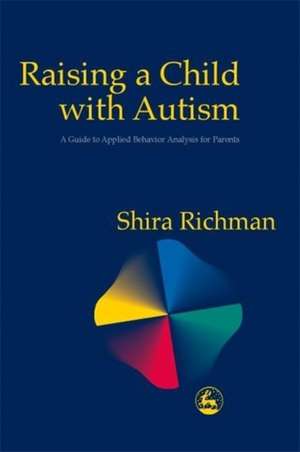
Raising a Child with Autism: A Guide to Applied Behavior Analysis for Parents
Autor Shira Richmanen Limba Engleză Paperback – noi 2000
Preț: 136.65 lei
Preț vechi: 171.93 lei
-21%
Puncte Express: 205
Carte disponibilă
Livrare economică 28 septembrie-12 octombrie
Livrare prin curier în România Termenul estimat este afișat lângă disponibilitate.
Transport gratuit de la 400.00 lei Plată online sau ramburs, în funcție de opțiunile comenzii.
Retur gratuit în 14 zile Comandă securizată și suport în română.
Specificații
ISBN-13: 9781853029103
ISBN-10: 1853029106
Pagini: 176
Ilustrații: black & white illustrations
Dimensiuni: 156 x 232 x 12 mm
Greutate: 0.28 kg
Editura: JESSICA KINGSLEY PUBLISHERS
Colecția Jessica Kingsley Publishers
Locul publicării:London, United Kingdom
ISBN-10: 1853029106
Pagini: 176
Ilustrații: black & white illustrations
Dimensiuni: 156 x 232 x 12 mm
Greutate: 0.28 kg
Editura: JESSICA KINGSLEY PUBLISHERS
Colecția Jessica Kingsley Publishers
Locul publicării:London, United Kingdom
V-ar putea interesa
-
 Preț: 78.57 lei
 -
 Ocd and MeBess CunninghamPreț: 318.43 lei
 -
 Jordon's PathwayRoland Bush-CavellPreț: 86.34 lei
 -
 Buh Bye MSClaudia SuzannePreț: 50.62 lei
 -
 Evading EbolaDavid DeRose MDPreț: 63.45 lei
 -
 I Remember Better When I PaintBerna G. HuebnerPreț: 162.03 lei
 -
 Beyond Cancer Treatment - Clearing and Healing the Underlying CausesDale Figtree Ph. D.Preț: 75.30 lei
 -
 Break Your Sugar Addiction RecipesGeoff WellsPreț: 50.73 lei
 -
 Alzheimer's Basic Caregiving - an ABC GuideKathy Laurenhue MaPreț: 67.93 lei
 -
 Healing JourneyLauren KingslandPreț: 59.93 lei
 -
 Lifestyle Makeover for Diabetics and Pre-DiabeticsGeorge F. TohmePreț: 198.57 lei
 -
 What Men Won't Talk about . . . and Women Need to KnowGlenda StandevenPreț: 62.07 lei
 -
 A Year of Living SickishlyJessie C. GrumanPreț: 36.19 lei
 -
 Cancer SurvivorshipJessie C. GrumanPreț: 33.22 lei
 -
 IBS-Free Recipes for the Whole FamilyPatsy Catsos RdnPreț: 134.93 lei
 -
 Fireballs in My EucharistJoseph PinzonePreț: 110.17 lei
 -
 The Statin Damage CrisisDuane Graveline MDPreț: 84.89 lei
 -
 Cholesterol Is Not the CulpritDr Fred KummerowPreț: 86.50 lei
 -
 It's Not That DeepJessica MollPreț: 48.24 lei
 -
 HIV/AIDS Prevention: Current Issues in Community PracticeDoreen D. Salina-5%Preț: 295.55 lei311.10 lei
 -
 -21%Preț: 302.86 lei382.62 lei
 -
 -24%Preț: 210.62 lei277.20 lei
 -
 -26%Preț: 218.27 lei293.05 lei
 -
 Preț: 62.78 lei
Recenzii
Behaviour therapy consultant Richman clearly outlines the applied behaviour analysis (ABA) activities that parents can use with ASD children. Included is this helpful guidance for toilet training, daily living and increasing communication and sibling interaction. Since ABA consultants may be out of financial or geographical reach of many parents, having a strong resource like this is invaluable.
Richman covers a broad range of training skills that will be important to all families struggling to help their child with autism. These range from how to structure a child's free time (a topic that is often not addressed in the intervention literature), teaching daily living skills including toileting and mealtimes behaviours, to communication and social skills. Additionally, advice is offered about problem behaviour and community activities. A section that is rarely found in these types of books addresses how to establish relationships between the child with autism and his or her siblings. Many of the more important concerns of these parents are mentioned and helpful tips are provided. Readers should also appreciate the contemporary nature of the information provided. The author has incorporated more recent advances in teaching skills, such as incidental teaching procedures, that are sometimes missing from such works.
This is a very practical book which is easy to read. It outlines the theory of Applied Behavioural Analysis and how families can use it with an autistic child to facilitate their child's learning and development of living skills. The author demonstrates, through practical examples, how Applied Behavioural Analysis techniques can be applied to many everyday situations that are experienced by families living with an autistic child. The book is aimed predominately at parents of autistic children, but would be a useful resource for occupational therapists and other professionals working with children.'
The book concludes with a case study and an extensive list of useful books, resources, contacts and support groups.
This highly informative guide teaches parents how to utlize Applied Behavior Analysis (ABA) in order to assist their child's daily living skills and social behaviour. Covering everything from advancing relationships with siblings to increasing their ability to communicate, this book will serve as an effective way to better prepare your child for the world.
Richman's book is more specifically aimed at Applied behaviour analysis...The reader is invited to learn about ABA, how to structure their child's free time... how to bring a child with autism into the community.
Richman covers a broad range of training skills that will be important to all families struggling to help their child with autism. These range from how to structure a child's free time (a topic that is often not addressed in the intervention literature), teaching daily living skills including toileting and mealtimes behaviours, to communication and social skills. Additionally, advice is offered about problem behaviour and community activities. A section that is rarely found in these types of books addresses how to establish relationships between the child with autism and his or her siblings. Many of the more important concerns of these parents are mentioned and helpful tips are provided. Readers should also appreciate the contemporary nature of the information provided. The author has incorporated more recent advances in teaching skills, such as incidental teaching procedures, that are sometimes missing from such works.
This is a very practical book which is easy to read. It outlines the theory of Applied Behavioural Analysis and how families can use it with an autistic child to facilitate their child's learning and development of living skills. The author demonstrates, through practical examples, how Applied Behavioural Analysis techniques can be applied to many everyday situations that are experienced by families living with an autistic child. The book is aimed predominately at parents of autistic children, but would be a useful resource for occupational therapists and other professionals working with children.'
The book concludes with a case study and an extensive list of useful books, resources, contacts and support groups.
This highly informative guide teaches parents how to utlize Applied Behavior Analysis (ABA) in order to assist their child's daily living skills and social behaviour. Covering everything from advancing relationships with siblings to increasing their ability to communicate, this book will serve as an effective way to better prepare your child for the world.
Richman's book is more specifically aimed at Applied behaviour analysis...The reader is invited to learn about ABA, how to structure their child's free time... how to bring a child with autism into the community.
Cuprins
1. What is autism? 2. Learning theory and Applied Behavior Analysis. 3. Structuring your child's free time. 4. Reducing maladaptive behaviors. 5. Daily living skills. 6. Increasing communication. 7. Sibling interaction. 8. Bringing your child with autism into the community. 9. A parent's personal account. Resources. Index.