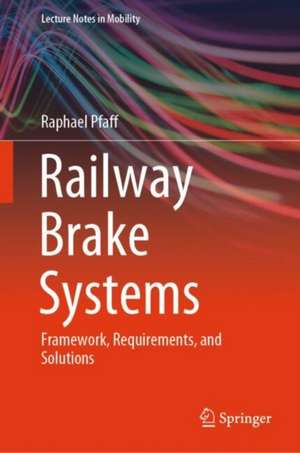
Railway Brake Systems: Framework, Requirements, and Solutions: Lecture Notes in Mobility
Autor Raphael Pfaffen Limba Engleză Hardback – 16 oct 2024
Din seria Lecture Notes in Mobility
- 18%
 Preț: 1059.65 lei
 - 18%
 Preț: 1057.08 lei
 - 15%
 Preț: 622.73 lei
 - 15%
 Preț: 611.57 lei
 - 18%
 Preț: 858.56 lei
 - 15%
 Preț: 616.28 lei
 - 18%
 Preț: 913.16 lei
 - 15%
 Preț: 616.15 lei
 - 18%
 Preț: 970.79 lei
 - 15%
 Preț: 622.29 lei
 - 15%
 Preț: 610.63 lei
 - 18%
 Preț: 1330.49 lei
 - 18%
 Preț: 908.91 lei
 - 18%
 Preț: 911.19 lei
 - 15%
 Preț: 613.23 lei
 - 18%
 Preț: 1176.42 lei
 - 18%
 Preț: 907.25 lei
 - 18%
 Preț: 1174.45 lei
 - 18%
 Preț: 1174.45 lei
 - 18%
 Preț: 907.25 lei
 - 15%
 Preț: 620.68 lei
 - 18%
 Preț: 901.32 lei
 - 18%
 Preț: 907.85 lei
 - 18%
 Preț: 968.95 lei
 - 18%
 Preț: 909.67 lei
 - 15%
 Preț: 621.80 lei
 - 18%
 Preț: 1176.56 lei
 - 18%
 Preț: 1180.51 lei
 - 15%
 Preț: 618.19 lei
 - 18%
 Preț: 1330.63 lei
 - 15%
 Preț: 627.14 lei
 - 15%
 Preț: 622.59 lei
 - 15%
 Preț: 620.86 lei
 - 24%
 Preț: 844.54 lei
Preț: 742.49 lei
Preț vechi: 964.27 lei
-23%
Puncte Express: 1114
Preț estimativ în valută:
131.32€ • 151.75$ • 113.33£
131.32€ • 151.75$ • 113.33£
Carte tipărită la comandă
Livrare economică 21-27 aprilie
Specificații
ISBN-13: 9783031699573
ISBN-10: 3031699572
Pagini: 243
Ilustrații: XX, 140 p.
Dimensiuni: 155 x 235 mm
Greutate: 0.6 kg
Ediția:2025
Editura: Springer Nature Switzerland
Colecția Springer
Seria Lecture Notes in Mobility
Locul publicării:Cham, Switzerland
ISBN-10: 3031699572
Pagini: 243
Ilustrații: XX, 140 p.
Dimensiuni: 155 x 235 mm
Greutate: 0.6 kg
Ediția:2025
Editura: Springer Nature Switzerland
Colecția Springer
Seria Lecture Notes in Mobility
Locul publicării:Cham, Switzerland
V-ar putea interesa
-
 The Untold Railway StoriesMonisha RajeshPreț: 150.84 lei
 -
 Railway Safety Management: Systems, Practices, and Emerging TrendsKatarzyna Chruzik-15%Preț: 420.53 lei494.75 lei
 -
 Race Car DesignDerek Seward-26%Preț: 391.00 lei525.88 lei
 -
 Railways: Types, Design & SafetyCacilie Reinhardt-30%Preț: 917.53 lei1316.23 lei
 -
 abc Rail Guide 2023Pip DunnPreț: 190.25 lei
 -
 British Railways Diesel and Electric LocomotivesHugh LongworthPreț: 276.37 lei
 -
 ABC Rail Guide 2024Pip DunnPreț: 188.60 lei
 -
 The Engine Driver's ManualBrian ToppingPreț: 188.87 lei
 -
 ABC British Railways Locomotives 1966 Combined VolumeCrecy PublishingPreț: 93.17 lei
 -
 The Acquired Wagons of British Railways Volume 7David LarkinPreț: 186.81 lei
 -
 ABC Rail Guide 2025Pip DunnPreț: 189.13 lei
 -
 200 Years of Britain's Railways in 14 JourneysSherin Aminossehe-5%Preț: 222.69 lei233.77 lei
 -
 Preț: 117.30 lei
 -
 Wagons of the Early British Rail EraDavid LarkinPreț: 98.67 lei
 -
 Industrial LocomotivesDavid RatcliffePreț: 72.18 leiNou
 -
 -18%Preț: 2400.69 lei2927.67 lei
 -
 Fundamentals of Railway DesignMarco GuerrieriPreț: 468.21 lei
 -
 -23%Preț: 607.04 lei788.36 lei
 -
 -18%Preț: 858.93 lei1047.47 lei
Cuprins
Introduction, Historical Development And Regulations.- Types, Structure And Properties Of Railway Vehicles.- Wheel-Rail Contact.
Notă biografică
Raphael Pfaff is Professor of Rail Vehicle Engineering at the FH Aachen University of Applied Science. He also serves as a chair of Rail Vehicles at RWTH Aachen University since February 2025. After an apprenticeship as cabinet maker, he studied Mechatronics, Mathematics and Control Engineering in Bochum, Hagen and Coventry, respectively. He gained his master’s degree in control engineering in 2006, and joined Siemens as a system engineer in that year. In parallel, he was pursuing his PhD studies in part-time at Coventry University . In 2008, Raphael Pfaff moved to Faiveley Transport, a railway company, which is now part of Wabtec. There, he started working as a brake system engineer e.g. for the Vectron locomotive and the new German high speed train ICE4. In 2014 he applied for a professorship role in rail vehicle engineering at the FH Aachen University of Applied Sciences, where he is currently responsible for the undergraduate course in rail vehicle engineering. His research interests cover: digitalization, modeling and simulation, prognostics and health management of rail vehicles, as well as the development of self-driving capabilities for railway shunting.
Textul de pe ultima copertă
This book offers a timely introduction to railway brake systems. It introduces operational aspects as well as a set of rail vehicle specific requirements, such as wheel-rail contact and rail vehicle dynamics. It discusses the process of brake control, in particular for automatic pneumatic brake system and brake systems for multiple units. In turn, the book gives insights into braking force generation, covering both friction brake systems and regenerative brakes. It also describes performance calculations, discussing concepts for brake systems design. Despite the focus is mainly on European braking systems, the book identifies key and general aspects, thus offering an inspiring reading for researchers and professionals that are active both inside and outside of Europe.
Caracteristici
Offers a practice-oriented introduction to railway brake systems Describes requirements and solutions for railway brake systems Offers extensive information on how to design and test railway brake systems