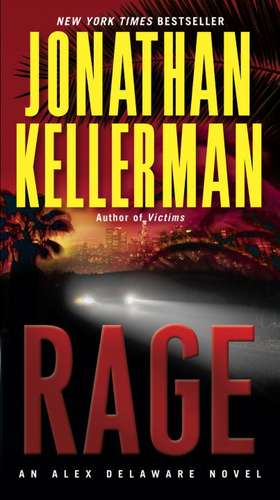
Rage
Autor Jonathan Kellermanen Limba Engleză Paperback – 26 mar 2013
Los Angeles, prezentul imediat. Orașul îngerilor devine scena unei confruntări brutale cu umbrele trecutului. Rand Duchay, un tânăr cu dizabilități intelectuale care a ucis un copil în urmă cu opt ani, este eliberat din detenție doar pentru a fi ucis cu sălbăticie la scurt timp. Ne-a atras atenția modul în care Jonathan Kellerman transformă o eliberare condiționată într-o cursă contra cronometru pentru adevăr. Găsim în această carte o tensiune insuportabilă: Rand dorea să îi mărturisească ceva psihologului Alex Delaware, dar secretul a murit odată cu el. Subliniem măiestria cu care autorul explorează nu doar crima, ci și cicatricile lăsate asupra unei comunități întregi. Cine a citit The Murder Book va recunoaște aici aceeași obsesie a detectivului Milo Sturgis pentru cazurile vechi care refuză să rămână îngropate, însă Rage se distinge printr-o abordare mult mai intimă a psihologiei vinovăției și a modului în care trauma infantilă modelează monștrii de mai târziu. Față de alte lucrări precum Jigsaw sau Unnatural History, unde accentul cade pe probele criminalistice, aici Jonathan Kellerman mizează pe intuiția psihologică. Ritmul este alert, capitolele sunt scurte, iar atmosfera este una de neliniște constantă. Este un labirint de nebunie și sinucideri unde adevărul este mai urât decât orice ne-am putea imagina.
Preț: 59.37 lei
Carte disponibilă
Livrare economică 06-20 noiembrie
Specificații
ISBN-10: 0345535146
Pagini: 448
Dimensiuni: 108 x 190 x 30 mm
Greutate: 0.25 kg
Editura: Random House
V-ar putea interesa
-
 CompulsionJonathan KellermanPreț: 60.27 lei
 -
 GuiltJonathan KellermanPreț: 60.74 lei
 -
 The Murder BookJonathan KellermanPreț: 70.10 lei
 -
 -25%Preț: 59.58 lei79.28 lei
 -
 Therapy (Alex Delaware series, Book 18): A compulsive psychological thrillerJonathan Kellerman-18%Preț: 59.02 lei72.11 lei
 -
 Bones (Alex Delaware series, Book 23): An ingenious psychological thrillerJonathan Kellerman-26%Preț: 58.52 lei78.78 lei
 -
 -25%Preț: 58.73 lei78.78 lei
 -
 -25%Preț: 59.09 lei78.98 lei
 -
 -26%Preț: 58.92 lei79.17 lei
 -
 -26%Preț: 58.73 lei79.05 lei
 -
 -25%Preț: 58.69 lei78.74 lei
 -
 -17%Preț: 91.35 lei110.28 lei
 -
 -26%Preț: 57.53 lei78.06 lei
 -
 Preț: 93.66 lei
 -
 Night Moves (Alex Delaware series, Book 33)Jonathan Kellerman-38%Preț: 95.77 lei153.85 lei
 -
 -24%Preț: 38.20 lei50.58 lei
 -
 City of the DeadJonathan Kellerman-18%Preț: 59.29 lei72.38 lei
 -
 The Texas MurdersJames PattersonPreț: 72.24 lei
 -
 SerpentineJonathan Kellerman-17%Preț: 54.29 lei65.69 lei
De ce să citești această carte
Recomandăm această carte cititorilor care caută un roman polițist profund, unde analiza psihologică primează în fața acțiunii brute. Rage oferă o perspectivă tulburătoare asupra sistemului de justiție juvenilă și a modului în care răul se ascunde sub masca banalității. Veți câștiga o experiență de lectură intensă, ghidată de unul dintre cele mai solide duo-uri din literatura de suspans contemporană: Alex Delaware și Milo Sturgis.
Despre autor
Jonathan Kellerman, născut în 1949, este un renumit autor american de romane polițiste, psiholog clinician și profesor de pediatrie. Experiența sa profesională vastă în psihologia copilului este fundamentul pe care a construit seria de succes dedicată lui Alex Delaware. Laureat al premiilor Edgar și Anthony, Kellerman a reușit să îmbine expertiza medicală cu ficțiunea de suspans, publicând peste 40 de romane care au devenit bestselleruri internaționale. Stilul său se remarcă prin acuratețea profilării psihologice și descrierea realistă a procedurilor de investigație din Los Angeles.
Notă biografică
Extras
On a slow, chilly Saturday in December, shortly after the Lakers overcame a sixteen-point halftime deficit and beat New Jersey, I got a call from a murderer.
I hadn’t watched basketball since college, had returned to it because I was working at developing my leisure skills. The woman in my life was visiting her grandmother in Connecticut, the woman who used to be in my life was living in Seattle with her new guy—temporarily, she claimed, as if I had a right to care—and my caseload had just abated.
Three court cases in two months: two child-custody disputes, one relatively benign, the other nightmarish; and an injury consult on a fifteen-year-old girl who’d lost a hand in a car crash. Now all the papers were filed and I was ready for a week or two of nothing.
I’d downed a couple of beers during the game and was nearly dozing on my living room sofa. The distinctive squawk of the business phone roused me. Generally, I let my service pick up. Why I answered, I still can’t say.
“Dr. Delaware?”
I didn’t recognize his voice. Eight years had passed.
“Speaking. Who’s this?”
“Rand.”
Now I remembered. The same slurred voice deepened to a man’s baritone. By now he’d be a man. Some kind of man.
“Where are you calling from, Rand?”
“I’m out.”
“Out of the C.Y.A.”
“I, uh . . . yeah, I finished.”
As if it had been a course of study. Maybe it had been. “When?”
“Coupla weeks.”
What could I say? Congratulations? God help us?
“What’s on your mind, Rand?”
“Could I, uh, talk to you?”
“Go ahead.”
“Uh, not this . . . like talk . . . for real.”
“In person.”
“Yeah.”
The living room windows were dark. Six forty-five p.m. “What do you want to talk about, Rand?”
“Uh, it would be . . . I’m kinda . . .”
“What’s on your mind, Rand?”
No answer.
“Is it something about Kristal?”
“Ye-ah.” His voice broke and bisected the word.
“Where are you calling from?” I said.
“Not far from you.”
My home office address was unlisted. How do you know where I live?
I said, “I’ll come to you, Rand. Where are you?”
“Uh, I think . . . Westwood.”
“Westwood Village?”
“I think . . . lemme see . . .” I heard a clang as the phone dropped. Phone on a cord, traffic in the background. A pay booth. He was off the line for over a minute.
“It says Westwood. There’s this big uh, a mall. With this bridge across.”
A mall. “Westside Pavilion?”
“I guess.”
Two miles south of the village. Comfortable distance from my house in the Glen. “Where in the mall are you?”
“Uh, I’m not in there. I kin see it across the street. There’s a . . . I think it says Pizza. Two z’s . . . yeah, pizza.”
Eight years and he could barely read. So much for rehab.
It took awhile but I got the approximate location: Westwood Boulevard, just north of Pico, east side of the street, a green and white and red sign shaped like a boot.
“I’ll be there in fifteen, twenty minutes, Rand. Anything you want to tell me now?”
“Uh, I . . . can we meet at the pizza place?”
“You hungry?”
“I ate breakfast.”
“It’s dinnertime.”
“I guess.”
“See you in twenty.”
“Okay . . . thanks.”
“You sure there’s nothing you want to tell me before you see me?”
“Like what?”
“Anything at all.”
More traffic noise. Time stretched.
“Rand?”
“I’m not a bad person.”
CHAPTER 2
What happened to Kristal Malley was no whodunit. The day after Christmas, the two-year-old accompanied her mother to the Buy-Rite Plaza in Panorama City. The promise of MEGA-SALE!!! DEEP DISCOUNTS!!! had stuffed the shabby, fading mall with bargain-hunters. Teenagers on winter break loitered near the Happy Taste food court and congregated among the CD racks of Flip Disc Music. The black-lit box of din that was the Galaxy Video Emporium pulsed with hormones and hostility. The air reeked of caramel corn and mustard and body odor. Frigid air blew through the poorly fitting doors of the recently closed indoor ice-skating rink.
Kristal Malley, an active, moody toddler of twenty-five months, managed to elude her mother’s attention and pull free of her grasp. Lara Malley claimed the lapse had been a matter of seconds; she’d turned her head to finger a blouse in the sale bin, felt her daughter’s hand slip from hers, turned to grab her, found her gone. Elbowing her way through the throng of other shoppers, she’d searched for Kristal, calling out her name. Screaming it.
Mall security arrived; two sixty-year-old men with no professional police experience. Their requests for Lara Malley to calm down so they could get the facts straight made her scream louder and she hit one of them on the shoulder. The guards restrained her and phoned the police.
Valley uniforms responded fourteen minutes later and a store-by-store search of the mall commenced. Every store was scrutinized. All bathrooms and storage areas were inspected. A troop of Eagle Scouts was summoned to help. K-9 units unleashed their dogs. The canines picked up the little girl’s scent in the store where her mother had lost her. Then, overwhelmed by thousands of other smells, the dogs nosed their way toward the mall’s eastern exit and floundered.
The search lasted six hours. Uniforms talked to each departing shopper. No one had seen Kristal. Night fell. Buy-Rite closed. Two Valley detectives stayed behind and reviewed the mall’s security videotapes.
All four machines utilized by the security company were antiquated and poorly maintained, and the black-and-white films were hazy and dark, blank for minutes at a time.
The detectives concentrated on the time period immediately following Kristal Malley’s reported disappearance. Even that wasn’t simple; the machines’ digital readouts were off by three to five hours. Finally, the right frames were located.
And there it was.
Long shot of a tiny figure dangling between two males. Kristal Malley had been wearing sweatpants and so did the figure. Tiny legs kicked.
Three figures exiting the mall at the east end. Nothing more; no cameras scanned the parking lot.
The tape was replayed as the D’s scanned for details. The larger abductor wore a light-colored T-shirt, jeans, and light shoes, probably sneakers. Short, dark hair. From what the detectives could tell, he seemed heavily built.
No facial features. The camera, posted high in a corner, picked up frontal views of incoming shoppers but only the backs of those departing.
The second male was shorter and thinner than his companion, with longer hair that appeared blond. He wore a dark-colored tee, jeans, sneakers.
Sue Kramer said, “They look like kids to me.”
“I agree,” said Fernie Reyes.
They continued viewing the tape. For an instant, Kristal Malley had twisted in her captor’s grasp and the camera caught 2.3 seconds of her face.
Too distant and poorly focused to register anything but a tiny, pale disk. The lead detective, a DII named Sue Kramer, had said, “Look at that body language. She’s struggling.”
“And no one’s noticing,” said her partner, Fernando Reyes, pointing to the stream of shoppers pouring in and out of the mall. People flowed around the little girl as if she were a piece of flotsam in a marina.
“Everyone probably figured they were horsing around,” said Kramer. “Dear God.”
Lara Malley had already viewed the tape through tears and hyperventilated breathing, and she didn’t recognize the two abductors.
“How can I?” she whimpered. “Even if I knew them, they’re so far away.”
Kramer and Reyes played it for her again. And again. Six more times. With each viewing, she shook her head more slowly. By the time a uniform entered the security room and announced “The father’s here,” the poor woman was nearly catatonic.
Figuring the video arcade attracted kids to the mall, the detectives brought in Galaxy’s owner and the two clerks who’d been on duty, brothers named Lance and Preston Kukach, acned, high-school dropout geeks barely out of their teens.
It took only a second for the owner to say, “The tape stinks but that’s Troy.” He was a fifty-year-old Caltech-trained engineer named Al Nussbaum, who’d made more money during three years of renting out video machines than a decade at the Jet Propulsion Labs. That day, he’d taken his own kids horseback riding, had come in to check the receipts.
“Which one’s Troy?” said Sue Kramer.
Nussbaum pointed to the smaller kid in the dark T-shirt. “He comes in all the time, always wears that shirt. It’s a Harley shirt, see the logo, here?”
His finger tapped the back of the tee. To Kramer and Reyes, the alleged winged logo was a faint gray smudge.
“What’s Troy’s last name?” said Kramer.
“Don’t know, but he’s a regular.” Nussbaum turned to Lance and Preston. The brothers nodded.
Fernie Reyes said, “What kind of kid is he, guys?”
“Asshole,” said Lance.
“Caught him trying to steal scrip once,” said Preston. “He leaned over the counter right when I was there and grabbed a roll. When I took it away he tried to whale on me, but I kicked his butt.”
“And you let him come back?” said Nussbaum.
The clerk flushed.
“We’ve got a policy,” Nussbaum told the detectives. “You steal, you’re out. Top of that, he hit you!”
Preston Kukach stared at the floor.
“Who’s the other one?” said Sue Kramer, pointing to the larger boy.
Preston kept his head down.
“If you know, spit it out,” Al Nussbaum demanded.
“Don’t know his name. He’s here once in a while, never plays.”
“What does he do?” said Sue Kramer.
“Hangs out.”
“With who?”
“Troy.”
“Always Troy?”
“Yeah.”
“Troy plays and this one hangs.”
“Yeah.”
Al Nussbaum said, “Now that you know who they are, why aren’t you going after them pronto, finding that kid?”
Reyes turned to the clerks. “What does hanging consist of?”
“He stands around while Troy plays,” said Lance.
“He ever try to steal?”
Head shakes from the Kukach brothers.
“Ever see either of them with little kids?”
“Nope,” said Lance.
“Never,” said Preston.
“What else can you tell us about them?” said Reyes.
Shrugs.
“Anything, guys. This is serious.”
“Spit it out,” said Al Nussbaum.
Lance said, “I dunno, but maybe they live close by.”
“Why do you say that?” said Sue Kramer.
“Because I seen ’em leaving and walking out to the parking lot and keep going onto the street. No one picked ’em up in a car, y’know?”
“Leaving at which exit?”
“The one that goes out to the parking lot.”
Al Nussbaum said, “Three exits go out to the parking lot, Lance.”
“The one near the garbage,” said Lance.
Fernie Reyes glanced at his partner and left.
No body in the Dumpsters out back near the eastern exit.
Five more hours of neighborhood canvass finally ID’d the two boys. Both of them lived in a low-income housing project set like a scar across the scrubby park that paralleled the rear of the mall. Two hundred shoddily built, federally financed one-bedroom units distributed among a quartet of three-story buildings, ringed by chain-link fencing in which dozens of holes had been cut. A scruffy, prisonlike place well known by uniforms who patrolled the area—415 City, they called it, after the penal code for disturbing the peace.
The manager of Building 4 watched the video for a second and pointed to the smaller boy. “Troy Turner. You guys been out here before on him. Last week, matter of fact.”
“Really,” said Sue Kramer.
“Yeah. He smacked his mother with a dinner plate, busted up the side of her face.” The manager massaged his own unshaved cheek. “Before that, he was scaring some of the little kids.”
“Scaring them how?”
“Grabbing and shoving, waving a knife. You guys shoulda locked him up. So what’d he do?”
“Who’s the bigger one?” said Reyes.
“Randolph Duchay. Kind of a retard but he doesn’t cause problems. He done something, it’s probably ’causea Troy.”
“How old are they?” said Fernie Reyes.
“Lemme see,” said the manager. “Troy’s twelve I think, maybe the other one’s thirteen.”
From the Hardcover edition.
Descriere scurtă
Troy Turner and Rand Duchay were barely teenagers when they murdered a younger child. While Troy died violently behind bars, the hulking, slow-witted Rand managed to survive his stretch. Now, at age twenty-one, he’s emerged a haunted, rootless man with a pressing need: to talk—once again—with psychologist Alex Delaware. But when Rand’s life comes to a brutal end, his words die with him.
LAPD homicide detective Milo Sturgis suspects that either karma or revenge caught up with Rand, but Delaware’s suspicions run darker. As Delaware and Sturgis retrace their steps through a grisly murder case that devastated a community, they discover madness, suicide, and even uglier truths waiting to be unearthed. And the nearer they come to understanding an unspeakable crime, the more harrowingly close they get to unmasking a monster hiding in plain sight.
Recenzii
“[Kellerman is] a master of the grab-the-reader contest. . . . The chills start within the first two pages.”—Saint Paul Pioneer Press
“[An] adrenaline-fueled read.”—People