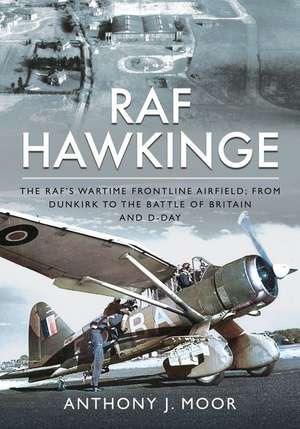
RAF Hawkinge
Autor Anthony J Mooren Limba Engleză Hardback – 30 ian 2024
Observăm o evoluție constantă în istoriografia aeronautică militară, care a trecut de la cronici generale ale conflictelor la studii monografice detaliate asupra bazelor strategice ce au susținut efortul de război. Lucrarea RAF Hawkinge de Anthony J Moor se înscrie în această tendință, oferind o perspectivă documentată asupra unui sit care a servit Royal Flying Corps încă din 1915. Structura cărții este susținută vizual de peste 150 de ilustrații monocrome, care transformă datele tehnice și cronologice într-o experiență de lectură imersivă, specifică publicațiilor editurii Pen & Sword Books Ltd. Suntem de părere că această lucrare extinde cadrul propus de RAF Duxford de Richard Smith cu date noi din perioada de tranziție de la aviația pre-belică la cerințele stricte ale teatrului de operațiuni european. În timp ce RAF Duxford se concentrează pe unitățile de elită dotate cu avioane Spitfire, volumul de față analizează evoluția infrastructurii de la Hawkinge, oferind detalii despre modul în care un teren rechiziționat a devenit un punct vital pe harta apărării britanice. Recomandăm acest volum pentru rigoarea cu care tratează transformarea unui aerodrom civil în bază militară, oferind un context geografic și logistic esențial pentru înțelegerea supremației aeriene.
Preț: 233.73 lei
Carte disponibilă
Livrare economică 07-21 noiembrie
Livrare express 24-30 octombrie pentru 52.44 lei
Specificații
ISBN-10: 1399071467
Pagini: 256
Ilustrații: 150+ mono integrated
Dimensiuni: 242 x 164 x 29 mm
Greutate: 0.85 kg
Editura: Pen & Sword Books Ltd
De ce să citești această carte
Recomandăm această carte pasionaților de istorie militară și aeronautică care doresc să exploreze evoluția bazei RAF Hawkinge. Cititorul câștigă o înțelegere profundă a logisticii Royal Flying Corps, susținută de un bogat material iconografic. Este un instrument de documentare ideal pentru cercetători și modelism, oferind detalii vizuale și istorice care nu se regăsesc în sintezele generale despre aviația britanică.
Despre autor
Anthony J Moor este un autor specializat în istoria aviației și a bazelor aeriene britanice, colaborând frecvent cu edituri de prestigiu precum Pen & Sword Books Ltd. Stilul său se remarcă prin ancorarea în documente de arhivă și utilizarea fotografiilor de epocă pentru a reconstitui atmosfera și detaliile tehnice ale unităților Royal Air Force. Expertiza sa se concentrează pe transformările structurale ale bazelor aeriene din sudul Angliei, oferind cititorilor o perspectivă de specialist asupra patrimoniului militar britanic.
Notă biografică
Descriere scurtă
-The Journal of the Air Force Historical Foundation
As the nearest RAF station to Occupied Europe, the airfield at Hawkinge in Kent found itself quite literally on the frontline during the Second World War. However, Hawkinge's association with British military aviation began more than two decades earlier, during the First World War.
Already a pre-war airfield, it was in 1915 that the land was requisitioned for use by the Royal Fling Corps. The first personnel arrived a few months later to serve at was initially named Folkestone Field. Mainly used as a base for transporting aircraft across to France and the Western Front, a name change to Hawkinge Aeroplane Dispatch Station soon followed, at which point its remit also included the transportation of supplies to troops in France and Belgium.
It was following the reorganization of the RAF in 1923 that Hawkinge underwent the next stage in its development. New hangars and operations buildings were erected, with water and communications systems installed. The airfield's role changed to that of training for both RAF and the Army; 25 Squadron was the first full squadron to be based at Hawkinge.
In the first months of the Second World War, airfield was re-designated as a Fighter Station in No.11 Group, following which the first Hurricanes from 3 Squadron arrived on 19 December 1939. Throughout the Battle of France and into the Dunkirk evacuation Hawkinge played a vital role providing around the clock air-cover for Allied forces. But it was in the summer of 1940 that Hawkinge endured its 'finest hour'.
The first Luftwaffe attack on Hawkinge occurred on 12 August. Despite widespread damage, the grass runways were quickly repaired, ensuring that the Spitfires and Hurricanes which used it as a forward base were soon operating again. Despite the Luftwaffe's best efforts, Hawkinge remained operational throughout the war.
As the RAF went on the offensive in 1941, Hawkinge had a vital part to play in maintaining these missions against Goering's forces - both as a location to refuel on the way out, or a place of refuge on the return, both for fighters and bombers alike, including those of the USAAF following America's entry into the war. Following the war, the fighter base was officially closed on 3 September 1945.
In 1964 the Ministry of Defence sold the land, although for a short while in 1968, memories of the war were invoked with the airfield's use in the making of the classic film Battle of Britain. Only a small corner of the original site has survived and is today home to the renowned Kent Battle of Britain Museum.