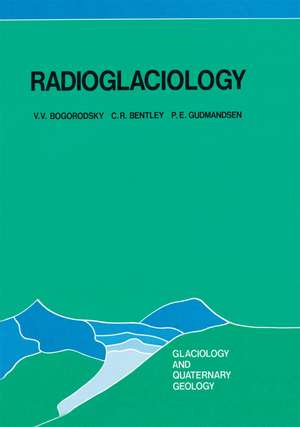
Radioglaciology: Glaciology and Quaternary Geology, cartea 1
Autor V.V. Bogorodsky Traducere de V. Chebotareva Autor C.R. Bentley, P.E. Gudmandsenen Limba Engleză Paperback – 19 oct 2011


Preț: 617.72 lei
Preț vechi: 726.72 lei
-15%
Puncte Express: 927
Carte tipărită la comandă
Livrare economică 20 noiembrie-04 decembrie
Livrare prin curier în România Termenul estimat este afișat lângă disponibilitate.
Transport gratuit pentru acest produs Plată online sau ramburs, în funcție de opțiunile comenzii.
Retur gratuit în 14 zile Comandă securizată și suport în română.
Specificații
ISBN-13: 9789401088305
ISBN-10: 9401088306
Pagini: 272
Ilustrații: XI, 254 p.
Dimensiuni: 178 x 254 x 14 mm
Greutate: 0.48 kg
Ediția:Softcover reprint of the original 1st ed. 1985
Editura: SPRINGER NETHERLANDS
Colecția Springer
Seria Glaciology and Quaternary Geology
Locul publicării:Dordrecht, Netherlands
ISBN-10: 9401088306
Pagini: 272
Ilustrații: XI, 254 p.
Dimensiuni: 178 x 254 x 14 mm
Greutate: 0.48 kg
Ediția:Softcover reprint of the original 1st ed. 1985
Editura: SPRINGER NETHERLANDS
Colecția Springer
Seria Glaciology and Quaternary Geology
Locul publicării:Dordrecht, Netherlands
Public țintă
ResearchCuprins
1: A Brief Survey of the Earth’s Ice Cover and Methods for its Investigation.- 1.1. The Geographical Distribution of Glaciers.- 1.2. Impact of Ice on Geophysical Processes.- 1.3. The Seismic Method.- 1.4. Gravitational and Magnetic Methods.- 1.5. Radar Sounding.- References: Chapter 1.- 2: Structure and Physical State of Glaciers.- 2.1. Internal Structure of Glaciers.- 2.2. Stratification and Temperature Regime of Glaciers.- 2.3. Glacier Regimen.- References: Chapter 2.- 3: Electromagnetic Wave Propagation in Ice.- 3.1. Crystalline Structure of Ice.- 3.2. The Electrical Properties of Monocrystalline Ice.- 3.3. Values of the Electrical Parameters.- 3.4. Pure Polycrystalline Ice.- 3.5. Impure Polycrystalline Ice.- 3.6. Snow.- 3.7. Propagation of Electromagnetic Waves in Glaciers.- References: Chapter 3.- 4: Equipment for Radar Sounding of Glaciers.- 4.1. Analysis.- 4.2. Estimation of Sounding Accuracy.- 4.3. Equipment to Measure the Thickness of Cold Glaciers.- 4.4. Equipment to Measure the Thickness of Temperate Glaciers.- 4.5. Radars to Study Internal Structure and State.- 4.6. Radars for Ice Movement Measurements.- 4.7. Laser Technique.- 4.8. Equipment of U.S.A., Denmark, and Great Britain for Radar Sounding of Cold Glaciers.- 4.9. Equipment of U.S.A., Denmark, and Great Britain for Radar Sounding of Temperate Glaciers.- 4.10. Specialized Equipment.- References: Chapter 4.- 5: Methods of Acquisition and Processing of Data.- 5.1. Radioglaciological Data Recording.- 5.2. Digital and Photographic Recording of Radioglaciological Observations.- References: Chapter 5.- 6: Scientific Results in Radioglaciology.- 6.1. Direct Measurements of Permittivity and Conductivity.- 6.2. Electromagnetic Wave Speed and its Measurement.- 6.3. Lateral Waves.- 6.4. Absorption ofElectromagnetic Waves.- 6.5. Polarization Studies.- 6.6. Ice Thickness and Subglacial Topography.- 6.7. Subglacial Physiography and Geology.- 6.8. Radar Sounding of Internal Layering.- 6.9. Movement of Glaciers.- 6.10. Nature of the Basal Interface.- 6.11. Detection of Hidden Crevasses.- 6.12. Estimation of Glacial Water Content.- References: Chapter 6.- Conclusion.