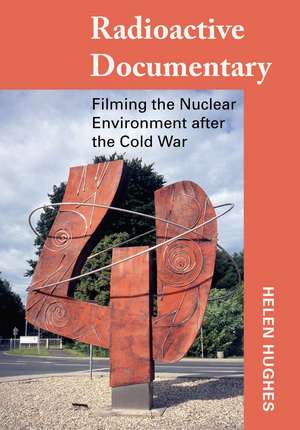
Radioactive Documentary
Autor Helen Hughesen Limba Engleză Hardback – 23 sep 2021
In her coherent, accessible analysis of the representation of radioactive spaces in documentary and experimental art films, Hughes shows us how the documentary form itself can help reimagine the relationships between people and their environments.
Preț: 650.44 lei
Preț vechi: 844.72 lei
-23%
Puncte Express: 976
Carte tipărită la comandă
Livrare economică 19-25 noiembrie
Livrare prin curier în România Termenul estimat este afișat lângă disponibilitate.
Transport gratuit pentru acest produs Plată online sau ramburs, în funcție de opțiunile comenzii.
Retur gratuit în 14 zile Comandă securizată și suport în română.
Specificații
ISBN-13: 9781789383843
ISBN-10: 1789383846
Pagini: 176
Dimensiuni: 175 x 250 x 14 mm
Greutate: 0.49 kg
Editura: Intellect Books
ISBN-10: 1789383846
Pagini: 176
Dimensiuni: 175 x 250 x 14 mm
Greutate: 0.49 kg
Editura: Intellect Books
Notă biografică
Helen Hughes is a senior lecturer in German and film studies at the University of Surrey, UK. She is the coeditor of Documentary and Disability and the author of Green Documentary: Environmental Documentary in the Twenty-First Century, also published by Intellect.
Cuprins
Chapter 1: Introduction: radioactive documentaries and a homage to Erik Barnouw
Chapter 2: Radioactive past: Volker Koepp’s Die Wismut (1993, Germany) and Suzan Baraza’s Uranium Drive-In (2013, US)
Chapter 3: Radioactive present: Toshi Fujiwara’s Mujin Chitai (No Man’s Zone, 2012, Japan) and Nikolaus Geyrhalter’s Pripyat (1999, Austria, Ukraine)
Chapter 4: Radioactive future: Michael Madsen’s Into Eternity (2010, Denmark) and Peter Gallison and Rob Moss’s Containment (2015, US)
Chapter 5: Radioactive past conditional: Volker Sattel’s Unter Kontrolle (Under Control, 2011, Germany) and Ivy Meerapol’s Indian Point (2015, US)
Chapter 6: Radioactive future conditional: Rob Stone’s Pandora’s Promise (2013, US) and Mika Taanila and Jussi Eerola’s Atomin Paluu (Return of the Atom, 2015, Finland)
Chapter 7: Conclusion: Radioactive continuous present: Mark Cousin’s Atomic: Living in Dread and Promise (2015, UK)
Chapter 2: Radioactive past: Volker Koepp’s Die Wismut (1993, Germany) and Suzan Baraza’s Uranium Drive-In (2013, US)
Chapter 3: Radioactive present: Toshi Fujiwara’s Mujin Chitai (No Man’s Zone, 2012, Japan) and Nikolaus Geyrhalter’s Pripyat (1999, Austria, Ukraine)
Chapter 4: Radioactive future: Michael Madsen’s Into Eternity (2010, Denmark) and Peter Gallison and Rob Moss’s Containment (2015, US)
Chapter 5: Radioactive past conditional: Volker Sattel’s Unter Kontrolle (Under Control, 2011, Germany) and Ivy Meerapol’s Indian Point (2015, US)
Chapter 6: Radioactive future conditional: Rob Stone’s Pandora’s Promise (2013, US) and Mika Taanila and Jussi Eerola’s Atomin Paluu (Return of the Atom, 2015, Finland)
Chapter 7: Conclusion: Radioactive continuous present: Mark Cousin’s Atomic: Living in Dread and Promise (2015, UK)