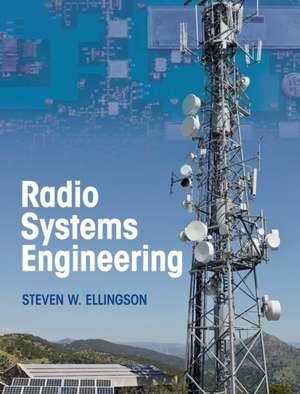
Radio Systems Engineering
Autor Steven W Ellingsonen Limba Engleză Hardback – 6 oct 2016
Autorul Steven W Ellingson aduce în acest volum o vastă expertiză în ingineria sistemelor, oferind un cadru riguros pentru analiza și proiectarea comunicațiilor wireless moderne. Ne-a atras atenția modul în care Radio Systems Engineering reușește să pună în echilibru rigoarea academică a Cambridge University Press cu necesitățile practice ale inginerului de teren, punând accent pe situațiile în care experiența reală deviază de la modelele teoretice standard. Structura este una progresivă, organizată în 18 capitole care ghidează cititorul de la elementele de bază ale antenelor și propagării către complexitatea transmițătoarelor și a procesării digitale. Apreciem în mod deosebit decizia autorului de a simplifica prezentarea inițială prin reducerea utilizării diagramelor Smith, permițând astfel o fixare mai rapidă a principiilor de modulație și zgomot înainte de a trece la designul circuitelor RF și la analiza sistemelor multistadiu. Complementar volumului An Introduction to Radio Frequency Engineering de Christopher Coleman, care se concentrează pe minimizarea aparatului matematic, lucrarea lui Ellingson oferă o acoperire mai extinsă a tehnologiilor contemporane, cum ar fi eșantionarea directă și implementările software-defined radio (SDR). În cele 650 de pagini, considerăm că includerea celor 376 de ilustrații și a tabelelor tehnice transformă textul dintr-un simplu manual într-un instrument de lucru esențial. De la analiza legăturii radio (link analysis) la conversia de frecvență în domeniul analogic, fiecare capitol este susținut de exemple de calcul realiste, pregătind studenții și profesioniștii pentru provocările integrate ale designului de sisteme radio complete, nu doar ale componentelor izolate.
Preț: 644.59 lei
Preț vechi: 795.79 lei
-19%
Carte tipărită la comandă
Livrare economică 30 noiembrie-14 decembrie
Specificații
ISBN-10: 1107068282
Pagini: 650
Ilustrații: 376 b/w illus. 29 tables
Dimensiuni: 208 x 260 x 39 mm
Greutate: 1.6 kg
Editura: Cambridge University Press
Locul publicării:New York, United States
V-ar putea interesa
-
 Electronics Demystified, Second EditionStan Gibilisco-38%Preț: 162.35 lei261.26 lei
 -
 -11%Preț: 668.13 lei750.70 lei
 -
 Microwave EngineeringDavid M Pozar-15%Preț: 1733.09 lei2038.93 lei
 -
 Microwave and Wireless Measurement TechniquesNuno Borges Carvalho-11%Preț: 525.97 lei590.99 lei
 -
 Modern RF and Microwave Measurement TechniquesValeria Teppati-14%Preț: 828.90 lei963.84 lei
 -
 Complete ElectronicsEarl BoysenPreț: 231.22 lei
 -
 Fundamentals of Microwave PhotUrick Jr-9%Preț: 859.60 lei944.61 lei
 -
 -27%Preț: 787.48 lei1078.73 lei
 -
 -15%Preț: 644.51 lei758.25 lei
 -
 -18%Preț: 1608.70 lei1961.84 lei
 -
 -18%Preț: 2082.63 lei2539.79 lei
 -
 Analysis of Synchronous MachinesT. A. Lipo-18%Preț: 2025.57 lei2470.22 lei
 -
 -18%Preț: 1625.81 lei1982.69 lei
 -
 Adaptive FilteringPaulo S. R. Diniz-15%Preț: 559.08 lei657.75 lei
De ce să citești această carte
Această resursă este esențială pentru inginerii care doresc să înțeleagă arhitectura integrală a unui sistem radio, nu doar circuitele individuale. Cititorul câștigă o perspectivă clară asupra compromisurilor dintre tehnologiile analogice și cele digitale (SDR). Este o recomandare solidă pentru cei care activează în telecomunicații și au nevoie de o bază teoretică dublată de metode de analiză aplicabile imediat în proiectarea de emițătoare și receptoare moderne.