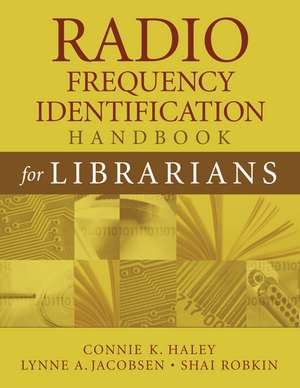
Radio Frequency Identification Handbook for Librarians
Autor Connie K. Haley, Lynne A. Jacobsen, Shai S. Robkinen Limba Engleză Paperback – 30 mar 2007
; Why should my library consider implementing RFID?
; What components make up an RFID system?
; How do I select a vendor?
; How do I manage a barcode-RFID conversion project?
Preț: 265.10 lei
Preț vechi: 358.39 lei
-26%
Puncte Express: 398
Carte tipărită la comandă
Livrare economică 08-22 iunie
Specificații
ISBN-13: 9781591583714
ISBN-10: 1591583713
Pagini: 176
Dimensiuni: 178 x 254 x 11 mm
Greutate: 0.37 kg
Ediția:New.
Editura: Bloomsbury Publishing
Colecția Libraries Unlimited
Locul publicării:New York, United States
ISBN-10: 1591583713
Pagini: 176
Dimensiuni: 178 x 254 x 11 mm
Greutate: 0.37 kg
Ediția:New.
Editura: Bloomsbury Publishing
Colecția Libraries Unlimited
Locul publicării:New York, United States
V-ar putea interesa
-
 Preț: 351.33 lei
 -
 Less Is More: A Practical Guide to Weeding School Library CollectionsDonna J. BaumbachPreț: 308.51 lei
 -
 Extensible Processing for Archives and Special CollectionsDaniel a. Santamaria-23%Preț: 424.21 lei550.93 lei
 -
 Cut Flower GardenErin Benzakein-24%Preț: 144.31 lei190.23 lei
 -
 -22%Preț: 271.53 lei346.91 lei
 -
 -26%Preț: 265.87 lei358.27 lei
 -
 -19%Preț: 576.76 lei712.04 lei
 -
 Moys Classification and Thesaurus for Legal MaterialsElizabeth M. Moys-23%Preț: 2175.11 lei2824.82 lei
Cuprins
Acknowledgments
Chapter 1: Introduction to RFID
Chapter 2: Considering Implementation of RFID
Chapter 3: Tags, Readers, and Applications
Chapter 4: How to Select a Vendor
Chapter 5: How to Manage the RFID Conversion Project
Appendix A: Answers to Frequently Asked Questions
Appendix B: Budget Sheet
Appendix C: Conversion Guidelines: A Sample
Appendix D1: Survey Results of Library RFID Products
Appendix D2: A Survey Letter
Appendix E: On Tag Sorting Features
Appendix F: RFID Resources
Appendix G: Using OpenRFP for RFID Vendor Selection
Suggested Readings
Index
Chapter 1: Introduction to RFID
Chapter 2: Considering Implementation of RFID
Chapter 3: Tags, Readers, and Applications
Chapter 4: How to Select a Vendor
Chapter 5: How to Manage the RFID Conversion Project
Appendix A: Answers to Frequently Asked Questions
Appendix B: Budget Sheet
Appendix C: Conversion Guidelines: A Sample
Appendix D1: Survey Results of Library RFID Products
Appendix D2: A Survey Letter
Appendix E: On Tag Sorting Features
Appendix F: RFID Resources
Appendix G: Using OpenRFP for RFID Vendor Selection
Suggested Readings
Index
Recenzii
The authors--two technical service librarians and a library vendor--introduce readers to RFID technology with an overview of implementation considerations including pros and cons. They also cover the RFID data model, privacy and security issues, the types of tags and readers available--including self-checkout and automated return/sorting systems--vendors, and managing a conversion project that uses existing barcode data. The appendixes include a Frequently Asked Questions section, a budget sheet, conversion guidelines, and a listing of RFID web resources. Overall, this book offers a thorough treatment of the subject and will be useful for libraries considering RFID.
Because of both the breadth and the depth of the information presented, this handbook could very nearly servce as a sole source for someone undertaking an RFID project. It covers all aspects of the technology and is very thorough in answering nearly every conceivable question a librarian might have when considering conversion to an RFID system. This guide is well-written and informative, and highly recommended for academic and public librarians interested in learning the basics of RFID or wishing to implement a system of their own.
The issue of whether and how to implement RFID in libraries is timely and pertinent to space planning as well as technology planning..This handbook is clearly written and makes techincal information easily understandable. The liberal use of lists, photographs, charts, and diagrams adds value for communicating with and training project teams. The author successfully present a professional tone that makes the information clear for any type of library and does not show bias for particular vendors..I highly recommend this handbook for any librarian who may participate in an RFID decision or implementation project.
This book provides some good hints and tips and gives a useful summary of this technology. As part of preliminary background reading this book provides some very useful technical information.
Haley, a system librarian at Chicago State University Library, provides background on the technology and benefits of radio frequency identification (RFID) technology in this guide for academic and public librarians wishing to convert to RFID technology. After a brief overview of how RFID technology works and its use in the retail environment, the guide discusses technical implementation issues for libraries as well as political and social concerns, costs, and physical logistics. Types of tags and readers are described, and there is advice on selecting a vendor. A final chapter outlines steps for managing the RFID conversion project. Appendices offer FAQs, sample budgets and conversion guidelines, and lists of web sites for RFID manufacturers, organizations, and news.
Radio Frequency Identification Handbook for Librarians is perfect for librarians wishing to convert to RFID technology.
This practical, clearly written guide will be helpful for librarians who are considering RFID systems for their institutions.
Because of both the breadth and the depth of the information presented, this handbook could very nearly servce as a sole source for someone undertaking an RFID project. It covers all aspects of the technology and is very thorough in answering nearly every conceivable question a librarian might have when considering conversion to an RFID system. This guide is well-written and informative, and highly recommended for academic and public librarians interested in learning the basics of RFID or wishing to implement a system of their own.
The issue of whether and how to implement RFID in libraries is timely and pertinent to space planning as well as technology planning..This handbook is clearly written and makes techincal information easily understandable. The liberal use of lists, photographs, charts, and diagrams adds value for communicating with and training project teams. The author successfully present a professional tone that makes the information clear for any type of library and does not show bias for particular vendors..I highly recommend this handbook for any librarian who may participate in an RFID decision or implementation project.
This book provides some good hints and tips and gives a useful summary of this technology. As part of preliminary background reading this book provides some very useful technical information.
Haley, a system librarian at Chicago State University Library, provides background on the technology and benefits of radio frequency identification (RFID) technology in this guide for academic and public librarians wishing to convert to RFID technology. After a brief overview of how RFID technology works and its use in the retail environment, the guide discusses technical implementation issues for libraries as well as political and social concerns, costs, and physical logistics. Types of tags and readers are described, and there is advice on selecting a vendor. A final chapter outlines steps for managing the RFID conversion project. Appendices offer FAQs, sample budgets and conversion guidelines, and lists of web sites for RFID manufacturers, organizations, and news.
Radio Frequency Identification Handbook for Librarians is perfect for librarians wishing to convert to RFID technology.
This practical, clearly written guide will be helpful for librarians who are considering RFID systems for their institutions.