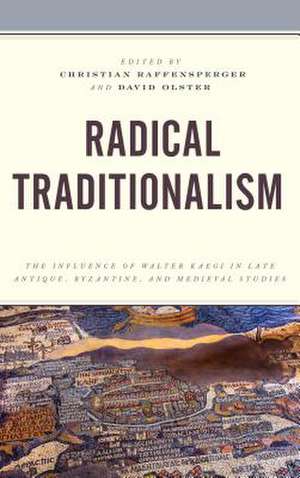
Radical Traditionalism: The Influence of Walter Kaegi in Late Antique, Byzantine, and Medieval Studies: Byzantium: A European Empire and Its Legacy
Editat de David Olster, Christian Raffenspergeren Limba Engleză Hardback – 28 noi 2018



Preț: 554.93 lei
Preț vechi: 837.14 lei
-34%
Puncte Express: 832
Preț estimativ în valută:
98.14€ • 115.16$ • 85.12£
98.14€ • 115.16$ • 85.12£
Carte tipărită la comandă
Livrare economică 09-23 martie
Specificații
ISBN-13: 9781498584869
ISBN-10: 1498584861
Pagini: 254
Ilustrații: 11 b/w photos; 1 table
Dimensiuni: 162 x 233 x 22 mm
Greutate: 0.5 kg
Editura: Bloomsbury Publishing
Colecția Lexington Books
Seria Byzantium: A European Empire and Its Legacy
Locul publicării:New York, United States
ISBN-10: 1498584861
Pagini: 254
Ilustrații: 11 b/w photos; 1 table
Dimensiuni: 162 x 233 x 22 mm
Greutate: 0.5 kg
Editura: Bloomsbury Publishing
Colecția Lexington Books
Seria Byzantium: A European Empire and Its Legacy
Locul publicării:New York, United States
V-ar putea interesa
-
 Early Christian Art and ArchitectureGuntram KochPreț: 187.43 lei
 -
 Family Fictions in Roman ArtNatalie Boymel Kampen-11%Preț: 570.84 lei641.39 lei
 -
 Reading Greek VasesAnn Steiner-11%Preț: 416.97 lei468.51 lei
 -
 Moche Art and Visual Culture in Ancient PeruMargaret A. JacksonPreț: 355.04 lei
 -
 Preț: 294.04 lei
 -
 Preț: 103.21 lei
 -
 Overcoming Ptolemy: The Revelation of an Asian World RegionGeoffrey C. Gunn-34%Preț: 671.38 lei1012.12 lei
 -
 Myth and Art in EkphrasisPatrick Hunt-19%Preț: 498.70 lei615.68 lei
 -
 To Live ForeverEdward Bleiberg-33%Preț: 130.29 lei194.38 lei
 -
 Preț: 307.86 lei
 -
 -23%Preț: 890.41 lei1156.38 lei
Cuprins
Chapter 1: Walter Kaegi: A Historiographic Review, David Olster
Part I: Quellenkritik
Chapter 2: Jerusalem in the Roman and Byzantine Periods in Mujir al-Din's Fifteenth-Century History of Jerusalem and Hebron, Robert Schick
Chapter 3: Logos and Ergon in the Histories of John VI Kantakouzenos, Leonidas Pittos
Chapter 4: Constans II's Odd Speech, David Olster
Part II: Politics / Institutional
Chapter 5: Reimagining the Ties between the House of Nubel and the Donatist Church in Late Roman North Africa, Nathan Leidholm
Chapter 6: Attila, Honoria, and the Nature of Hunnic Rule, Charles W. King
Chapter 7: The Optics of Byzantine Blinding in Medieval Eastern Europe, Christian Raffensperger
Part III: Political / Cultural
Chapter 8: The character of Hincmar of Reims in four ninth-century manuscripts, Jeremy Thompson
Chapter 9: George of Pisidia and Contra Severum: Panegyric and Polemic as Sources for Interpreting Religious Policy, Daniel Larison
Chapter 10: Seminaries, Cults, and Militia in Byzantine Heresiologies: A Genealogy of the Labeling of Paulicians, Hisatsugu Kusabu
Chapter 11: Performing History at the Forum of Constantine, Galina Tirnanic
Chapter 12: The Conversion of Sacrifice in Late Antique Art, Alice Christ
Epilogue: Walter Kaegi and His Legacy, David Olster and Christian Raffensperger
Part I: Quellenkritik
Chapter 2: Jerusalem in the Roman and Byzantine Periods in Mujir al-Din's Fifteenth-Century History of Jerusalem and Hebron, Robert Schick
Chapter 3: Logos and Ergon in the Histories of John VI Kantakouzenos, Leonidas Pittos
Chapter 4: Constans II's Odd Speech, David Olster
Part II: Politics / Institutional
Chapter 5: Reimagining the Ties between the House of Nubel and the Donatist Church in Late Roman North Africa, Nathan Leidholm
Chapter 6: Attila, Honoria, and the Nature of Hunnic Rule, Charles W. King
Chapter 7: The Optics of Byzantine Blinding in Medieval Eastern Europe, Christian Raffensperger
Part III: Political / Cultural
Chapter 8: The character of Hincmar of Reims in four ninth-century manuscripts, Jeremy Thompson
Chapter 9: George of Pisidia and Contra Severum: Panegyric and Polemic as Sources for Interpreting Religious Policy, Daniel Larison
Chapter 10: Seminaries, Cults, and Militia in Byzantine Heresiologies: A Genealogy of the Labeling of Paulicians, Hisatsugu Kusabu
Chapter 11: Performing History at the Forum of Constantine, Galina Tirnanic
Chapter 12: The Conversion of Sacrifice in Late Antique Art, Alice Christ
Epilogue: Walter Kaegi and His Legacy, David Olster and Christian Raffensperger
Recenzii
A fitting tribute to one of North America's most widely-respected scholars of Byzantium, this collection of chapters on a broad selection of different themes and topics illustrates not only the scholarship of the authors, all of whom studied with Walter Kaegi, but is perhaps more importantly a testament to the range, breadth of scholarship and intellectual leadership of their mentor.
Few scholars live to become classics in their own time, but Walter Kaegi is among them. As fashions came and went, Kaegi continued to produce solid, original, and lasting scholarship grounded in the critical use of primary sources and engagement with past historians. The work of his students included in this volume pledges the vital survival of this tradition for the lasting benefit of late Roman, early medieval, and especially Byzantine Studies.
Few scholars live to become classics in their own time, but Walter Kaegi is among them. As fashions came and went, Kaegi continued to produce solid, original, and lasting scholarship grounded in the critical use of primary sources and engagement with past historians. The work of his students included in this volume pledges the vital survival of this tradition for the lasting benefit of late Roman, early medieval, and especially Byzantine Studies.