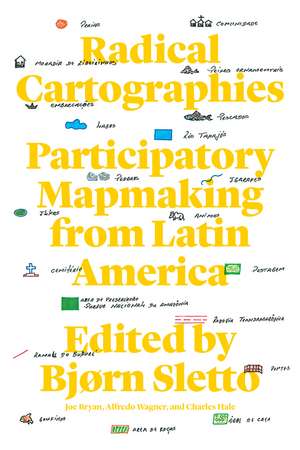
Radical Cartographies: Participatory Mapmaking from Latin America
Editat de Bjørn Sletto, Joe Bryan, Alfredo Wagner, Charles Haleen Limba Engleză Hardback – 15 sep 2020
Lucrarea Radical Cartographies aduce o perspectivă proaspătă și necesară asupra modului în care tehnologia cartografică, istoric un instrument al puterii coloniale, este acum reînsușită de comunitățile marginalizate. Spre deosebire de literatura clasică de specialitate, acest volum nu se limitează la teoria reprezentării spațiale, ci documentează direct lupta pentru justiție socială prin intermediul hărții. Subliniem faptul că volumul funcționează ca un dialog între mediul academic și activismul de teren, oferind o platformă vocilor indigene și afro-descendente din America Latină.
Structura cărții este organizată riguros în trei secțiuni. Prima parte explorează dimensiunea culturală și simbolică, evidențiind modul în care narațiunile orale devin repere geografice. A doua parte se concentrează pe aplicații politice și juridice, unde cartografia participativă este utilizată pentru a demonta „ficțiunile politice” și pentru a apăra biodiversitatea (Ixofillmogen). Ultima secțiune analizează implicațiile acestor practici pentru etnografia modernă. Reținem că cele 40 de ilustrații incluse nu sunt simple anexe, ci dovezi ale modului în care spațiul este redefinit de jos în sus.
În comparație cu New Directions in Radical Cartography de Phil Cohen, care analizează impactul tehnologiilor digitale la nivel global, Radical Cartographies oferă o abordare mult mai aplicată pe contextul specific al Americii Latine. Dacă Weaponizing Maps de Joe Bryan (care este și co-editor aici) investighează tensiunea dintre originile militare ale cartografiei și mobilizarea politică, acest volum extinde analiza către conservarea identității culturale și planificarea teritorială participativă. Este o resursă esențială pentru înțelegerea geografiei umane contemporane, dincolo de convențiile occidentale.
Preț: 337.52 lei
Carte disponibilă
Livrare economică 16-30 noiembrie
Livrare express 30 octombrie-05 noiembrie pentru 42.02 lei
Specificații
ISBN-10: 1477320881
Pagini: 256
Ilustrații: 40 b&w illustrations
Dimensiuni: 152 x 229 x 28 mm
Greutate: 0.54 kg
Editura: University of Texas Press
Colecția University of Texas Press
V-ar putea interesa
-
 Human Geography: A Very Short IntroductionPatricia Daley-20%Preț: 57.15 lei71.12 lei
 -
 Preț: 351.88 lei
 -
 Preț: 187.52 lei
 -
 Preț: 289.75 lei
 -
 Cartographies of Exclusion - Anti-Semitic Mapping in Medieval EnglandAsa Simon Mittman-23%Preț: 625.30 lei812.08 lei
 -
 40 Maps That Will Change How You See the WorldAlastair Bonnett-17%Preț: 123.53 lei148.13 lei
 -
 -27%Preț: 184.83 lei254.33 lei
 -
 Geographies of Difference, Indifference and Mis-difference: The Guarani-Kaiowa People and the Myths of Brazilian DevelopmentAntonio Augusto Rossotto Ioris-32%Preț: 552.26 lei816.98 lei
 -
 Radical CartographyWilliam Rankin-44%Preț: 133.13 lei237.71 lei
 -
 The Library of Lost MapsJames CheshirePreț: 275.46 lei
 -
 -18%Preț: 222.91 lei272.98 lei
 -
 We Are Green and TremblingGabriela Cabezón CámaraPreț: 135.93 lei
 -
 All Mapped Out: How Maps Shape UsMike DugganPreț: 113.44 lei
 -
 -19%Preț: 82.04 lei100.69 lei
 -
 Territorialising Space in Latin AmericaAndrew Boni Noguez-17%Preț: 514.82 lei620.26 lei
 -
 Land Use – Handbook of the Anthropocene in Latin America IOlaf Kaltmeier-24%Preț: 374.69 lei495.04 lei
De ce să citești această carte
Recomandăm această carte profesioniștilor din geografie, antropologie și științe politice care doresc să înțeleagă funcția politică a hărților. Cititorul va câștiga o perspectivă unică asupra modului în care datele spațiale pot deveni instrumente de emancipare pentru comunitățile indigene. Este un studiu de caz esențial despre rezistența prin cunoaștere geografică în fața globalizării.
Despre autor
Volumul este coordonat de un colectiv de experți de prestigiu. Bjørn Sletto este profesor la University of Texas at Austin, specializat în planificare participativă și justiție socială în America Latină. Joe Bryan este cunoscut pentru cercetările sale privind drepturile funciare indigene și autor al unor lucrări de referință despre utilizarea tactică a hărților. Alfredo Wagner Berno de Almeida este un sociolog brazilian recunoscut pentru activitatea sa în cartografia socială a comunităților tradiționale, în timp ce Charles Hale este un antropolog de renume, expert în relațiile dintre stat și popoarele indigene.
Descriere scurtă
In twelve essays written by community leaders, activists, and scholars, Radical Cartographies critically explores the ways in which participatory mapping is being used by Indigenous, Afro-descendant, and other traditional groups in Latin America to preserve their territories and cultural identities. Through this pioneering volume, the authors fundamentally rethink the role of maps, with significant lessons for marginalized communities across the globe, and launch a unique dialogue about the radical edge of a new social cartography.
Notă biografică
Alfredo Wagner is a professor of graduate studies at the State University of Maranhão and founder of the New Social Cartography Project of the Amazon.
Joe Bryan is an associate professor in geography at the University of Colorado, Boulder, and coauthor of Weaponizing Maps: Indigenous Peoples and Counterinsurgency in the Americas.
Charles Hale is the dean of the School of Social Sciences at the University of California, Santa Barbara, and author of Más que un Indio: Racial Ambivalence and Neoliberal Multiculturalism in Guatemala.
Cuprins
- Introduction: Radical Social Cartographies (Bjørn Sletto)
- Part I
- 1. Oral Narratives in the Rincón Zapoteco: A Cartography of Processes (Melquiades (Kiado) Cruz)
- 2. Social Polygraphy: Territory as a Living Memorial to Culture and Nature (Álvaro César Velasco Álvarez)
- 3. Emulating Kuyujani: Boundary Making in the Caura River Basin, Venezuela (Nalúa Rosa Silva Monterrey)
- Part II
- 4. Revealing Territorial Illusions and Political Fictions through Participatory Cartography (Wendy Pineda)
- 5. Mapuche Cartography: Defending Ixofillmogen (Pablo Mansilla Quiñones and Miguel Melin Pehuen)
- 6. The Ethnocartography of Sumak Allpa: The Kichwa Indigenous Community of Pastaza, Ecuador (Alfredo Vitery and Alexandra Lamiña)
- 7. Social Cartography and Territorial Planning in Robles, Colombia (Carlos Alberto González)
- Part III
- 8. New Social Cartography and Ethnographic Practice (Alfredo Wagner Berno de Almeida)
- 9. Social Cartography and the Struggle for Multiethnic, Urban Indigenous Lands: The Case of the Beija-Flor Aldeia in Rio Preto da Eva, Brazil (Emmanuel de Almeida Farias Júnior)
- 10. Participatory Cultural Mapping in Nvwken, Mapuce Territory, Argentina: Exploring Other Forms of Territorial Representation (María Laura Nahuel)
- 11. Political Appropriation of Social Cartography in Defense of Quilombola Territories in Alcântara, Maranhão, Brazil (Davi Pereira Júnior)
- Commentary: What Sort of Territory? What Sort of Map? (Joe Bryan)
- Afterword (Charles R. Hale)
- Contributors
- Index