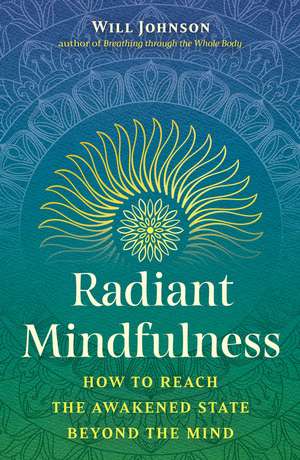
Radiant Mindfulness: How to Reach the Awakened State beyond the Mind
Autor Will Johnsonen Limba Engleză Paperback – 7 mai 2026
• Explores the culminating instruction of the Buddha in the Satipatthana Sutta to breathe through the whole body
• Teaches you how to alter your physiology to move beyond the static consciousness of mindfulness to a natural, spontaneous state of embodied awareness
• Provides instruction and somatic koans for practicing the core principles of radiant mindfulness—awakening the body, liberating the breath, and opening up to vision and sound
Drawing on the Buddha’s teachings, Will Johnson provides a daily practice that moves beyond the static consciousness of mindfulness to a natural, spontaneous state of embodied awareness. Acknowledging the foundational importance and structural limitations of mindfulness practice, he explores the often overlooked culminating instruction of the Buddha in the Satipatthana Sutta to breathe through the whole body.
Through somatic reflections and meditations, Johnson shows you how to alter your physiology to change consciousness. He explains how to move through levels of conscious awareness, from the passive observation of the breath and the reality of this present moment to radiant mindfulness—an awakening of the body, liberation of breath, and opening up to vision and sound. In this state, the “I” disappears but awareness becomes heightened and unfiltered, allowing a direct experience of unity with the world and within oneself.
This book offers ways to spontaneously achieve the enlightened state beyond the mind that the Buddha taught as the true goal of meditation. The simple yet profound practice of radiant mindfulness can transform everyday life into a path of spiritual awakening.
Preț: 111.68 lei
Precomandă
Puncte Express: 168
Carte nepublicată încă
Doresc să fiu notificat când acest titlu va fi disponibil:
Se trimite...
Specificații
ISBN-13: 9798888500606
Pagini: 128
Dimensiuni: 137 x 210 x 10 mm
Greutate: 0.13 kg
Editura: Inner Traditions/Bear & Company
Colecția Inner Traditions
Pagini: 128
Dimensiuni: 137 x 210 x 10 mm
Greutate: 0.13 kg
Editura: Inner Traditions/Bear & Company
Colecția Inner Traditions
Notă biografică
Will Johnson is the director of the Institute for Embodiment Training and the founder of Bambu Hueco, a retreat center in Costa Rica that views the body as the doorway to spiritual growth and transformation. The author of several books, including Breathing through the Whole Body, The Radical Path of Somatic Dharma, Breathing as Spiritual Practice, and Eyes Wide Open, he teaches a deeply body-oriented approach to sitting meditation at Buddhist centers around the world. He lives in Costa Rica.
Extras
You Are How You Breathe
How are you breathing? Right now. In this very moment as you’re reading these words on a page or screen. Don’t change a thing. Just stay in the headspace that you’re in and take a moment to tune in to how you’re breathing before reading any further . . .
The quality of your breath is a mirrored reflection of your state of being in this moment. How you breathe creates who you are.
one kind of breath
raises you up in the radiance of love
another kind of breath
gossips and starts wars
Rumi
What kind of breath breathes you when you’re absorbed in language or thinking, either creatively or subconsciously, when you’re centered in the mind of words? How much oxygen is entering your body on your inhalation as you read these words? How much used air leaves your body as you exhale?
The all too obvious answer is . . . not very much. Lost in thought or engrossed in language, very little breath goes in and out of your body. You breathe enough to keep the body alive but not enough to liberate its innate radiance.
Most of the time when you’re fully engaged in whatever you’re doing and suddenly think to turn your attention to how you’re breathing, you quickly realize that there’s really not much breath happening at all. What breath there is, is shallow, slight, faint, with only a very small amount of air entering and leaving your body. And the body hardly moves. The diminished breath that creates the consciousness that passes as normal in the world is dependent on imposing stillness onto your body. The rib cage hardly moves. Neither does the spine. The head sits still atop the rest of the body. The consciousness that passes as normal in the world at large holds back the breath, and the way you hold back on anything is to freeze and become still.
The stillness creates a physical boundary beyond which breath can’t go. Body becomes a barely moving container rather than a living pulsation. Stillness creates a numbing throughout the body, and numbness ensures that the natural, vibratory presence of body gets dialed down. For the body to become a transmitter of radiance, its sensations want to come back alive, and its breath wants to blossom.
While the holding still that keeps breath contained hides out everywhere in the body, its stillness can be particularly noticed in the rib cage. The rib cage isn’t a medieval vest of armor fashioned from metal. Every one of its twenty-four individual ribs is designed to move, billowing outward on the inhalation, contracting back in on the exhalation, but that’s not how a body lost in thought breathes. Far from it, and in fact quite the opposite. When you’re engaged with language, when you’re lost in thought and identify yourself as the speaker of those thoughts, the rib cage hardly moves at all. It’s frozen. It’s still.
For your innate radiance to come alive, breath wants to be freed from the stillness that contains it so it can be felt making transmitted motion throughout the body’s mass. It’s as though your body were a balloon. Breath fills your body on the inhalation and empties itself back out on the exhalation. As you breathe in, everything in the body can be felt to expand; as you exhale, everything empties—just as though you were filling and emptying a balloon. Such a breath is the polar opposite of the small and constrained breath that being lost in thought is dependent upon.
The Buddha’s instructions begin by encouraging you to bring the almost entirely unconscious process of breathing to conscious awareness, to focus on the breath as it enters and leaves the body. Just start becoming aware of this most primal of bodily interactions and exchanges with the world in which you live. Maybe you’re instructed to place your entire attention on the ticklish feeling the breath makes as it passes in and out of your nostrils or how, even in the stillest of bodies, breath can be felt to slightly expand the belly forward on the inhalation and then draw it back in on the exhalation. It’s a wonderful practice for developing strong concentration. Even better, it requires you to alter . . . nothing. Don’t feel you need to change a thing about what you’re becoming so aware of. Just be aware. Exactly as you are. Exactly as breath is. The mind of concentrated awareness of the passage of breath is wonderful to experience.
Moving on, however, the culminating instruction points you in an entirely different direction. It speaks to the prospect not just of becoming aware of breath but of liberating it from its bondage inside a body that’s frozen. To breathe through the whole body, you want to free the breath from the constraining tensions and holdings that keep it contained, and you also have to be willing to let go of the quality of consciousness that accompanies such a restrained breath.
What I believe the Buddha is essentially telling us in his culminating instruction on breath is to discover who we are and what happens to us when we’re able to experience the kind of breath that actually feels as though it’s engaging and making its way through the whole body.
And, once again, the good news is that exploring this level of instruction requires you to do nothing conventionally heroic. You just need to let go, to relax the tensions in your body that keep breath small, and letting go is far more a something you allow than anything you do. You hold a rock in your hand. You turn your hand to the ground. You don’t need to throw it. You just . . . let go, and the rock falls. The gesture of letting go is the opposite of muscular tensing and exertion, and to discover a breath that can breathe through the whole body, you want first just to pinpoint where that tension lives and then relax and let it go. As you keep letting go to a breath that naturally starts engaging more and more of the body, you enter a cyclic stream that, breath by breath, keeps exposing you to your innate radiance.
You can’t hold back the breath and expect radiant awakening to occur, and as you learn to breathe much more freely and deeply, just as the Buddha is suggesting, you can’t stop radiance from blossoming.
one kind of breath
keeps you locked away
inside your thinking mind
no matter how aware of it
you may be
another kind of breath
takes you beyond your thinking mind
and explodes you open
into radiance
you are
how you breathe
We’re all doing our best at showing up for life, but still there may be little awareness of the thought streams that run wild in our heads or the breath that sustains their current. Lost in thought is the quality of consciousness that has the votes and consensus for being normal in contemporary culture. Lost in thought, you naturally identify yourself as the one speaking those thoughts. That’s you. That’s who you are, and the primary mechanism you rely on to continue to function within this consciousness and sense of self is by keeping your body still and your breath small. What the Buddha is telling us in the culminating instruction is to try something altogether different: find your way to a breath that moves through your entire body not unlike how a wave moves through a body of water, and then welcome the far more dynamically radiant consciousness that naturally expresses itself when you do. He’s not in any way suggesting that you strive to transform lost in thought into heightened awareness. The culminating instruction has nothing to do with the mind. He’s just telling us to figure out how to breathe through the whole body and suddenly awakening occurs all by itself.
If your conventional pattern of breathing locks you into patterns of stillness and uncomfortably held tensions, you mostly hang out in the thought streams in your mind. So what happens to these streams, what happens to the whole dynamic of identity (so based on the who it must be that’s thinking these streams) when the stillness and tension let go and you discover what it is to breathe through the whole body?
How are you breathing? Right now. In this very moment as you’re reading these words on a page or screen. Don’t change a thing. Just stay in the headspace that you’re in and take a moment to tune in to how you’re breathing before reading any further . . .
The quality of your breath is a mirrored reflection of your state of being in this moment. How you breathe creates who you are.
one kind of breath
raises you up in the radiance of love
another kind of breath
gossips and starts wars
Rumi
What kind of breath breathes you when you’re absorbed in language or thinking, either creatively or subconsciously, when you’re centered in the mind of words? How much oxygen is entering your body on your inhalation as you read these words? How much used air leaves your body as you exhale?
The all too obvious answer is . . . not very much. Lost in thought or engrossed in language, very little breath goes in and out of your body. You breathe enough to keep the body alive but not enough to liberate its innate radiance.
Most of the time when you’re fully engaged in whatever you’re doing and suddenly think to turn your attention to how you’re breathing, you quickly realize that there’s really not much breath happening at all. What breath there is, is shallow, slight, faint, with only a very small amount of air entering and leaving your body. And the body hardly moves. The diminished breath that creates the consciousness that passes as normal in the world is dependent on imposing stillness onto your body. The rib cage hardly moves. Neither does the spine. The head sits still atop the rest of the body. The consciousness that passes as normal in the world at large holds back the breath, and the way you hold back on anything is to freeze and become still.
The stillness creates a physical boundary beyond which breath can’t go. Body becomes a barely moving container rather than a living pulsation. Stillness creates a numbing throughout the body, and numbness ensures that the natural, vibratory presence of body gets dialed down. For the body to become a transmitter of radiance, its sensations want to come back alive, and its breath wants to blossom.
While the holding still that keeps breath contained hides out everywhere in the body, its stillness can be particularly noticed in the rib cage. The rib cage isn’t a medieval vest of armor fashioned from metal. Every one of its twenty-four individual ribs is designed to move, billowing outward on the inhalation, contracting back in on the exhalation, but that’s not how a body lost in thought breathes. Far from it, and in fact quite the opposite. When you’re engaged with language, when you’re lost in thought and identify yourself as the speaker of those thoughts, the rib cage hardly moves at all. It’s frozen. It’s still.
For your innate radiance to come alive, breath wants to be freed from the stillness that contains it so it can be felt making transmitted motion throughout the body’s mass. It’s as though your body were a balloon. Breath fills your body on the inhalation and empties itself back out on the exhalation. As you breathe in, everything in the body can be felt to expand; as you exhale, everything empties—just as though you were filling and emptying a balloon. Such a breath is the polar opposite of the small and constrained breath that being lost in thought is dependent upon.
The Buddha’s instructions begin by encouraging you to bring the almost entirely unconscious process of breathing to conscious awareness, to focus on the breath as it enters and leaves the body. Just start becoming aware of this most primal of bodily interactions and exchanges with the world in which you live. Maybe you’re instructed to place your entire attention on the ticklish feeling the breath makes as it passes in and out of your nostrils or how, even in the stillest of bodies, breath can be felt to slightly expand the belly forward on the inhalation and then draw it back in on the exhalation. It’s a wonderful practice for developing strong concentration. Even better, it requires you to alter . . . nothing. Don’t feel you need to change a thing about what you’re becoming so aware of. Just be aware. Exactly as you are. Exactly as breath is. The mind of concentrated awareness of the passage of breath is wonderful to experience.
Moving on, however, the culminating instruction points you in an entirely different direction. It speaks to the prospect not just of becoming aware of breath but of liberating it from its bondage inside a body that’s frozen. To breathe through the whole body, you want to free the breath from the constraining tensions and holdings that keep it contained, and you also have to be willing to let go of the quality of consciousness that accompanies such a restrained breath.
What I believe the Buddha is essentially telling us in his culminating instruction on breath is to discover who we are and what happens to us when we’re able to experience the kind of breath that actually feels as though it’s engaging and making its way through the whole body.
And, once again, the good news is that exploring this level of instruction requires you to do nothing conventionally heroic. You just need to let go, to relax the tensions in your body that keep breath small, and letting go is far more a something you allow than anything you do. You hold a rock in your hand. You turn your hand to the ground. You don’t need to throw it. You just . . . let go, and the rock falls. The gesture of letting go is the opposite of muscular tensing and exertion, and to discover a breath that can breathe through the whole body, you want first just to pinpoint where that tension lives and then relax and let it go. As you keep letting go to a breath that naturally starts engaging more and more of the body, you enter a cyclic stream that, breath by breath, keeps exposing you to your innate radiance.
You can’t hold back the breath and expect radiant awakening to occur, and as you learn to breathe much more freely and deeply, just as the Buddha is suggesting, you can’t stop radiance from blossoming.
one kind of breath
keeps you locked away
inside your thinking mind
no matter how aware of it
you may be
another kind of breath
takes you beyond your thinking mind
and explodes you open
into radiance
you are
how you breathe
We’re all doing our best at showing up for life, but still there may be little awareness of the thought streams that run wild in our heads or the breath that sustains their current. Lost in thought is the quality of consciousness that has the votes and consensus for being normal in contemporary culture. Lost in thought, you naturally identify yourself as the one speaking those thoughts. That’s you. That’s who you are, and the primary mechanism you rely on to continue to function within this consciousness and sense of self is by keeping your body still and your breath small. What the Buddha is telling us in the culminating instruction is to try something altogether different: find your way to a breath that moves through your entire body not unlike how a wave moves through a body of water, and then welcome the far more dynamically radiant consciousness that naturally expresses itself when you do. He’s not in any way suggesting that you strive to transform lost in thought into heightened awareness. The culminating instruction has nothing to do with the mind. He’s just telling us to figure out how to breathe through the whole body and suddenly awakening occurs all by itself.
If your conventional pattern of breathing locks you into patterns of stillness and uncomfortably held tensions, you mostly hang out in the thought streams in your mind. So what happens to these streams, what happens to the whole dynamic of identity (so based on the who it must be that’s thinking these streams) when the stillness and tension let go and you discover what it is to breathe through the whole body?
Cuprins
Introduction: Back to the Future
• PART 1 •
Foundations of Radiance
You Are How You Breathe
The Path of the Dropping of Prefixes:
From Unconsciousness to Sciousness
• PART 2 •
The Practice of
Radiant Mindfulness
The Two Prerequisites
The First Prerequisite
The Second Prerequisite
Rising and Falling
Rising and Falling of the Belly
Rising and Falling through the
Whole Body
Freeing Your Neck
Radiant Vision, Radiant Sound
Removing the Virtual Virtual-Reality Headset
Softening Vision
Adding Sound to Vision
Walking on the Earth
Walking with Grace
Moving through Life
The Radiant Glow of Loving-Kindness
Loving Yourself
Kiss of Love
Reverse Engineering Enlightenment
Recipe for Radiant Mindfulness
Instructions on Breathing from the
Satipatthana Sutta
Radiant Breathing through the
Whole Body
Rocketing to Inner Space and Back
Ten Breaths of Radiance
Afterword: The Birthing of Western Dharma
Author’s Note
The Song of Radiant Mindfulness
• PART 1 •
Foundations of Radiance
You Are How You Breathe
The Path of the Dropping of Prefixes:
From Unconsciousness to Sciousness
• PART 2 •
The Practice of
Radiant Mindfulness
The Two Prerequisites
The First Prerequisite
The Second Prerequisite
Rising and Falling
Rising and Falling of the Belly
Rising and Falling through the
Whole Body
Freeing Your Neck
Radiant Vision, Radiant Sound
Removing the Virtual Virtual-Reality Headset
Softening Vision
Adding Sound to Vision
Walking on the Earth
Walking with Grace
Moving through Life
The Radiant Glow of Loving-Kindness
Loving Yourself
Kiss of Love
Reverse Engineering Enlightenment
Recipe for Radiant Mindfulness
Instructions on Breathing from the
Satipatthana Sutta
Radiant Breathing through the
Whole Body
Rocketing to Inner Space and Back
Ten Breaths of Radiance
Afterword: The Birthing of Western Dharma
Author’s Note
The Song of Radiant Mindfulness
Recenzii
“Radiant Mindfulness is Will Johnson’s masterwork—a clear, potent, and deeply embodied guide to living a wakeful life. Drawing on decades of experiential insight, he shows with rare precision that true mindfulness does not emerge from transcending the body but from entering it fully. A must-read handbook for anyone seeking to free their practice from the confines of the meditation cushion.”
“Will Johnson continues to expand and illuminate the truth of the Buddha’s teaching. From Johnson’s seminal work with the posture of meditation and movement in stillness, to resting our practice more expansively, to breathing with the whole body and expanding our experience to sight and sound, we now move off the cushion and into our lives, radiantly. Mindfulness, now so ubiquitous in our world, has a true and firm foundation, somatically based in his wisdom and masterful guidance. This book invites us to more fully expand into our lives with ease and capacity to connect with the shimmering nature of what is present, always.”
“Will Johnson continues to expand and illuminate the truth of the Buddha’s teaching. From Johnson’s seminal work with the posture of meditation and movement in stillness, to resting our practice more expansively, to breathing with the whole body and expanding our experience to sight and sound, we now move off the cushion and into our lives, radiantly. Mindfulness, now so ubiquitous in our world, has a true and firm foundation, somatically based in his wisdom and masterful guidance. This book invites us to more fully expand into our lives with ease and capacity to connect with the shimmering nature of what is present, always.”