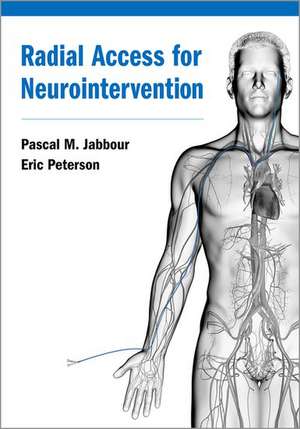
Radial Access for Neurointervention
Editat de Pascal Jabbour, Eric Petersonen Limba Engleză Hardback – 13 oct 2021
For the longest time, neuroendovascular procedures have been done through the femoral artery (TFA) located in the thigh and groin region. Over the last decade, interventional cardiologists have pioneered a newer approach: by utilizing the radial artery in the wrist to access the arterial system, a new procedure has been employed: radial access. Numerous studies and randomized controlled trials have demonstrated this to be a safer way of performing endovascular procedures, and a majority of the interventional cardiac procedures are performed via radial access.
The neurointerventional community, however, has been slow to adopt this innovation. The radial access innovation is finally making its way to the neurointerventional community. Radial Access for Neurointervention has all the literature supporting illustrating how radial access is useful to the neuro community. Detailed chapters describe the techniques of radial access including positioning the patient on the table, driving the microcatheters intracranially, aneurysms treatment, AVM/AVF embolizations, complications management, and more. Readily enhanced throughout with pictures and movies, this first-of-its-kind book will guide neurointerventionalists to transition their practices to radial first.
Preț: 699.87 lei
Preț vechi: 946.04 lei
-26%
Carte disponibilă
Livrare economică 06-17 noiembrie
Specificații
ISBN-10: 0197524176
Pagini: 160
Dimensiuni: 259 x 180 x 13 mm
Greutate: 0.56 kg
Editura: Oxford University Press
Colecția OUP USA
Locul publicării:New York, United States
Recenzii
Notă biografică
Pascal M. Jabbour, MD The Angela and Richard T. Clark Distinguished Professor of Neurological Surgery and Division Chief of Neurovascular Surgery And Endovascular Neurosurgery Thomas Jefferson University Hospital Eric Peterson, MD FAANS Associate Professor of Neurological Surgery Chief of Endovascular Neurosurgery University of Miami MILLER School of Medicine Jackson Memorial Hospital
Cuprins
- Chapter 1: Why Radial?
- Chapter 2: Room Setup and Access Techniques
- Chapter 3: Distal radial "Snuff Box" Approach
- Chapter 4: Diagnostic Angiography
- Chapter 5: Interventional Procedures
- Chapter 6 : Aneurysms treatment
- Chapter 7: AVM / AVF treatment
- Chapter 8 : Carotid Stenting
- Chapter 9: Stroke
- Chapter 10: The left radial approach
- Chapter 11: Use of Long Radial Sheaths
- Chapter 12: Closure techniques
- Chapter 13: Pediatric Transradial Approach
- Chapter 14 : Intra Operative Transradial Angiograms
- Chapter 15: Getting out of Trouble
- Chapter 16: How to Convert your Practice from TFA to TRA
- Chapter 17: Future Directions