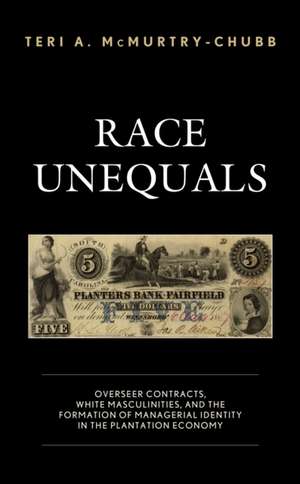
Race Unequals: Overseer Contracts, White Masculinities, and the Formation of Managerial Identity in the Plantation Economy
Autor Teri A. McMurtry-Chubben Limba Engleză Paperback – 15 apr 2023
| Toate formatele și edițiile | Preț | Express |
|---|---|---|
| Paperback (1) | 208.15 lei 6-8 săpt. | |
| Bloomsbury Publishing – 15 apr 2023 | 208.15 lei 6-8 săpt. | |
| Hardback (1) | 492.24 lei 6-8 săpt. | |
| Bloomsbury Publishing – 28 apr 2021 | 492.24 lei 6-8 săpt. |
Preț: 208.15 lei
Preț vechi: 277.94 lei
-25%
Puncte Express: 312
Preț estimativ în valută:
36.84€ • 43.05$ • 31.98£
36.84€ • 43.05$ • 31.98£
Carte tipărită la comandă
Livrare economică 19 februarie-05 martie
Preluare comenzi: 021 569.72.76
Specificații
ISBN-13: 9781498599085
ISBN-10: 1498599087
Pagini: 148
Ilustrații: 5 tables;
Dimensiuni: 151 x 229 x 11 mm
Greutate: 0.23 kg
Editura: Bloomsbury Publishing
Colecția Lexington Books
Locul publicării:New York, United States
ISBN-10: 1498599087
Pagini: 148
Ilustrații: 5 tables;
Dimensiuni: 151 x 229 x 11 mm
Greutate: 0.23 kg
Editura: Bloomsbury Publishing
Colecția Lexington Books
Locul publicării:New York, United States
Cuprins
Introduction: The World The Planters Made
Chapter 1: The Overseer, His Contracts, and His Contractual Relationships
Chapter 2: Profitable Planters, Industrious Overseers, Maintaining the Status Quo
Chapter 3: "Pushing" Torture, Managing Violence, and Planter Regulation of Overseer Control
Chapter 4: White Masculinities, Private Law, and the Battle for Social Control
Chapter 5: Immoral Men, Immoral Ends, Deference as Social Death
Epilogue: The "Lost Cause" and the Legacy of Plantation Management
Bibliography
About the Author
Chapter 1: The Overseer, His Contracts, and His Contractual Relationships
Chapter 2: Profitable Planters, Industrious Overseers, Maintaining the Status Quo
Chapter 3: "Pushing" Torture, Managing Violence, and Planter Regulation of Overseer Control
Chapter 4: White Masculinities, Private Law, and the Battle for Social Control
Chapter 5: Immoral Men, Immoral Ends, Deference as Social Death
Epilogue: The "Lost Cause" and the Legacy of Plantation Management
Bibliography
About the Author
Recenzii
Meticulously researched and gracefully written, Race Unequals is an important chapter in the history of management. It moves tellingly from plantations, to legislatures, to courtrooms in the antebellum South. Vivid accounts of litigation-especially over planter regulation of overseers' abuse of slaves and concerning what now would be called 'wage theft'-animate this intelligent examination of intraracial class conflicts among whites, their gendered dimensions, and their impacts on the lives of the enslaved.
Teri A. McMurtry-Chubb's clear and elegantly written history of wealthy enslavers' manipulations of overseers' whiteness and masculinity dispenses with the prevalent narrative of race as biological, demonstrating instead that race and gender are social and legal constructions arranged and bargained for through private ordering and given the force of public law by the courts. Her meticulous excavation and compelling presentation of overseers' management of planters' enslaved chattel as a means of securing the capital attached to their statuses as middle-class white men underscore the centrality of race to American notions of property and highlight the unbreakable relationships between contract, caste, and capitalism.
Race Unequals is a nuanced and gripping portrayal of the world of white men who exercised power over enslaved people without legal ownership. Overseers at once stood in the shoes of the enslaver, brandishing the whip and chain, and themselves negotiated a subordinate position in white society, often in conflict with the planters who employed them. McMurtry-Chubb's painstaking research in the records of contracts, litigation, and planters' account books reveals the complexities of white masculinity in a world stratified by wealth as well as race, yet she also brings her subjects to life with an unerring eye for the telling detail and memorable story.
This book presents a fascinating portrait of the legal relationships among white male planters, their white male overseers, and the enslaved Black persons who worked the plantations in the Antebellum South. The book establishes that caste, race, and gender, in particular masculinities, created and perpetuated status differences between the planters and the overseers; planters used contracts to limit the overseers' ability to increase their status or to own persons or property. While the planters professed dedication to statutes that protected enslaved human beings from mistreatment, they escaped blame for violence by relinquishing to overseers authority to discipline the enslaved. Planters simultaneously undercut their overseers' authority and masculinity by giving them 'feminine' caregiving responsibilities for their sick enslaved persons. The book is a fresh look at the emerging managerial class and how white masculinities were negotiated through legal means.
In this book McMurtry-Chubb makes a banner contribution to the legal and gender history of the Old South by analyzing the gap in privilege and power between plantation patriarchs and their overseers. Even as they imbued overseers with pernicious authority over the enslaved, planters used contracts and litigation to enforce the deference and circumscribe the social mobility of overseers. In performing their own hegemonic masculinity, planters cast overseers as auxiliaries but not members of the ruling class. With deep research and insight, McMurtry-Chubb illuminates the tangled web of complicity, hierarchy, and dependence that connected elite and nonelite white Southern men.
Teri A. McMurtry-Chubb's clear and elegantly written history of wealthy enslavers' manipulations of overseers' whiteness and masculinity dispenses with the prevalent narrative of race as biological, demonstrating instead that race and gender are social and legal constructions arranged and bargained for through private ordering and given the force of public law by the courts. Her meticulous excavation and compelling presentation of overseers' management of planters' enslaved chattel as a means of securing the capital attached to their statuses as middle-class white men underscore the centrality of race to American notions of property and highlight the unbreakable relationships between contract, caste, and capitalism.
Race Unequals is a nuanced and gripping portrayal of the world of white men who exercised power over enslaved people without legal ownership. Overseers at once stood in the shoes of the enslaver, brandishing the whip and chain, and themselves negotiated a subordinate position in white society, often in conflict with the planters who employed them. McMurtry-Chubb's painstaking research in the records of contracts, litigation, and planters' account books reveals the complexities of white masculinity in a world stratified by wealth as well as race, yet she also brings her subjects to life with an unerring eye for the telling detail and memorable story.
This book presents a fascinating portrait of the legal relationships among white male planters, their white male overseers, and the enslaved Black persons who worked the plantations in the Antebellum South. The book establishes that caste, race, and gender, in particular masculinities, created and perpetuated status differences between the planters and the overseers; planters used contracts to limit the overseers' ability to increase their status or to own persons or property. While the planters professed dedication to statutes that protected enslaved human beings from mistreatment, they escaped blame for violence by relinquishing to overseers authority to discipline the enslaved. Planters simultaneously undercut their overseers' authority and masculinity by giving them 'feminine' caregiving responsibilities for their sick enslaved persons. The book is a fresh look at the emerging managerial class and how white masculinities were negotiated through legal means.
In this book McMurtry-Chubb makes a banner contribution to the legal and gender history of the Old South by analyzing the gap in privilege and power between plantation patriarchs and their overseers. Even as they imbued overseers with pernicious authority over the enslaved, planters used contracts and litigation to enforce the deference and circumscribe the social mobility of overseers. In performing their own hegemonic masculinity, planters cast overseers as auxiliaries but not members of the ruling class. With deep research and insight, McMurtry-Chubb illuminates the tangled web of complicity, hierarchy, and dependence that connected elite and nonelite white Southern men.