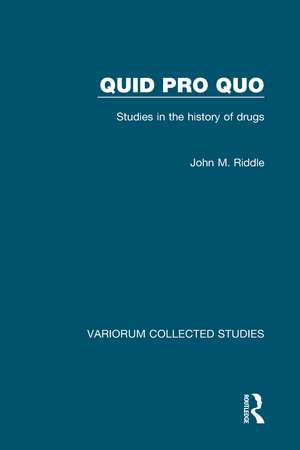
Quid pro quo: Studies in the History of Drugs: Variorum Collected Studies
Autor John M. Riddleen Limba Engleză Hardback – 16 apr 1992
Din seria Variorum Collected Studies
- 18%
 Preț: 819.40 lei
 - 27%
 Preț: 1001.46 lei
 - 18%
 Preț: 817.97 lei
 - 8%
 Preț: 462.54 lei
 -
 Preț: 391.83 lei
 - 11%
 Preț: 397.81 lei
 - 18%
 Preț: 1347.90 lei
 - 27%
 Preț: 1406.25 lei
 - 18%
 Preț: 1349.92 lei
 - 15%
 Preț: 438.73 lei
 - 18%
 Preț: 817.97 lei
 - 18%
 Preț: 1348.92 lei
 -
 Preț: 418.49 lei
 - 18%
 Preț: 819.40 lei
 - 18%
 Preț: 819.40 lei
 - 18%
 Preț: 819.06 lei
 - 18%
 Preț: 819.76 lei
 - 18%
 Preț: 1346.09 lei
 - 18%
 Preț: 816.49 lei
 - 18%
 Preț: 818.25 lei
 -
 Preț: 442.70 lei
 -
 Preț: 352.37 lei
 -
 Preț: 472.65 lei
 - 18%
 Preț: 1348.23 lei
 - 18%
 Preț: 1147.81 lei
 - 18%
 Preț: 1348.03 lei
 - 18%
 Preț: 1354.95 lei
 -
 Preț: 398.09 lei
 -
 Preț: 417.44 lei
 -
 Preț: 396.84 lei
 - 18%
 Preț: 1349.39 lei
 -
 Preț: 504.76 lei
 - 18%
 Preț: 819.59 lei
 - 18%
 Preț: 1120.96 lei
 - 18%
 Preț: 902.77 lei
 - 18%
 Preț: 713.80 lei
 - 18%
 Preț: 1256.11 lei
 - 18%
 Preț: 726.26 lei
 - 18%
 Preț: 1013.62 lei
 - 18%
 Preț: 1261.45 lei
 -
 Preț: 418.73 lei
 - 18%
 Preț: 1112.48 lei
 - 18%
 Preț: 1066.58 lei
 - 18%
 Preț: 713.80 lei
 - 18%
 Preț: 1303.18 lei
 - 18%
 Preț: 724.85 lei
 - 23%
 Preț: 1750.26 lei
 - 18%
 Preț: 1071.02 lei
 - 18%
 Preț: 725.21 lei
 - 18%
 Preț: 1255.93 lei
Preț: 352.65 lei
Preț vechi: 371.21 lei
-5%
Puncte Express: 529
Carte tipărită la comandă
Livrare economică 12-26 noiembrie
Livrare prin curier în România Termenul estimat este afișat lângă disponibilitate.
Transport gratuit de la 400.00 lei Plată online sau ramburs, în funcție de opțiunile comenzii.
Retur gratuit în 14 zile Comandă securizată și suport în română.
Specificații
ISBN-13: 9780860783190
ISBN-10: 0860783197
Pagini: 330
Dimensiuni: 152 x 229 x 19 mm
Greutate: 0.77 kg
Ediția:1
Editura: Taylor & Francis
Colecția Routledge
Seria Variorum Collected Studies
Locul publicării:Oxford, United Kingdom
ISBN-10: 0860783197
Pagini: 330
Dimensiuni: 152 x 229 x 19 mm
Greutate: 0.77 kg
Ediția:1
Editura: Taylor & Francis
Colecția Routledge
Seria Variorum Collected Studies
Locul publicării:Oxford, United Kingdom
Public țintă
Academic and PostgraduateCuprins
Contents: Pomum ambrae: amber and ambergris in plague remedies; The introduction and use of Eastern drugs in the Early Middle Ages; Lithotherapy in the Middle Ages - lapidaries considered as medical texts; The Latin alphabetical Dioscorides manuscript group; Amber in ancient pharmacy: the transmission of information about a single drug; Theory and practice in medieval medicine; Book reviews, lectures, and marginal notes: three previously unknown 16th-century contributions to pharmacy, medicine and botany - Ioannes Manardus, Franciscus Frigimelica and Melchior Guilandinus; Albert on stones and minerals; Pseudo-Dioscorides Ex herbis femininis and early medieval medical botany; Gargilius Martialis as a medical writer; The Pseudo-Hippocratic Dynamidia; Ancient and medieval chemotherapy for cancer; Byzantine commentaries on Dioscorides; Folk tradition and folk medicine: recognition of drugs in Classical antiquity; Methodology of historical drug research; Indexes.
Recenzii
'...Riddle’s reading of medieval texts sheds welcome light on therapeutic practices of the distant past...[there are] substantive contributions to the study of medieval medicine presented in this anthology.' Bulletin of the History of Medicine, Vol. 67
Descriere
All too often ancient herbal and other remedies have been dismissed as ’simply’ folklore, of no relevance to medical science. John Riddle’s approach, however, has been to explore the history of drugs with the hypothesis that ancient and medieval medicines were effective - a methodology that he expounds in the final essay (hitherto unpublished). Indeed, he shows, both from detailed case-studies and from the comparison of the listings given by classical and medieval authorities with those in modern pharmacopoeias, that our ancestors had discovered and made effective use of many of the drugs used in medicine today, from antiseptics and analgesics to oral contraceptives, even chemotherapy for cancer. There is the suggestion, therefore, that more careful examination and identification of the drugs used in the past may reveal chemicals that can be exploited anew. Central to these studies is the investigation of how a drug was used and how knowledge about it was transmitted - and perhaps also distorted in the process - from the Classical world through the Middle Ages.