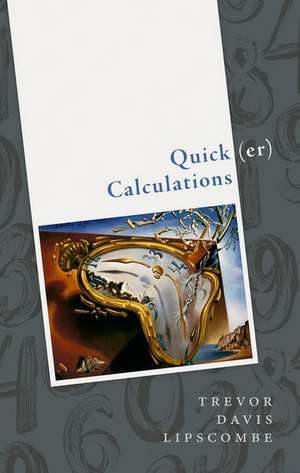
Quick(er) Calculations: How to add, subtract, multiply, divide, square, and square root more swiftly
Autor Trevor Davis Lipscombeen Limba Engleză Hardback – 6 mai 2021
Preț: 170.04 lei
Preț vechi: 201.35 lei
-16%
Puncte Express: 255
Carte disponibilă
Livrare economică 13-18 noiembrie
Livrare express 28 octombrie-03 noiembrie pentru 57.20 lei
Livrare prin curier în România Termenul estimat este afișat lângă disponibilitate.
Transport gratuit de la 400.00 lei Plată online sau ramburs, în funcție de opțiunile comenzii.
Retur gratuit în 14 zile Comandă securizată și suport în română.
Specificații
ISBN-13: 9780198852650
ISBN-10: 0198852657
Pagini: 192
Ilustrații: 4 grayscale line figures
Dimensiuni: 142 x 223 x 15 mm
Greutate: 0.36 kg
Ediția:1
Editura: OUP OXFORD
Colecția OUP Oxford
Locul publicării:Oxford, United Kingdom
ISBN-10: 0198852657
Pagini: 192
Ilustrații: 4 grayscale line figures
Dimensiuni: 142 x 223 x 15 mm
Greutate: 0.36 kg
Ediția:1
Editura: OUP OXFORD
Colecția OUP Oxford
Locul publicării:Oxford, United Kingdom
V-ar putea interesa
-
 Maths on the Back of an EnvelopeRob EastawayPreț: 92.17 lei
 -
 At Sixes and SevensRachel RileyPreț: 108.45 lei
 -
 The Trachtenberg Speed System of Basic MathematicsJakow Trachtenberg-19%Preț: 69.89 lei86.15 lei
 -
 Think Like A Maths Genius: The Art of Calculating in Your HeadMichael Shermer-20%Preț: 74.69 lei92.91 lei
 -
 Preț: 118.95 lei
 -
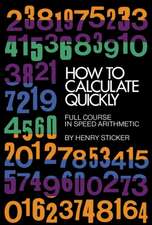 How to Calculate QuicklyHenry StickerPreț: 73.82 lei
 -
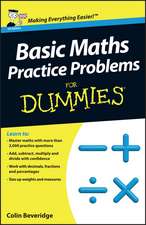 Basic Maths Practice Problems For Dummies, UK EditionColin BeveridgePreț: 96.39 lei
 -
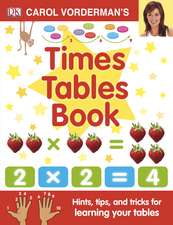 Carol Vorderman's Times Tables Book, Ages 7-11 (Key Stage 2)Carol Vorderman-13%Preț: 45.91 lei53.00 lei
 -
 Desperate MeasuresKjartan PoskittPreț: 37.58 lei
 -
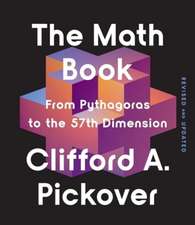 The Math Book: From Pythagoras to the 57th DimensionClifford Pickover A-30%Preț: 153.64 lei218.60 lei
 -
 Pencil and Paper MathsUsbornePreț: 55.59 lei
 -
 Maths All Around You: MeasurementsRob Colson-38%Preț: 50.75 lei81.26 lei
 -
 180! Darts Puzzles for KidsFreddie Flight-26%Preț: 47.76 lei64.74 lei
 -
 -42%Preț: 71.10 lei122.67 lei
 -
 50 Math Tricks That Will Change Your LifeTanya ZakowichPreț: 127.01 lei
 -
 A Year in NumbersKyle D. EvansPreț: 80.32 lei
 -
 Maths for Practice and RevisionPeter RobsonPreț: 35.30 lei
Recenzii
If you think mental arithmetic is out of date in the 21st century, think again. This engaging book is about insight and interestingness beyond the simple utility of quicker calculations. The general style is original and characterful, and makes the book distinctive.
This book is about very elementary concepts that ought to be read by sophisticated people who appreciate that elementary does not mean trivial. The author's erudite scholarship shines in the prose, along with just the right level of dry wit. It's serious stuff he's writing about (without numbers and arithmetic, our modern world simply vanishes into the ancient past where numbers were limited to none, one, and many), but in such a way that the reader does not slowly nod-off into a coma.
Lipscombe's book is unusual, being, as it is, an expansive view of a small subject. The text he presents here is excellent, and is a model of everything a writer strives for: concision, simplicity, directness, accuracy, and surprise.
This book is about very elementary concepts that ought to be read by sophisticated people who appreciate that elementary does not mean trivial. The author's erudite scholarship shines in the prose, along with just the right level of dry wit. It's serious stuff he's writing about (without numbers and arithmetic, our modern world simply vanishes into the ancient past where numbers were limited to none, one, and many), but in such a way that the reader does not slowly nod-off into a coma.
Lipscombe's book is unusual, being, as it is, an expansive view of a small subject. The text he presents here is excellent, and is a model of everything a writer strives for: concision, simplicity, directness, accuracy, and surprise.
Notă biografică
Trevor Lipscombe graduated with an undergraduate degree in theoretical physics from Queen Mary College, University of London, and then obtained a doctorate in theoretical physics from the University of Oxford. He is the author, with Alice Calaprice, of “Albert Einstein: A Biography,” and sole author of “The Physics of Rugby,” which was selected as one of the best ten physics books of 2009. He edited the critical edition of Saint John Henry Newman's novel “Loss and Gain.” Trevor was a postdoctoral researcher at the Levich Institute at the City College of New York, but has also worked in a homeless shelter, a physics journal, and three university presses. He remains fond of finding ways to present science-related materials simply.
Cuprins
- Preface
- Introduction
- Challenge
- 1: Arithmetical Advice
- 2: Speedier Sums and Subtractions
- Interlude I: The Magic of 111,111
- 3: Accounting for Taste -- Adding Columns Quickly
- Interlude II: Checking, Check Digits, and Casting out Nines
- 4: Quicker Quotients and Pleasing Products -- Multiply and Divide by Specific Numbers
- Interlude III: Doomsday
- 5: Calculations with Constraints -- Multiply and Divide by Numbers with Specific Properties
- Interlude IV: Multicultural Multiplication
- 6: Super Powers -- Calculate Squares, Square Roots, Cube Roots, and More
- 7: Close-Enough Calculations -- Quick and Accurate Approximations
- Interlude V: Approximating the Number of Space Aliens
- 8: Multiplying Irrationally
- The Grand Finale
- Further Reading
- Appendix I: Calculating Doomsday
- Appendix II: The Squares from 1 to 100