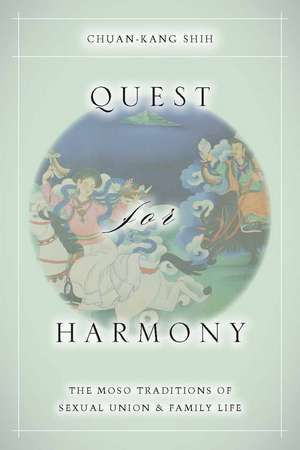
Quest for Harmony: The Moso Traditions of Sexual Union and Family Life.
Autor Chuan-kang Shihen Limba Engleză Hardback – 7 dec 2009
Destinată nivelului de licență avansată, master și cercetare doctorală în antropologie, Quest for Harmony reprezintă prima monografie de referință în limba engleză dedicată populației Moso din provinciile chineze Yunnan și Sichuan. Observăm cum Chuan-kang Shih reconstruiește meticulos structura unei societăți matriliniare unice, centrată pe sistemul „tisese” — o formă de vizită nocturnă care înlocuiește instituția tradițională a căsătoriei. Spre deosebire de modelele conjugale clasice, partenerii tisese locuiesc în gospodării separate, relația lor fiind guvernată exclusiv de un acord mutual, fără obligații contractuale sau exclusivitate.
Analiza se distinge prin rigoarea datelor colectate pe parcursul a aproape două decenii de teren (1987–2006), oferind o perspectivă istorică asupra perioadei de dinainte de 1956. Autorul evită abordările senzaționaliste, preferând o examinare fină a modului în care armonia socială este menținută prin separarea funcțiilor economice de cele reproductive. Textul completează perspectiva oferită de The Kingdom of Women, adăugând o profunzime academică și o documentare etnografică riguroasă acolo unde volumul lui Choo Waihong se concentrează mai mult pe experiența personală și observația directă de tip jurnalistic. De asemenea, lucrarea oferă un contrast necesar față de studiile de caz din Gender and Family Practices, care analizează relațiile de tip „living apart together” în contextul modernității urbane chineze, în timp ce Shih explorează rădăcinile ancestrale și structurale ale acestui fenomen în comunitățile rurale izolate.
Preț: 525.53 lei
Preț vechi: 648.80 lei
-19%
Carte tipărită la comandă
Livrare economică 07-21 decembrie
Specificații
ISBN-10: 080476199X
Pagini: 352
Dimensiuni: 152 x 229 x 25 mm
Greutate: 0.59 kg
Editura: Stanford University Press
Colecția Stanford University Press
V-ar putea interesa
-
 Nazis in SkokieDonald Alexander DownsPreț: 234.11 lei
 -
 The Theory and Practice of VirtueGilbert C. MeilaenderPreț: 202.95 lei
 -
 Preț: 471.35 lei
 -
 -23%Preț: 677.12 lei879.38 lei
 -
 -27%Preț: 771.15 lei1056.38 lei
 -
 Preț: 470.04 lei
 -
 Preț: 477.66 lei
 -
 Preț: 453.21 lei
 -
 Russian Formalism – A MetapoeticsPeter SteinerPreț: 422.53 lei
 -
 Without Foundations – Justification in Political TheoryDonald J. HerzogPreț: 446.00 lei
 -
 Preț: 464.14 lei
 -
 Preț: 443.94 lei
 -
 Preț: 444.72 lei
 -
 Preț: 335.92 lei
 -
 The Aesthetic Function of ArtGary IsemingerPreț: 474.23 lei
 -
 Law and Life of Rome, 90 B.C.-A.D. 212J A CrookPreț: 162.50 lei
 -
 The Roman SoldierG. R. WatsonPreț: 230.68 lei
 -
 The Art of Quartet PlayingDavid BlumPreț: 121.46 lei
 -
 Maritime Strategy or Coalition Defense?Robert W. Komer-15%Preț: 435.38 lei512.21 lei
 -
 Studies in the Age of ChaucerThomas J. HeffernanPreț: 444.27 lei
 -
 -23%Preț: 488.36 lei634.23 lei
 -
 Preț: 380.37 lei
 -
 In the Mirror – Literature and Politics in Siam in the American EraBenedict R. O`g AndersonPreț: 195.18 lei
De ce să citești această carte
Această lucrare este esențială pentru cercetătorii interesați de sistemele de rudenie și diversitatea structurilor familiale. Cititorul câștigă o înțelegere profundă a modului în care o societate poate funcționa stabil fără instituția căsătoriei formale. Este un titlu fundamental pentru bibliografia de antropologie socioculturală, oferind date concrete despre singura cultură matriliniară din China care practică instituția tisese.
Despre autor
Chuan-kang Shih este un antropolog recunoscut pentru expertiza sa în societățile din Asia de Est. Cercetarea sa asupra populației Moso, începută în 1987, a devenit un punct de reper în studiile de gen și rudenie. Prin activitatea sa academică și terenul extins desfășurat pe parcursul a două decenii, Shih a reușit să traducă complexitatea tradițiilor orale și a practicilor sociale Moso într-un limbaj academic accesibil, fiind citat frecvent pentru acuratețea cu care a documentat tranziția acestei societăți spre modernitate.