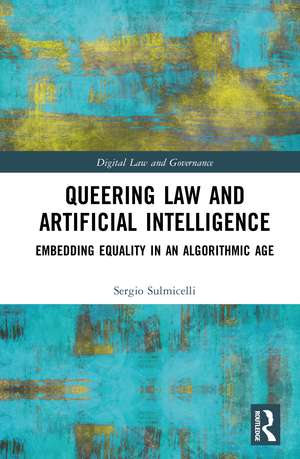
Queering Law and Artificial Intelligence: Embedding Equality in an Algorithmic Age: Digital Law and Governance
Autor Sergio Sulmicellien Limba Engleză Hardback – 20 ian 2027
The book evaluates how different legal systems respond to three categories of algorithmic bias: foundational, technical, and interpretative. These models are assessed by their ability to implement the three legal strategies proposed in the book: equality by design, equality by participation, and equality by education. Moving "from the margins to the core", the book uses queer perspectives as a methodological lens through which to expose the structural limitations of existing approaches to equality and to rethink their foundations. It demonstrates that equality must not remain strictly a formal value or ex post remedy but must be embedded as a structural criterion of legitimacy in the design, regulation, and deployment of AI systems.
The book will be of interest to researchers in the fields of diversity and equality, queer and gender law, artificial intelligence and law, and emerging technologies.
Preț: 1102.92 lei
Preț vechi: 1462.27 lei
-25% Precomandă
Puncte Express: 1654
Carte nepublicată încă
Livrare prin curier în România Precomanda se expediază când titlul devine disponibil.
Transport gratuit pentru acest produs Plată online sau ramburs, în funcție de opțiunile comenzii.
Retur gratuit în 14 zile Comandă securizată și suport în română.
Doresc să fiu notificat când acest titlu va fi disponibil:
Se trimite...
Specificații
ISBN-13: 9781041219460
ISBN-10: 1041219466
Pagini: 300
Dimensiuni: 156 x 234 mm
Ediția:1
Editura: Taylor & Francis
Colecția Routledge
Seria Digital Law and Governance
Locul publicării:Oxford, United Kingdom
ISBN-10: 1041219466
Pagini: 300
Dimensiuni: 156 x 234 mm
Ediția:1
Editura: Taylor & Francis
Colecția Routledge
Seria Digital Law and Governance
Locul publicării:Oxford, United Kingdom
Public țintă
AcademicCuprins
Introduction: Artificial Intelligence, Identity, and the Crisis of Equality
Part I: Equality and Discrimination in the Algorithmic Society
1. Algorithmic Bias: A Typology of Foundational, Technical, and Interpretative Discrimination
2. Technology and the Legal Architecture of Equality
3. Equality and Antidiscrimination Law and Its Inadequacy in the Algorithmic Society
Part II: Queering Law, Technology, and Discrimination
4. Queer Legal Critique: Law, Sex, Gender, and Sexuality
5. Legal and Algorithmic Taxonomies: Classification and Queer Erasure
6. Queer Life and Queer Discrimination: Health, Recognition, Expression
Part III: From the Margins to the Core: A Technology-Oriented Principle of Equality
7. Technology-Responsive Constitutionalism and the Foundations of Algorithmic Equality
8. Equality by Design, Participation, and Education
9. Comparative Models of AI and Equality Regulation
10. Queer Constitutionalism and the Future of AI Equality
Part I: Equality and Discrimination in the Algorithmic Society
1. Algorithmic Bias: A Typology of Foundational, Technical, and Interpretative Discrimination
2. Technology and the Legal Architecture of Equality
3. Equality and Antidiscrimination Law and Its Inadequacy in the Algorithmic Society
Part II: Queering Law, Technology, and Discrimination
4. Queer Legal Critique: Law, Sex, Gender, and Sexuality
5. Legal and Algorithmic Taxonomies: Classification and Queer Erasure
6. Queer Life and Queer Discrimination: Health, Recognition, Expression
Part III: From the Margins to the Core: A Technology-Oriented Principle of Equality
7. Technology-Responsive Constitutionalism and the Foundations of Algorithmic Equality
8. Equality by Design, Participation, and Education
9. Comparative Models of AI and Equality Regulation
10. Queer Constitutionalism and the Future of AI Equality
Notă biografică
Sergio Sulmicelli is Colin Phegan Lecturer at The University of Sydney Law School, where he is a member of the Critical AI Literacy Working Group and the Centre for AI, Trust and Governance. He holds a PhD in Law from the University of Trento and was an Academic Fellow in Comparative Public Law at Bocconi University. He has undertaken visiting research at NYU, UNSW, and the Centro de Estudios Europeos Luis Ortega Álvarez. His research focuses on artificial intelligence, equality and anti-discrimination law, and comparative public law.
Descriere
This book rethinks the role of equality law in the age of artificial intelligence. It evaluates how different legal systems respond to algorithmic bias. It will be of interest to researchers in the fields of diversity and equality, queer and gender law, artificial intelligence and law, and emerging technologies.