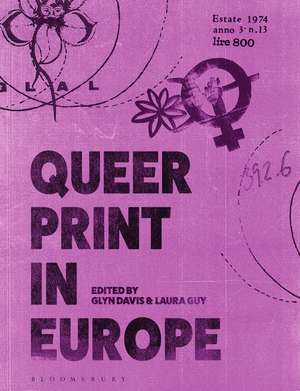
Queer Print in Europe
Editat de Glyn Davis, Laura Guyen Limba Engleză Paperback – 17 noi 2022
Queer Print in Europe is the first book devoted to the exploration of queer print cultures in Europe, following the birth of an international gay rights movement in the late 1960s. By unearthing these ephemeral paper documents from archives and personal collections, including materials that have been out of circulation since they were first distributed, this book examines how the production and dissemination of queer print intersected with the emergence of LGBTQ+ activism within specific national contexts. This vital contribution to queer history explores borders and political movements, and the ways in which these materials contributed, through their international circulation, to the creation of a 'post-national' queer community.
Illustrated throughout with examples of manifestos, flyers, posters, zines and other forms of print media, it features interviews with those responsible for making, distributing or archiving queer print, alongside a series of new theoretical essays that set particular publications and the individuals and groups that produced them in context. The book isolates specific instances of queer print media and scrutinises their design aesthetics, identifying both the significant contribution that queer print has made to histories of LGBTQ+ struggle and to the history of print design.
Preț: 194.76 lei
Preț vechi: 237.27 lei
-18%
Puncte Express: 292
Carte disponibilă
Livrare economică 30 octombrie-13 noiembrie
Livrare express 15-21 octombrie pentru 89.22 lei
Livrare prin curier în România Termenul estimat este afișat lângă disponibilitate.
Transport gratuit de la 400.00 lei Plată online sau ramburs, în funcție de opțiunile comenzii.
Retur gratuit în 14 zile Comandă securizată și suport în română.
Specificații
ISBN-13: 9781350273498
ISBN-10: 135027349X
Pagini: 272
Ilustrații: 100 colour illus
Dimensiuni: 188 x 246 x 22 mm
Greutate: 0.75 kg
Editura: Bloomsbury Publishing
Colecția Bloomsbury Visual Arts
Locul publicării:London, United Kingdom
ISBN-10: 135027349X
Pagini: 272
Ilustrații: 100 colour illus
Dimensiuni: 188 x 246 x 22 mm
Greutate: 0.75 kg
Editura: Bloomsbury Publishing
Colecția Bloomsbury Visual Arts
Locul publicării:London, United Kingdom
V-ar putea interesa
-
 QueerbookMalcolm MackenziePreț: 64.08 lei
 -
 Some Men In London: Queer Life, 1945-1959Peter Parker-19%Preț: 185.15 lei227.63 lei
 -
 Some Men In London: Queer Life, 1960-1967Peter ParkerPreț: 226.82 lei
 -
 -27%Preț: 68.17 lei93.18 lei
 -
 Queer ArtGemma Rolls-Bentley-21%Preț: 155.81 lei198.36 lei
 -
 Queer Crafts: Material Practices and the Making of IdentityDaniel Fountain-10%Preț: 161.83 lei180.46 lei
 -
 Writing Queer PerformanceBourgeois & Maurice-22%Preț: 180.44 lei232.68 lei
 -
 -26%Preț: 58.30 lei78.51 lei
 -
 Writing Queer HistoryDr Matt Cook-19%Preț: 144.82 lei178.03 lei
 -
 We Are Your ChildrenDavid Roberts-34%Preț: 132.45 lei200.55 lei
 -
 Queer GeorgiansAnthony DelaneyPreț: 158.09 lei
 -
 -30%Preț: 110.72 lei157.08 lei
 -
 Queer Lens: A History of PhotographyPaul MartineauPreț: 457.69 lei
 -
 -23%Preț: 248.88 lei323.17 lei
 -
 Come TogetherAubrey WalterPreț: 98.49 lei
 -
 Queer LondonAlim KherajPreț: 107.59 lei
 -
 100 Queer Films Since StonewallChelsea McCracken-30%Preț: 108.97 lei156.08 lei
 -
 Desi QueersChurnjeet Mahn-25%Preț: 122.01 lei162.95 lei
 -
 Queer Modernism: 1900–1950Susanne Gaensheimer-16%Preț: 298.76 lei357.52 lei
 -
 Queer Happened HereMarc ZinamanPreț: 320.09 lei
Cuprins
Introduction, Glyn Davis (University of St Andrews, UK) and Laura Guy (Glasgow School of Art, UK)
Part One: Politics of Community Building
1. Silent Voices: The 'Arabs' and Gay Liberation in France, Antoine Idier (ESAM, France)
2. 'Happiness was in the Pages of this Monthly': The Birth of the Lesbian Press in France and the Fabric of a Space of One's Own (1976-1990), Ilana Eloit (University of Geneva, Switzerland)
3. Seeking Acceptance or Revolution? An Overview of the First Italian LGBTQ Magazines, 1971-1979, Dario Pasquini (Independent Researcher, Italy)
4. Change Always has to Build: In Conversation with Gail Lewis, Taylor Le Melle (Independent Researcher, the Netherlands)
Part Two: Materials and Making
5. The Sexual Revolt in Spain in the 1970s through its Publications: Ideas, Fears and Aesthetics, Alberto Berzosa (Carlos III University of Madrid, Spain) and Gracia Trujillo (Complutense University of Madrid, Spain)
6. Sexual Difference and Queer Subjectivity in Slovak LGBTQ Print Periodicals, Viera Lorencova (Fitchburg State University, USA)
7. Revolt Press, Internationalization and the Development of Gay Markets in Sweden before HIV/AIDS, Thomas Cubbin (University of Gothenburg, Sweden)
8. Mietje: In Conversation with Gert Hekma and Mattias Duyves, Benny Nemer (Royal Academy of Fine Arts (KASK), Belgium)
Part Three: Generational Interactions
9. This Too is Polish Culture: In Conversation with Karol Radziszewski, Aleksandra Gajowy (Independent Researcher, UK)
10. Queer Memory in (re)Constituting and Forgetting the Trans '70s in the UK, Nat Raha (University of St Andrews, UK)
11. Encapsulated Time: Generational and Cultural Discrepancies in West German Lesbian Magazines of the 1970s, Janin Afken (Humboldt University, Germany)
12. Lavender Menace Revisited: In Conversation with Sigrid Nielsen, Bob Orr and James Ley, Fiona Anderson (Newcastle University, UK)
Part One: Politics of Community Building
1. Silent Voices: The 'Arabs' and Gay Liberation in France, Antoine Idier (ESAM, France)
2. 'Happiness was in the Pages of this Monthly': The Birth of the Lesbian Press in France and the Fabric of a Space of One's Own (1976-1990), Ilana Eloit (University of Geneva, Switzerland)
3. Seeking Acceptance or Revolution? An Overview of the First Italian LGBTQ Magazines, 1971-1979, Dario Pasquini (Independent Researcher, Italy)
4. Change Always has to Build: In Conversation with Gail Lewis, Taylor Le Melle (Independent Researcher, the Netherlands)
Part Two: Materials and Making
5. The Sexual Revolt in Spain in the 1970s through its Publications: Ideas, Fears and Aesthetics, Alberto Berzosa (Carlos III University of Madrid, Spain) and Gracia Trujillo (Complutense University of Madrid, Spain)
6. Sexual Difference and Queer Subjectivity in Slovak LGBTQ Print Periodicals, Viera Lorencova (Fitchburg State University, USA)
7. Revolt Press, Internationalization and the Development of Gay Markets in Sweden before HIV/AIDS, Thomas Cubbin (University of Gothenburg, Sweden)
8. Mietje: In Conversation with Gert Hekma and Mattias Duyves, Benny Nemer (Royal Academy of Fine Arts (KASK), Belgium)
Part Three: Generational Interactions
9. This Too is Polish Culture: In Conversation with Karol Radziszewski, Aleksandra Gajowy (Independent Researcher, UK)
10. Queer Memory in (re)Constituting and Forgetting the Trans '70s in the UK, Nat Raha (University of St Andrews, UK)
11. Encapsulated Time: Generational and Cultural Discrepancies in West German Lesbian Magazines of the 1970s, Janin Afken (Humboldt University, Germany)
12. Lavender Menace Revisited: In Conversation with Sigrid Nielsen, Bob Orr and James Ley, Fiona Anderson (Newcastle University, UK)
Recenzii
Queer Print in Europe presents a timely and necessary analysis of queer printmaking, zines and print culture. It is unique in its use of interviews, its wide-ranging historical and political analysis and its challenge to a rights-based historical teleology common in North American analyses of LGBTQ+ cultural phenomenon.
This book represents a vital contribution to the fields of queer history and queer print cultures. It starts from the insistence that queer community relies on the networked circulation of objects, information and ideas. From there, the various chapters explore a range of publications, each exploring how the circulation of printed material since the 1970s has shaped European LGBTQ activism. The collection offers a rich history of European queer print cultures and provides methodologies for future research in the field.
Davis and Guy provide a well-organized and thoughtfully selected collection of essays that represent an exciting broadening of the field of queer print culture from its often US-centered perspective. Exploring themes of inclusion/exclusion, connection/debate, past/present, this book offers both scholars and those interested in queer culture an enticing entry into queer worldmaking. In bringing different voices together and exploring a variety of publications, Queer Print in Europe does exactly what these circulated objects did-foster connection and invite further collaboration.
This book represents a vital contribution to the fields of queer history and queer print cultures. It starts from the insistence that queer community relies on the networked circulation of objects, information and ideas. From there, the various chapters explore a range of publications, each exploring how the circulation of printed material since the 1970s has shaped European LGBTQ activism. The collection offers a rich history of European queer print cultures and provides methodologies for future research in the field.
Davis and Guy provide a well-organized and thoughtfully selected collection of essays that represent an exciting broadening of the field of queer print culture from its often US-centered perspective. Exploring themes of inclusion/exclusion, connection/debate, past/present, this book offers both scholars and those interested in queer culture an enticing entry into queer worldmaking. In bringing different voices together and exploring a variety of publications, Queer Print in Europe does exactly what these circulated objects did-foster connection and invite further collaboration.