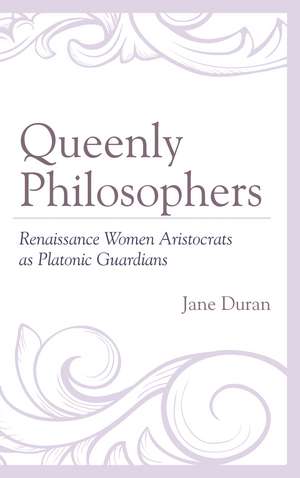
Queenly Philosophers: Renaissance Women Aristocrats as Platonic Guardians
Autor Jane Duranen Limba Engleză Hardback – 20 sep 2017
Preț: 641.84 lei
Preț vechi: 959.78 lei
-33%
Puncte Express: 963
Carte tipărită la comandă
Livrare economică 20 noiembrie-04 decembrie
Livrare prin curier în România Termenul estimat este afișat lângă disponibilitate.
Transport gratuit pentru acest produs Plată online sau ramburs, în funcție de opțiunile comenzii.
Retur gratuit în 14 zile Comandă securizată și suport în română.
Specificații
ISBN-13: 9781498541367
ISBN-10: 1498541364
Pagini: 304
Dimensiuni: 157 x 236 x 27 mm
Greutate: 0.61 kg
Editura: Bloomsbury Publishing
Colecția Lexington Books
Locul publicării:New York, United States
ISBN-10: 1498541364
Pagini: 304
Dimensiuni: 157 x 236 x 27 mm
Greutate: 0.61 kg
Editura: Bloomsbury Publishing
Colecția Lexington Books
Locul publicării:New York, United States
Cuprins
Preface
Acknowledgments
PART ONE: The Guardian Question
Chapter One: Philosopher Queens
PART TWO: Theology and Philosophy
Chapter Two: The 1500's as a Time of Change
Chapter Three: Mary Sidney Herbert, the Countess of Pembroke
Chapter Four: Katherine Parr, Queen Consort
Chapter Five: Elizabeth I
PART THREE: Science and Philosophy
Chapter Six: The 1600's and Intellectual Ferment
Chapter Seven: Margaret Cavendish, Duchess of Newcastle
Chapter Eight: Aphra Behn and the Aristocratic Circle
PART FOUR: Commitments and Philosophers
Chapter Nine: The Aristocratic Guardians
Bibliography
Acknowledgments
PART ONE: The Guardian Question
Chapter One: Philosopher Queens
PART TWO: Theology and Philosophy
Chapter Two: The 1500's as a Time of Change
Chapter Three: Mary Sidney Herbert, the Countess of Pembroke
Chapter Four: Katherine Parr, Queen Consort
Chapter Five: Elizabeth I
PART THREE: Science and Philosophy
Chapter Six: The 1600's and Intellectual Ferment
Chapter Seven: Margaret Cavendish, Duchess of Newcastle
Chapter Eight: Aphra Behn and the Aristocratic Circle
PART FOUR: Commitments and Philosophers
Chapter Nine: The Aristocratic Guardians
Bibliography
Recenzii
This new work on woman philosophers presents a major contributionto the literature. Little work having been done previously on these particular women as philosophers, this work enlightens its audience not only about the works of these five women but about the world of England in the 16th and 17th centuries. Through careful analyses of the works, through making clear the environment in which the works were written, and through making clear the necessity of having access to the court, either by being aristocrats themselves or by association-this text contributes to the understanding of these particular philosophers and their works and to the history of women writing philosophy as well as to a more comprehensive understanding of the history of philosophy than now exists.
With ingeniously careful development Professor Duran convinces us that five names ought to be added to that of Margaret Cavendish as philosophers of the early modern period: Aphra Benn, Elizabeth I, Katharine Parr and Mary Sidney Herbert. A solid case is made that Plato happily would nod 'yes' to the question 'is this a philosopher-Queen?' Duran makes the case that each was queenly (if not Queen) and had the personal character and requisite philosophic acumen to successfully rule in a Republic-like ideal society. A fascinating idea and a welcome introduction of additional contributions by women to the history of philosophy.
With ingeniously careful development Professor Duran convinces us that five names ought to be added to that of Margaret Cavendish as philosophers of the early modern period: Aphra Benn, Elizabeth I, Katharine Parr and Mary Sidney Herbert. A solid case is made that Plato happily would nod 'yes' to the question 'is this a philosopher-Queen?' Duran makes the case that each was queenly (if not Queen) and had the personal character and requisite philosophic acumen to successfully rule in a Republic-like ideal society. A fascinating idea and a welcome introduction of additional contributions by women to the history of philosophy.